
By Dr. Mark Bekhit, Radiologist · Last updated September 2026
Short answer: bulk-billed radiology means the clinic accepts the Medicare benefit as full payment for one eligible service, so you pay $0 for it. In the June quarter of 2025–26, about 77 of every 100 Medicare-billed diagnostic-imaging services were bulk billed nationally. The figure was about 66 of every 100 for ultrasound and 85 of every 100 for CT. These figures exclude services without a Medicare benefit. They do not predict one clinic’s billing decision.
On this page
What does bulk-billed radiology mean?
Bulk billing is a payment arrangement for an eligible Medicare service. The imaging clinic sends the claim to Medicare and accepts the Medicare benefit as full payment. The patient does not pay for that service.
You may be asked to assign the Medicare benefit to the clinic. You can do this with a digital or paper signature, or on an EFTPOS terminal. This confirmation lets Medicare pay the clinic directly.
The important phrase is for that service. If one appointment includes more than one examination or procedure, not everything at the visit must be bulk billed. A clinic can bulk bill one eligible examination and privately bill another service.
The practical rule: “bulk billed” describes how one eligible service is billed. It is not a permanent label for every patient, every scan or every service at that clinic.
A clinic may use “no out-of-pocket cost” to describe the same outcome. Healthdirect states that if a diagnostic imaging clinic bulk bills your test, you have no cost for that test. If the service is privately billed instead, the clinic charges its own fee and any Medicare benefit is handled separately.
How common is bulk billing for radiology?
About 77 of every 100 Medicare-billed diagnostic-imaging services were bulk billed nationally in the June quarter of 2025–26. This excludes services without a Medicare benefit and does not describe one clinic’s policy. The quarterly workbook was published on 10 August 2026.
- Ultrasound66%
- CT85%
- X-ray group82%
- Nuclear medicine88%
- MRI81%
Australia, June quarter 2025–26. These group rates exclude services without a Medicare benefit. They do not predict one clinic’s policy.
See state rates and average patient payments
For every 100 Medicare-billed diagnostic-imaging services, about 78 were bulk billed in NSW, 80 in Victoria, 75 in Queensland, 73 in South Australia, 71 in Western Australia, 68 in Tasmania, 84 in the Northern Territory and 50 in the ACT.
Among services that were patient billed, the average contribution was $144.94 for ultrasound, $179.09 for CT, $82.86 for the diagnostic radiology group, $129.02 for nuclear medicine and $200.43 for MRI.
These group averages do not predict the cost of one scan. Source: Australian Government diagnostic-imaging quarterly statistics.
Does a referral guarantee that your scan will be bulk billed?
No. A diagnostic imaging request and a clinic’s billing decision answer different questions. The request identifies the service and should include sufficient clinical information. Medicare eligibility depends on whether the service matches a current Medicare Benefits Schedule (MBS) item and its conditions. Bulk billing then depends on whether the clinic chooses to accept the Medicare benefit as full payment.
Medicare subsidises listed X-ray, ultrasound, CT, MRI and nuclear medicine services, but item restrictions can involve age, frequency, requester requirements and other conditions. Only accredited practices can provide Medicare-eligible diagnostic imaging services. For an R-type service, the request rule is one eligibility condition; it is not a price promise. For the most common of these services, our X-ray cost guide sets out each item’s fee, how often patients paid nothing and the current bulk-billing rate by state.
For an R-type service, Medicare benefits are generally not payable unless the practitioner receives a request before the service, subject to specified exemptions. The request must identify the service and should include enough clinical information to help the clinic perform it accurately.
If the clinical information is insufficient, the requester may be asked for more information and the scan may be delayed. Separately, a request should meet any specific requirements of the relevant MBS item; failure to provide that item-specific information may mean a benefit is not paid. The diagnostic imaging request guide explains the common requester pathways without turning them into a billing guarantee.
A request is not a quote: it can support Medicare eligibility, but it does not set the clinic’s fee or require the clinic to bulk bill.
That distinction explains why two clinics can quote different amounts for the same requested scan. Diagnostic imaging clinics set their own fees, and the clinic makes the bulk-billing choice for the service. The government sets Medicare fees and benefits; it does not set each clinic’s retail fee.
What changes the amount you pay?
Your final cost depends on the Medicare item, the clinic’s fee, its bulk-billing choice and whether the scan occurs during a hospital admission.
Compare the four payment pathways
On a phone, swipe the table sideways to see all columns.
For an out-of-hospital MBS service that is not bulk billed, the out-of-pocket cost is the difference between the clinic’s fee and the Medicare benefit. Patients commonly pay the clinic first and then receive the applicable Medicare benefit. The fee, benefit and final amount are three separate figures.
If you want an independent reference point, the Department of Health’s Medical Costs Finder includes some diagnostic imaging services and MBS items. It is useful for understanding fee language, but your booking quote remains the figure that matters for your appointment.
How can you compare a clinic and book?
Start with the required examination and your city. For example, compare CT clinics in Brisbane, MRI clinics in Sydney or ultrasound clinics in Melbourne. These pages record services and contact details. They do not state a clinic’s billing policy.
You are not locked to the clinic named on the request. You may choose another clinic as long as it offers the scan you need. This lets you compare clinics without asking the requester to rewrite the form solely because another company is printed on it.
With the request in front of you, check that the clinic performs the exact examination. MBS restrictions can include age, frequency and requester conditions.
Then use one three-part cost check. Ask about the cost before the scan. The clinic chooses whether to bulk bill. If it does not, the outpatient gap is the clinic’s fee minus any applicable Medicare benefit.
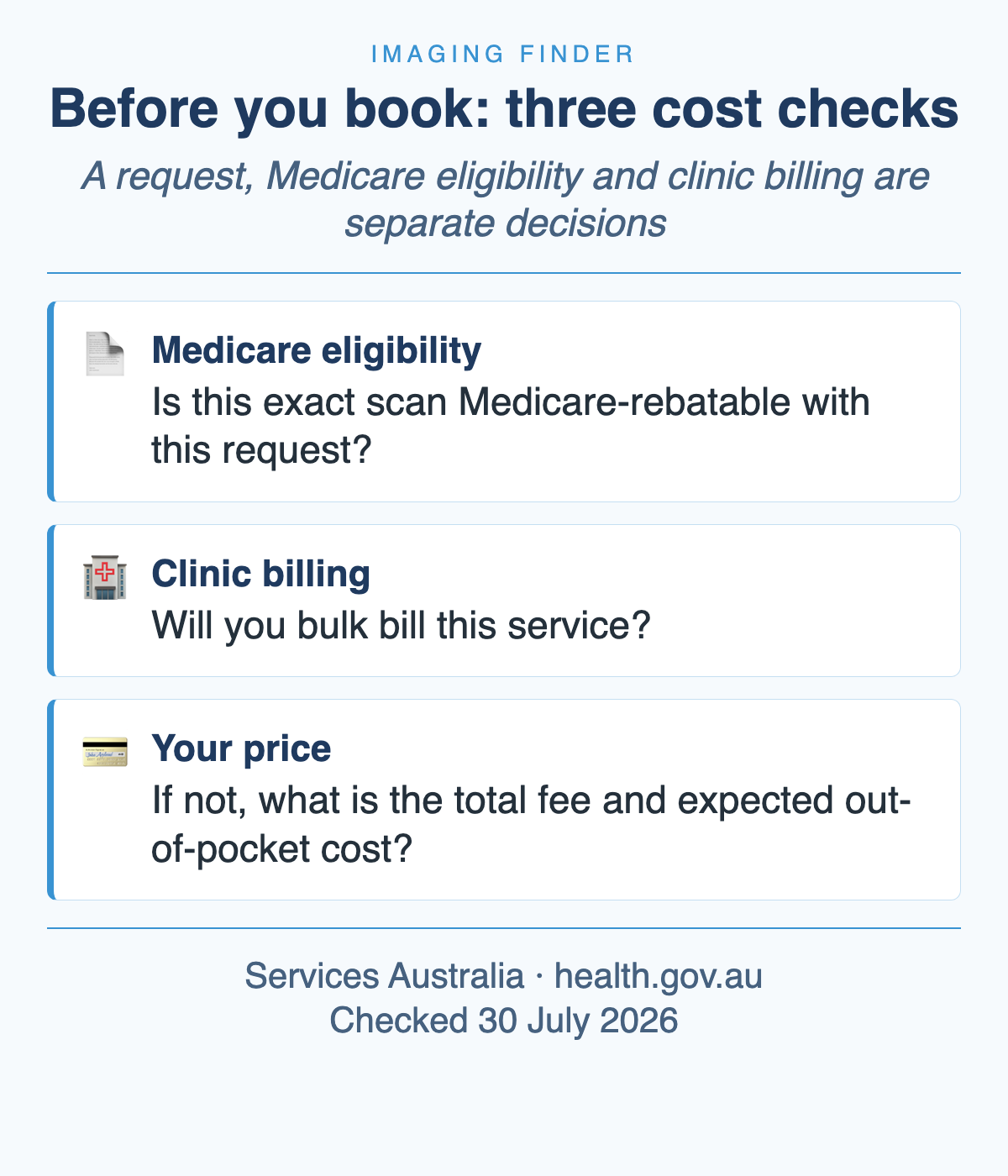
If the request contains several examinations, use the three questions for each one. A visit with more than one service may include different billing decisions. A single appointment time does not turn several services into one billing decision.
Once the appointment is confirmed, follow the clinic’s instructions for the scan. The ultrasound preparation guide explains common fasting and bladder-preparation pathways, while the imaging clinic’s instructions apply to the examination it has booked.
Can private health insurance pay a radiology gap?
No—not for an out-of-hospital Medicare service. Private health insurers cannot cover out-of-hospital Medicare services, including diagnostic imaging. If a private radiology clinic patient-bills an eligible outpatient scan, the calculation is the clinic fee minus the Medicare benefit.
The hospital boundary is different. A private patient in a public or private hospital may have out-of-pocket costs. This admitted-care rule is separate from outpatient billing.
A person with a Medicare card pays no out-of-pocket costs for treatment as a public patient in a public hospital. That source establishes the charging rule; it does not promise that a private imaging request will be accepted into a public outpatient service. The public-versus-private imaging guide keeps the two funding pathways separate.
Sources and methodology
Sources and methodology
The billing definitions and booking questions were checked against Services Australia, the Australian Government Department of Health, current MBS diagnostic-imaging guidance and healthdirect in September 2026. The national, modality and state rates come from the June-quarter 2025–26 diagnostic-imaging workbook published on 10 August 2026. These sources do not establish a clinic’s current policy for a particular scan.
- Services Australia — bulk billing
- Services Australia — screening, tests and scans
- Department of Health — diagnostic imaging and Medicare
- Department of Health — out-of-pocket costs
- healthdirect — radiographers and radiologists
- Department of Health — Medicare quarterly diagnostic-imaging statistics, June quarter 2025–26
This article is general information, not personal medical advice. Discuss your individual report and next steps with the healthcare professional responsible for your care.

Author: Dr. Mark Bekhit
Dr Mark Bekhit (MBChB, FRANZCR) is a musculoskeletal radiologist practising in Brisbane and an AHPRA-registered specialist in diagnostic radiology (MED0002920947). He spends as much time building software as reading scans: he founded Imaging Finder (Australia) and Radiology Clinics NZ to make imaging easier to find, and builds radiology dictation and pain-tracking tools with one aim — better patient outcomes and a smoother reporting workflow. Outside the reading room he's usually training, bringing the same performance mindset to imaging.
Leave a Reply