By Dr. Mark Bekhit, Radiologist · Last updated September 2026
Someone you know has paid about $3,000 for a full-body MRI. The ads keep finding you, and there is a small worry you have not taken to a doctor. Whether the scan is worth paying for is the question the ads skip.
Short answer: About $3,000, all of it out of your own pocket. On 15 September 2026, five operators advertised $2,990 to $3,950 for a whole-body scan or package; an Adelaide practice charges $800 for high-risk patients. Medicare pays nothing for a whole-body MRI in someone with no symptoms; its one whole-body item, 63564, is for a confirmed TP53 (Li-Fraumeni) gene fault. RANZCR, the radiologists’ college, does not recommend it for people without symptoms unless they have had a cancer or carry a cancer predisposition syndrome. For someone with no symptoms and ordinary risk, my answer is no.
What a full-body MRI costs in Australia
A whole-body MRI covers the head, neck, chest, abdomen and pelvis in one session. MRI uses strong magnets and radio waves, not X-ray radiation, and the operators advertise scans of 45 to 60 minutes, with appointments of up to 90 minutes once preparation is included. The prices below are what each operator published on the day we checked. They are advertised prices rather than quotes, and packages change.
Advertised prices read from each operator’s own website on 15 September 2026; Whole Body MRI stamps its prices as current at 27 March 2026. The Adelaide MRI service is a different product: a radiology practice offering the scan to people a doctor already considers high risk, which is one of the two groups the college’s statement below leaves room for. Its Woodville and Payneham clinics are in our directory as Adelaide MRI and Adelaide East MRI (listings checked 15 September 2026; confirm the whole-body service and its price with the practice). The other five operators are not listed anywhere in our directory.
Why Medicare pays nothing
The schedule itself says so, in wording that repays a slow read.
The rule: Unless the Minister directs otherwise, Medicare benefits are not payable for health screening services, and a health screening service is any examination or test “not reasonably required for the management of the medical condition of the patient”. The exceptions are specific: screening mammography under its own items (59300 and 59303), and the routine tests your own GP judges necessary at a check-up, for example. That list does not include a whole-body MRI for a person with no symptoms, and the schedule adds that a check-up “should not necessarily be accompanied by an extensive battery of diagnostic investigations”.
The MRI items are built the same way: each names a body region and a reason. Item 63001 is a head MRI for a tumour of the brain or its coverings. Item 63551 is a head MRI a GP can request for unexplained seizures, or for unexplained chronic headache where something inside the skull is suspected. A scan of everything, for no stated reason, is the screening service the note excludes.
In 2023–24, for that GP-requested head MRI done out of hospital, 87% of patients paid nothing at all, and among those who did pay, the typical amount was $150. The figure is the government’s own, from Medical Costs Finder. Same kind of machine; what moves the bill from $3,000 to nothing for most patients is a doctor’s written reason and a scan of one region for one question, not the same whole-body scan with a referral attached. Our MRI and Medicare guide lists which scans a GP can request and which need a specialist, and the MRI cost guide covers what a targeted scan costs when you do pay.
There is one whole-body exception, and it proves the rule. Since 1 March 2023, item 63564 funds a whole-body MRI for the early detection of cancer, once every 12 months, for people with a confirmed fault in the TP53 gene (Li-Fraumeni syndrome), requested by a specialist working with a clinical geneticist. Schedule fee $1,698.25, 85% benefit $1,593.75. Medicare pays when the risk is proven and documented, and not for the same scan bought on a hunch.
What the radiologists’ college says
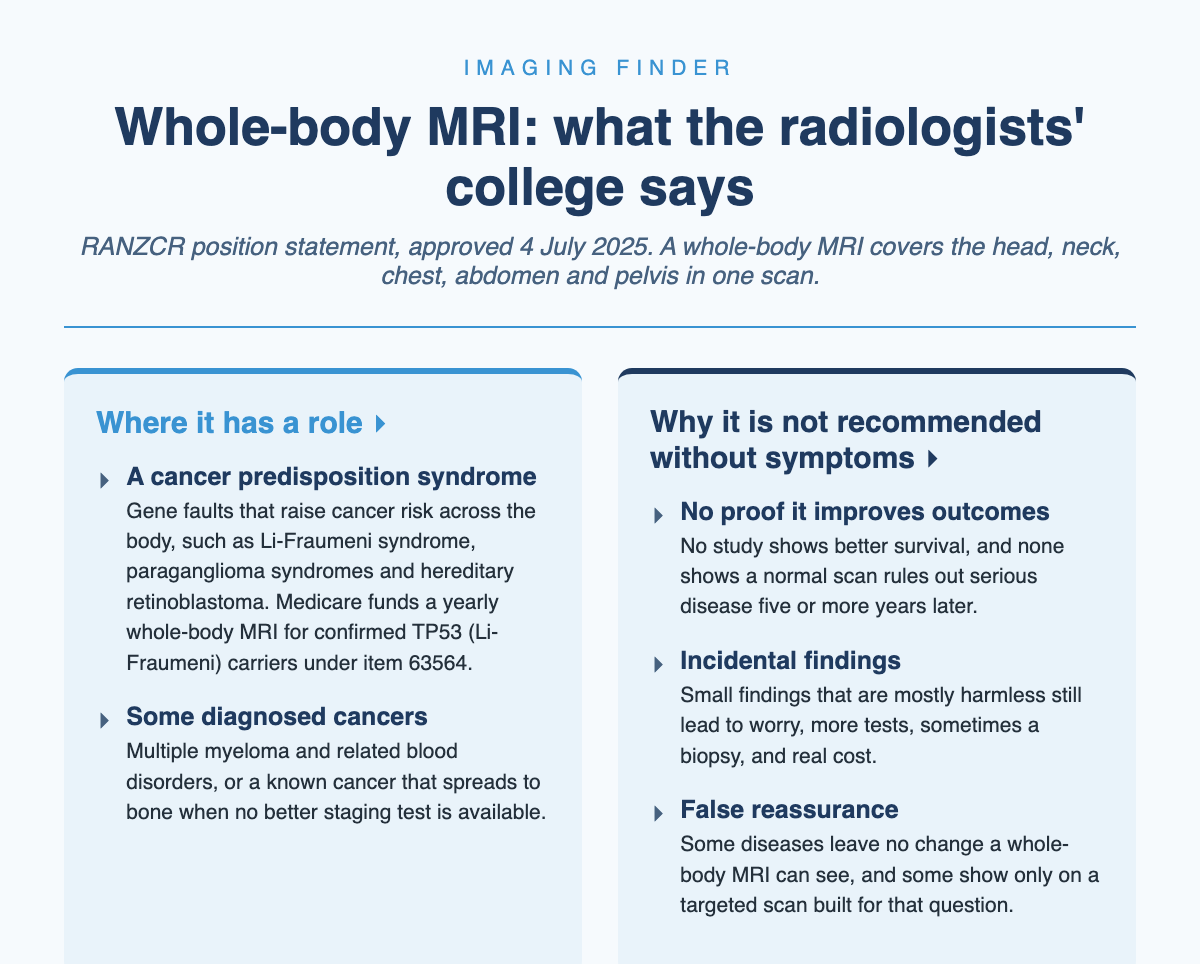
The Royal Australian and New Zealand College of Radiologists published a position statement on whole-body MRI screening, version 1.1 approved on 4 July 2025. Its recommendation is worth quoting in full: “Currently there is no evidence that demonstrates significant improvement in health outcomes when performing whole body MRI screening in an asymptomatic population. The College does not recommend performing whole body MRI screening in asymptomatic patients who do not have a previously diagnosed malignancy or a cancer predisposition syndrome.”
Two points in the statement matter more than the headline. No study has shown that people who have the scan live longer or better. And no study has confirmed that a “clear” whole-body MRI still means clear five or more years later. The reassurance the scan sells is the one thing it has not been shown to deliver.
My view as a radiologist
I report MRI as part of my work, and the college’s position matches how these examinations are actually built. Two things need adding in plain words.
First, the catch is the scan protocol. A targeted MRI of one knee or one liver runs a set of sequences built to answer one question, and that single region can take from 10 minutes to over an hour depending on the question. A whole-body examination spends about an hour across five regions. Each region gets a survey rather than a work-up. A whole-body scan can therefore miss what a targeted scan finds.
Second, “we found something” is a common result of scanning a healthy body in detail, not a rare one. A small spot in the liver or the kidney that is almost certainly harmless still has to be described. The report then recommends a follow-up scan, which needs a doctor’s request if Medicare is to fund it; sometimes it needs a biopsy. My judgement, and I offer it as judgement rather than a statistic: the worry these findings cause is usually out of all proportion to the harm they were ever going to do.
The honest use case is the one the college names: an inherited cancer syndrome, or a diagnosed cancer where whole-body imaging is the staging tool. Medicare’s only whole-body MRI item, 63564, covers just one of those groups: confirmed TP53 carriers. Staging a diagnosed cancer is funded through other imaging items on a specialist’s request. Adelaide MRI’s $800 service is pitched at high-risk patients on a GP’s request, close to that exception, and it says plainly on its own page that MRI can miss some tumours, especially small ones.
If you still want one, buy these four things
✓ A written report from a specialist radiologist that you keep.
✓ A named doctor who will own the follow-up if something is found.
✓ An implant check before you book: pacemakers, clips, cochlear implants and some metal implants rule out MRI or change how it is done.
✓ A copy of the report for your GP, because a Medicare-funded follow-up scan needs a doctor’s written request.
What to do instead
The four national screening programs are free when bulk billed, and a targeted MRI on a doctor’s request is Medicare-funded when the item matches. Which of the two applies depends on whether anything is actually wrong.
If something specific is worrying you
Take the worry to a GP first. A symptom turns a screening scan into a diagnostic one, and a written request for one of the listed items is what Medicare funds. For adults the GP-requestable MRI list is short (unexplained seizures and unexplained chronic headache are two head examples above), and our MRI and Medicare guide has the rest. Once you have the request, use it at any practice that offers the scan: the form your doctor hands you may carry one brand, but you are free to choose.
Before you book a targeted MRI
✓ Shortlist MRI clinics in Sydney, Melbourne, Brisbane, Perth or Adelaide.
✓ Ask: “Is the item on my request Medicare-eligible at this practice?”
✓ Ask: “What will I pay on the day?”
✓ Our directory lists MRI clinics for a targeted scan. The dedicated screening operators in the table above are booked with the operator directly.
If the worry is your heart, the scan you are probably thinking of is a different one, and our calcium score and CT angiogram guide covers what it costs and who it suits.
If nothing is wrong and you want to stay ahead
Australia runs four screening programs that have earned their place. The college’s own statement names breast and lung screening as the kind of targeted screening that large trials have shown to reduce disease. A screening test cannot diagnose cancer; it tells you whether you need a diagnostic test, and that is the whole point.
Program rules as published by Services Australia, page updated 14 November 2025. If you are overdue for one of these, that is a better use of an afternoon than a whole-body scan.
Common questions
Can I get an MRI without a referral in Australia?
healthdirect’s answer is that you need a referral from your doctor to get an MRI, and for any scan you want Medicare to help with, that is the whole story: no written request, no benefit. The screening operators in the table above differ on whether they will book you without one. What none of them can do is turn a self-booked scan into a Medicare item afterwards: every MRI item is a requested service, and the request comes first.
What about a full-body CT scan?
Different physics, same rule. A CT scan is a type of X-ray and uses a high level of radiation, so it should only be used when necessary, which is a poor fit for scanning a healthy body that has nothing wrong with it. A whole-body CT bought on a hunch sits under the same exclusion as a whole-body MRI. Of the four national programs, only lung screening uses CT, and it is a low-dose scan for people aged 50 to 70 with a smoking history. Our CT radiation guide puts the doses in context.
Will private health insurance pay for it?
Do not assume so. Whether a fund covers any of a diagnostic test depends on your level of hospital cover, and the rebates healthdirect describes are for private hospital services. Nothing on the government pages suggests a scan you book yourself at a screening clinic qualifies, so ring your fund with the operator’s name and the scan’s name before you pay a deposit.
How we know: sources and method
The college’s position comes from the RANZCR statement Whole Body MRI Screening in Low-Risk Patients, version 1.1, approved 4 July 2025. The Medicare rule is general explanatory note GN.13.33 of the Medicare Benefits Schedule; the item examples and fees were read on 15 September 2026 and carry Schedule fees updated on 1 July 2026. What patients paid comes from the Department of Health’s Medical Costs Finder, filtered to diagnostic radiology, out of hospital, 2023–24, the same filter our MRI cost guide uses, so the two pages agree. Screening program rules are from Services Australia (updated 14 November 2025); MRI and CT basics from healthdirect and InsideRadiology. Operator prices are the advertised prices on each operator’s own page on 15 September 2026; they verify that operator only, and a written quote is the only price that binds anyone.
This article is general information, not personal medical advice. Discuss your individual report and next steps with the healthcare professional responsible for your care.

Author: Dr. Mark Bekhit
Dr Mark Bekhit (MBChB, FRANZCR) is a musculoskeletal radiologist practising in Brisbane and an AHPRA-registered specialist in diagnostic radiology (MED0002920947). He spends as much time building software as reading scans: he founded Imaging Finder (Australia) and Radiology Clinics NZ to make imaging easier to find, and builds radiology dictation and pain-tracking tools with one aim — better patient outcomes and a smoother reporting workflow. Outside the reading room he's usually training, bringing the same performance mindset to imaging.
Leave a Reply