MRI and Medicare in Australia: who can refer, what’s covered

3 Jul 2026 11 min read No comments Data Insights
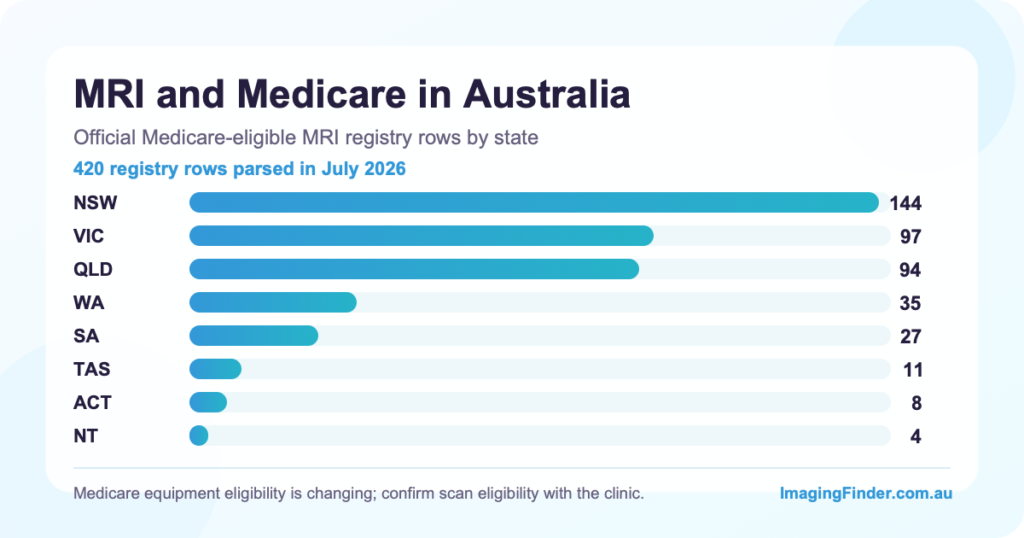
Infographic showing official Medicare-eligible MRI registry rows by Australian state

Short answer: Most adult MRI items on the Medicare Benefits Schedule must be requested by a specialist or consultant physician — a GP referral is not enough. The exceptions a GP can request are specific: certain head, cervical spine and acute knee scans for patients 16 and over, and six paediatric scans for children under 16. Whether you pay on the day depends on the clinic’s billing: bulk billed means no cost, otherwise you pay a gap. About 486 clinics list MRI across Australia as at July 2026.

Is your MRI covered by Medicare?

Medicare pays a rebate on an MRI when three things line up: the scan matches a Medicare Benefits Schedule (MBS) item, the request comes from the right kind of doctor, and the machine doing the scan is Medicare-eligible. Miss any one of the three and there is no rebate — even at a clinic that bulk bills every other patient in the waiting room.

The requester rule catches the most people. For most adult MRI items, the schedule requires a written request from a specialist or consultant physician that identifies the clinical indication (MBS note IN.0.18, accessed 7 July 2026). A GP referral for an adult shoulder, lumbar spine or pelvic MRI will still get you scanned — you just pay the full private fee, with nothing back from Medicare.

GPs are the genuine exception for exactly ten items: four adult scans and six paediatric scans, listed in the next section. The same specialist-request pattern applies to most Medicare-funded PET-CT scans, and the rules differ again for X-ray, ultrasound and CT — our guide to Medicare-eligible scans by modality covers each one.

Which MRIs can a GP refer for a Medicare rebate?

Ten MRI items can be requested by a GP — the MBS wording is “a medical practitioner other than a specialist or consultant physician”. Four apply from age 16, six apply to children under 16. Fees and rebates below are the schedule as at July 2026; each item number links to its MBS page.

Adults and teenagers 16 and over

MBS item Scan Medicare pays when the referral says Rebate (85%)
63551 Head Unexplained seizures, or unexplained chronic headache with suspected intracranial pathology $394.25
63554 Cervical spine Suspected cervical radiculopathy (nerve-root compression in the neck) $350.45
63557 Cervical spine Suspected cervical spine trauma $481.90
63560 Knee (ages 16–49) Acute trauma with inability to extend the knee (possible meniscal tear), or findings suggesting an ACL tear $394.25

Two knee limits trip people up. Medicare pays for no more than three GP-requested knee MRIs per patient per year, and there is no GP knee item at all from age 50 — a 52-year-old with the identical injury needs a specialist request (MBS knee imaging factsheet, accessed 7 July 2026). There is also no GP-requestable adult item for the lumbar spine, shoulder, hip or pelvis: a rebate on those needs a specialist.

Children under 16

MBS item Scan Medicare pays when the referral says Rebate (85%)
63507 Head Unexplained seizure; unexplained headache with suspected significant pathology; sinus disease not responding to treatment $394.25
63510 Spine After an X-ray: significant trauma, unexplained neck or back pain with neurological signs, or unexplained back pain with suspected significant pathology $438.05
63513 Knee Suspected internal joint derangement $394.25
63516 Hip After an X-ray: suspected septic arthritis, slipped capital femoral epiphysis or Perthes disease $394.25
63519 Elbow After an X-ray: suspected fracture or avulsion injury that would change management $394.25
63522 Wrist After an X-ray: suspected scaphoid fracture $438.05

Rebates shown are the 85 per cent Medicare benefit; if the clinic bulk bills, you pay nothing. Four of the six children’s items require a plain X-ray first — the MRI rebate follows the X-ray, not the other way around.

What will you actually pay?

“Medicare-rebatable” is not the same as free. If the clinic bulk bills, it accepts the Medicare benefit as full payment and you pay nothing (Services Australia, accessed 7 July 2026). If it doesn’t, you pay the clinic’s fee and claim the rebate back — the difference is your gap.

The arithmetic is fixed at one end only. The rebate on an out-of-hospital MRI item is 85 per cent of the schedule fee — $394.25 on the $463.80 GP-requested knee item as at July 2026, for example — and for almost all imaging items, a bulk-billed service is paid at 95 per cent of the schedule fee, which the clinic accepts as the whole price (MBS note IN.0.19). The other end is open: clinics set their own fees, so two clinics can charge different gaps on the identical item.

One right worth knowing: the referral is yours. Forms often carry one provider’s branding, but you are free to take the request to any provider that offers the scan (Services Australia, above). If avoiding a gap is the priority, our bulk-billed radiology guide explains how to find clinics that routinely bulk bill.

What changed in 2025 and 2026, and what changes on 1 July 2027?

Until mid-2025, Medicare-eligible MRI machines needed a Commonwealth licence, and many metropolitan machines were only “partially” eligible — able to bill some MRI items but not others. From 1 July 2025, those equipment licences became practice-based, and every partial or ineligible machine at a licensed practice became fully Medicare-eligible (MBS equipment factsheet, accessed 7 July 2026). That single change removed most of the old “this machine can’t do your item” problem in the capital cities.

The 1 July 2026 round was smaller but practical (MBS diagnostic imaging factsheet, accessed 7 July 2026): co-claiming restrictions were removed from four breast imaging items including breast MRI item 63464, so a high-risk breast MRI, ultrasound and mammogram can now be claimed on the same day; a request form is now valid for 14 days rather than 7 for completing all scans listed on it; and schedule fees rose for nuclear medicine scans using gallium-67 or thallium-201.

The 1 July 2027 change is the big one. Subject to legislation passing, the licence requirement for MRI equipment is removed entirely, and all existing and new MRI machines become fully Medicare-eligible. What does not change is everything else in this article: the specialist and GP request rules stay, machines must still sit in an accredited practice that also offers X-ray, ultrasound and CT under radiologist supervision, and machines past their allowed age — 10 years, extendable to 20 with upgrades — still lose eligibility. From 2027 the question “is this machine eligible?” mostly disappears; the question “is my referral eligible?” remains.

How do you find a Medicare-eligible MRI clinic?

The Department of Health publishes a list of Medicare-eligible MRI locations for each state and territory, naming every site with its practice name, address and registration number, plus a national map. The department’s own caveat is worth quoting: “Not all magnetic resonance imaging (MRI) machines are Medicare-eligible.” The NSW list alone runs to more than 140 sites (accessed 7 July 2026). What the lists don’t tell you: opening hours, wait times, whether the clinic bulk bills, or whether it offers private non-rebatable MRI. For those, you need the clinic itself.

City Clinics listing MRI Compare and book
Sydney about 84 MRI clinics in Sydney
Melbourne about 95 MRI clinics in Melbourne
Brisbane 54 MRI clinics in Brisbane
Perth 28 MRI clinics in Perth
Australia-wide about 486 —

Counts are from clinic listings published in our directory as at July 2026. A clinic listing MRI doesn’t guarantee every MRI item is rebatable there — the department’s list above is the authoritative record of Medicare-eligible sites.

Why two nearby MRI clinics can give different answers

Patients are sometimes told by one clinic that an MRI is Medicare-rebatable and by another that it is not. Until the 2025 licence change, the two clinics may have held different equipment eligibility — one machine full, one partial. They may match your referral to different item numbers. And they may simply bill differently: one bulk bills the item, the other charges a gap on it.

There can also be a wording problem. A referral that says “MRI knee — pain” with no mechanism of injury cannot be matched to item 63560, which needs acute trauma with specific findings. Expect the clinic to ring your GP for more detail rather than guess. If two nearby clinics give you different answers about the same referral, that is annoying, but it is usually safer than discovering the cost only after the appointment — the front desk is checking your exact item number, not being difficult.

What to say when you book an MRI

One sentence on the phone does most of the work:

The booking script: “I have a referral for an MRI of [body part] for [the reason written on the referral]. Can you check whether this exact scan is Medicare-rebatable at your clinic, whether you bulk bill it or what the gap is, and whether I need contrast or any preparation?”

If the booking team can’t answer on the spot, offer to email the referral through before they quote — the wording on the form is what they check against the schedule. Before you hang up, run through these six points:

  1. State the exact MRI written on the referral, including body part and side.
  2. Is that exact scan Medicare-rebatable at this location?
  3. Bulk billed or a gap — and if a gap, how many dollars on the day?
  4. Is contrast planned, and are kidney-function blood tests needed first?
  5. Declare pacemakers, implants, metal fragments, pregnancy, kidney disease and claustrophobia — healthdirect notes that some people cannot have an MRI at all, such as those with a pacemaker or certain implants.
  6. Should previous imaging be brought in or transferred before the appointment?

Raise claustrophobia when you book, not on the day — clinics can plan for it, and contrast decisions sometimes change the appointment length.

Related reading: MRI vs CT — which do you need? and radiology wait times, public vs private.

Frequently asked questions about MRI and Medicare

Does a referral guarantee a Medicare rebate on an MRI?

No. The scan must match an MBS item’s indication, the request must come from the right kind of doctor, and the site must be Medicare-eligible. A GP referral for a knee MRI in a 55-year-old attracts no rebate because the GP knee item stops at 49 — a specialist can request a knee MRI at any age.

Can my GP refer me for a knee or back MRI?

Knee: yes, if you are 16–49 and the scan is for acute trauma with a suspected meniscal or ACL tear (item 63560), up to three per year. At 50 or over, no. Back: there is no GP-rebatable adult lumbar spine item, and the cervical spine items cover only suspected radiculopathy or trauma. For children under 16, spine item 63510 applies after an X-ray.

How much does an MRI cost without Medicare?

There is no standard price — diagnostic imaging providers set their own fees, so a non-rebatable MRI is quoted clinic by clinic (Services Australia). When a scan is rebatable the numbers firm up: bulk billed means you pay nothing; otherwise you pay the clinic’s fee and claim back 85 per cent of the schedule fee, which is $394.25 on a GP-requested knee MRI as at July 2026.

Is a specialist referral always needed for an MRI rebate?

For most adult items, yes — the schedule requires a written request from a specialist or consultant physician identifying the clinical indication (MBS note IN.0.18). The exceptions are the ten GP-requestable items tabled above: adult head, cervical spine and acute knee scans, plus six paediatric scans. Outside that list, Medicare contributes only on a specialist request.

What changes on 1 July 2027?

Subject to legislation, the requirement for MRI machines to hold a Commonwealth licence is removed and all existing and new machines become fully Medicare-eligible. That widens where an eligible referral can be used. It does not change who can request each item or which indications qualify — the referral rules in this article still decide the rebate.

Do I have to book at the clinic printed on my referral form?

No. Referral forms often carry one provider’s branding, but Services Australia is explicit: you are free to choose your own provider as long as they offer the scan you need. The referral travels with you — take it to whichever clinic has the billing, availability and location that suit you.

How we know: sources and methodology

The clinic counts in this article come from listings published in the Imaging Finder directory in July 2026, and the Medicare-eligible site figures come from the Department of Health, Disability and Ageing’s MRI location lists. Every Medicare rule — item numbers, indications, fees, rebates and the 2025–2027 equipment changes — was read directly on MBS Online, health.gov.au, Services Australia or healthdirect on 7 July 2026; the links below go to the exact pages. Treat the counts as a reliable guide to where MRI is offered rather than a promise about your specific scan: item wording changes with schedule updates, and billing is set clinic by clinic. Fees quoted are the July 2026 schedule.

This article is general information, not personal medical advice. Availability, Medicare eligibility, billing and preparation can change — confirm the specifics with your referrer and the clinic.

Dr. Mark Bekhit
Author: Dr. Mark Bekhit

Dr Mark Bekhit (MBChB, FRANZCR) is a musculoskeletal radiologist practising in Brisbane and an AHPRA-registered specialist in diagnostic radiology (MED0002920947). He spends as much time building software as reading scans: he founded Imaging Finder (Australia) and Radiology Clinics NZ to make imaging easier to find, and builds radiology dictation and pain-tracking tools with one aim — better patient outcomes and a smoother reporting workflow. Outside the reading room he's usually training, bringing the same performance mindset to imaging.

Leave a Reply

Your email address will not be published. Required fields are marked *