By Dr. Mark Bekhit, Radiologist · Last updated September 2026
You are pregnant, you have a request form in your bag, and you have just looked up four clinics that quote four different prices for the same scan. Here is the part almost nobody explains: the size of your Medicare rebate is decided by the paperwork, not by the clinic you choose.
The quick answer
Short answer: Medicare pays a set benefit for each pregnancy scan, fixed by the stage of the pregnancy. The 17–22 week morphology scan carries a $100.20 benefit and the dating scan before 12 weeks carries $60.10 — but only if the practice has your doctor’s written request before the scan starts. Without it, the practice bills the cheaper non-requested item instead and the benefit falls to $38.00 for the 20-week scan, or $35.00 for the dating scan.
Many practices charge more than the benefit, and the difference is yours. In 2023–24, 43% of patients having a morphology scan at a radiology practice paid nothing; among those who did pay, the median was about $160 — a national figure, not a quote.
On this page
• Which scan happens when, and what Medicare pays
• Why the same 20-week scan pays two different rebates
Which scan happens when, and what Medicare pays
Pregnancy scans are timed around what can actually be seen, and each window has its own Medicare item.
A dating scan before 12 weeks establishes how far along you are, where the pregnancy is sitting, whether there is a heartbeat and how many there are. The nuchal translucency scan follows during weeks 11 to 13: the nuchal translucency is the normal fluid space behind the baby’s neck, and measuring it helps estimate the risk of Down syndrome and some other conditions. The measurement is taken between 11 weeks 4 days and 13 weeks 6 days; allow about 30 minutes.
The big one is the morphology scan at 17 to 22 weeks — the head-to-toe anatomy check, which also assesses the placenta, the fluid around the baby, the cervix and growth. It is recommended from 17 weeks onwards and preferably before 21 weeks, when the structures are big enough to see clearly but not yet crowded. Allow 30 to 45 minutes. A scan at 12 to 16 weeks gives an earlier look at development and anatomy, and after 22 weeks further scans check growth, position, the placenta and the fluid.
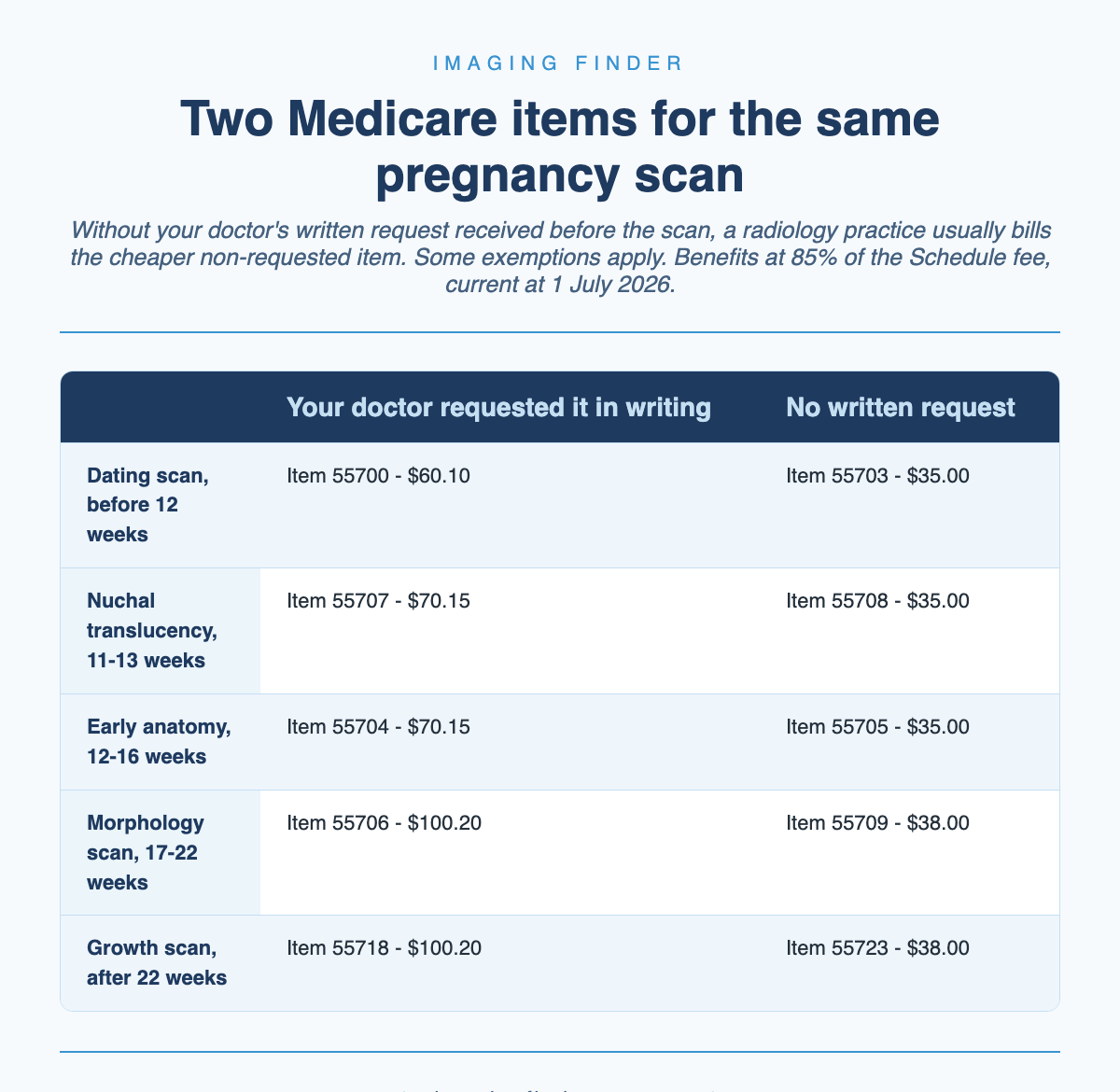
Each item carries a Schedule fee set by the government, and the Schedule lists the Medicare benefit beside it. The figures below are the 85% benefit shown on each item, current at 1 July 2026.
Schedule fees and benefits for out-of-hospital services from the Medicare Benefits Schedule, items 55700, 55704, 55706, 55707 and 55718, current at 1 July 2026 and checked as at September 2026. For how imaging billing works more broadly, see our cost guide.
The benefit is the fixed part. The practice’s own fee is not, and no rule caps it — which is exactly why those four websites quoted you four numbers. Where a practice bulk bills, you pay nothing and it receives 95% of the Schedule fee rather than 85%.
Your midwife, GP or obstetrician decides which of these you need and when. Nothing here is a reason to skip one on cost grounds. Keepsake and gender-reveal scans sit outside all of this: a scan purely to determine the sex of a baby is generally not a clinically relevant service, so it carries no Medicare item and you pay privately.
Why the same 20-week scan pays two different rebates
Every obstetric ultrasound item exists twice in the schedule: a requested version, marked (R), for a scan a doctor asked for in writing, and a non-requested version, marked (NR), which pays far less. The scan is identical. The money is not.
The same 20-week scan, two different items:
• Your doctor requested it in writing — item 55706, benefit $100.20
• No written request — item 55709, benefit $38.00
For the morphology scan the requested item pays about two and a half times as much; the dating scan splits the same way, $60.10 against $35.00.
The rule is simple. Medicare will not pay the requested item unless the practice received your doctor’s written request before the scan began. Otherwise it bills the non-requested item. The practice’s fee does not change; your rebate shrinks by about $62 on a morphology scan, so the gap you pay grows by the same amount.
The most valuable thing in your bag is the request form. It does not have to be signed, your doctor can send it electronically, and a participating midwife can write one for the dating, nuchal translucency, morphology and later scans.
If you have left the form at home, say so at reception before the scan starts. Your doctor can send another copy through electronically, and as long as the practice accepts requests that way and it arrives before the scan starts, the requested item still stands. If a request was genuinely made and then lost, the practice can instead confirm it with your doctor, and the written-request rule is waived. Either way, a two-minute call from reception is worth up to $62.
A repeat 17-to-22 week scan can be claimed on item 55712 at a higher $115.15 benefit, but only when a further examination is clinically indicated after a morphology scan in the same pregnancy, and the request comes from a doctor with obstetric qualifications — a Member or Fellow of the obstetricians’ college, a Diploma of Obstetrics or equivalent, or obstetric privileges at a non-metropolitan hospital. If your repeat scan was arranged by your obstetrician rather than your GP, that is why the rebate can look different.
A second exemption is worth knowing. A consultant physician or specialist who assesses you and determines the scan is necessary — an obstetrician, say — can claim the requested item without a written request, whether she scans you herself or it is done on her behalf. That exemption does not extend to a specialist in diagnostic radiology, so the form still matters when your scan happens at a radiology practice.
What people actually paid
Schedule fees tell you what Medicare contributes, not what lands on your card. For that, the Department of Health publishes what patients were actually charged at diagnostic radiology practices across Australia in 2023–24.
Out-of-hospital services at diagnostic radiology practices, Australia, 2023–24, from the Department of Health’s Medical Costs Finder. “Paid nothing” is the share of patients with no out-of-pocket cost, and “median payment” is the middle amount among those who did pay. Historical national figures as at September 2026, not a price for your appointment.
The striking number is the spread between scans. In that year, seven patients in ten paid nothing for a scan after 22 weeks. For the nuchal translucency, fewer than one in four did. Same pregnancy, very different odds of a bill nationally, and our bulk-billing guide explains why practices differ.
That makes the nuchal translucency the appointment most worth budgeting for.
What to ask before you book
Preparation is easy: some fluid in your bladder but not an uncomfortably full one, and clothing that gives easy access to your abdomen. The practice sends its own instructions, and our general preparation guide covers the rest.
Worth saying plainly, because it worries people: these scans are performed by sonographers who are specially trained and accredited to do them, and a radiologist or obstetric sonologist checks the images and writes the report.
The money question is the one worth a phone call.
Ask the practice when you book
✓ “Which item number will you bill for a scan at [X] weeks?”
✓ “Do you bulk bill that item, and does a concession card change it?”
✓ “If not, what do I pay on the day and what comes back from Medicare?”
✓ “Is anything billed separately — for example if an internal scan is needed too?”
✓ “Do you do nuchal translucency measurements here?”
✓ “If the scan can’t be finished today, is the return visit charged again?”
✓ “Do you have my doctor’s written request, or should I bring it in?”
These scans are done in hospital radiology departments, private radiology practices and dedicated obstetric clinics. To shortlist clinics near you, start with our listings for Sydney, Melbourne or Brisbane. The directory lists clinics by service and location rather than by pregnancy scanning specifically.
If your scan is gynaecological rather than obstetric — pain, bleeding, a cyst or suspected endometriosis outside pregnancy — the items and rebates are different, and our pelvic ultrasound cost guide covers them.
What these scans can and cannot tell you
These are safe scans, with no radiation involved — our guide to imaging safety in pregnancy covers the scans that do use it.
What they are not is a guarantee. The nuchal translucency scan is screening: it estimates a likelihood, it does not diagnose anything. On its own it is about 75% accurate for predicting Down syndrome, rising to about 85% with the blood test your doctor orders between 10 and 12 weeks. Nineteen in twenty women get a normal result. Whether to have it is a conversation with your GP, obstetrician or midwife, not a decision to make on price.
The morphology scan is thorough but not complete. Development is normal in 98 to 99% of pregnancies, and against that reassuring background the scan detects roughly 60% of abnormalities overall and about half of Down syndrome cases. I would rather you knew those numbers than assumed a clear scan rules everything out.
If something needs discussing, the sonographer is not the person to ask — they are working through a long checklist, and the report goes to the doctor who requested it, who has your full history. Our guide to reading a radiology report explains the document.
Common questions
Will Medicare pay for extra scans in the same pregnancy?
Usually yes, when there is a medical reason and the scan matches an item for that stage. The schedule does block certain combinations: a dating scan cannot be claimed within 24 hours of several other obstetric items, and the requested and non-requested versions of the 17-to-22 week scan cannot both be claimed in one pregnancy.
Is the rebate different if I am expecting twins?
Yes, and from the first-trimester scan onwards. Once an ultrasound confirms a multiple pregnancy, twin-specific items apply at each later stage: nuchal translucency on item 55742 and the 12-to-16 week scan on 55740 (both a $104.25 benefit), then 55759 at 17 to 22 weeks and 55768 after 22 weeks (both $150.20). Each pays more than the single-pregnancy equivalent, and none can be billed alongside it for the same stage.
What if the baby is lying awkwardly and the scan cannot be finished?
You may be asked to return another day to complete it. If the baby is lying so that part of the anatomy cannot be seen, the sonographer cannot finish the checklist — and this happens often enough that it should not alarm you. It is a scheduling problem, not a finding.
Does my request form expire?
No. Requests for diagnostic imaging do not expire and stay valid until the scan has been done. Useful if a form has sat in your bag for weeks, or if you book somewhere other than the practice your doctor mentioned — the request travels with you, because it is a request for a scan, not a booking at one clinic. One catch: if your doctor put several scans on the one form, the rest have to be done within fourteen days of the first.
How we know: sources and method
The item numbers, Schedule fees and benefits come from the Medicare Benefits Schedule, read on 8 September 2026; every item quoted carries a Schedule fee updated on 1 July 2026. The rule that a requested scan needs the doctor’s written request beforehand comes from Services Australia. What patients paid comes from the Department of Health’s Medical Costs Finder, filtered to diagnostic radiology and to services provided outside hospital, nationally, for 2023–24 — the most recent year published. Those are historical averages across the whole country, so they describe the pattern rather than your appointment. The clinical detail on timing, accuracy and preparation comes from InsideRadiology, the patient information service of the Royal Australian and New Zealand College of Radiologists.
Fees change with the schedule and practices set their own charges, so the one number to confirm is the price for the item on your request form, from the practice you book with.
This article is general information, not personal medical advice. Discuss your individual report and next steps with the healthcare professional responsible for your care. It does not replace a written quote for your exact requested service.

Author: Dr. Mark Bekhit
Dr Mark Bekhit (MBChB, FRANZCR) is a musculoskeletal radiologist practising in Brisbane and an AHPRA-registered specialist in diagnostic radiology (MED0002920947). He spends as much time building software as reading scans: he founded Imaging Finder (Australia) and Radiology Clinics NZ to make imaging easier to find, and builds radiology dictation and pain-tracking tools with one aim — better patient outcomes and a smoother reporting workflow. Outside the reading room he's usually training, bringing the same performance mindset to imaging.
Leave a Reply