
By Dr. Mark Bekhit, Radiologist · Last updated September 2026
The quick answer
Short answer: An ultrasound costs $0 when the clinic bulk bills an eligible Medicare service. Otherwise, you usually pay the clinic’s fee and receive a set Medicare benefit, leaving a gap. In 2023–24 government data, 80% paid nothing for an abdominal ultrasound; those who paid typically paid $110. For a pregnancy ultrasound at 17 to 22 weeks, 43% paid nothing and the typical payment among those who paid was $160. Ask for the total fee, Medicare benefit and final gap before booking.
About 66 of every 100 Medicare-billed ultrasound services were bulk billed nationally in the June quarter of 2025–26. This excludes ultrasound services without a Medicare benefit. It does not predict one clinic’s billing decision.
Start with the exact ultrasound: use the pregnancy ultrasound cost guide or pelvic ultrasound cost guide when either matches your request.
On this page
- How much does an ultrasound cost in Australia?
- What did patients actually pay for common ultrasounds?
- Why can two ultrasound quotes be different?
- Does Medicare cover an ultrasound?
- Will private health insurance cover an ultrasound?
- How do you get a useful quote before booking?
- Where can you find an ultrasound clinic?
- How we know: sources and method
How much does an ultrasound cost in Australia?
There is no national retail price for an ultrasound. The Australian Government sets Medicare fees and benefits, while each imaging clinic sets its own fee. Your cost follows one of the pathways below.
See current Medicare fee examples
For an out-of-hospital service, Medicare usually pays 85% of the Schedule fee. A clinic can charge more than that fee. The benefit is not 85% of your bill.
The number to compare: the final amount left after Medicare, not the Schedule fee and not the amount you hand over before claiming. The same eligible scan can be $0 at one clinic and leave a gap at another because clinics set their own fees and choose whether to bulk bill.
What did patients actually pay for common ultrasounds?
The Schedule table shows statutory figures. The Australian Government’s Medical Costs Finder answers a different question: what patients were charged for out-of-hospital services in 2023–24. The graphic pairs two figures for each exact item.
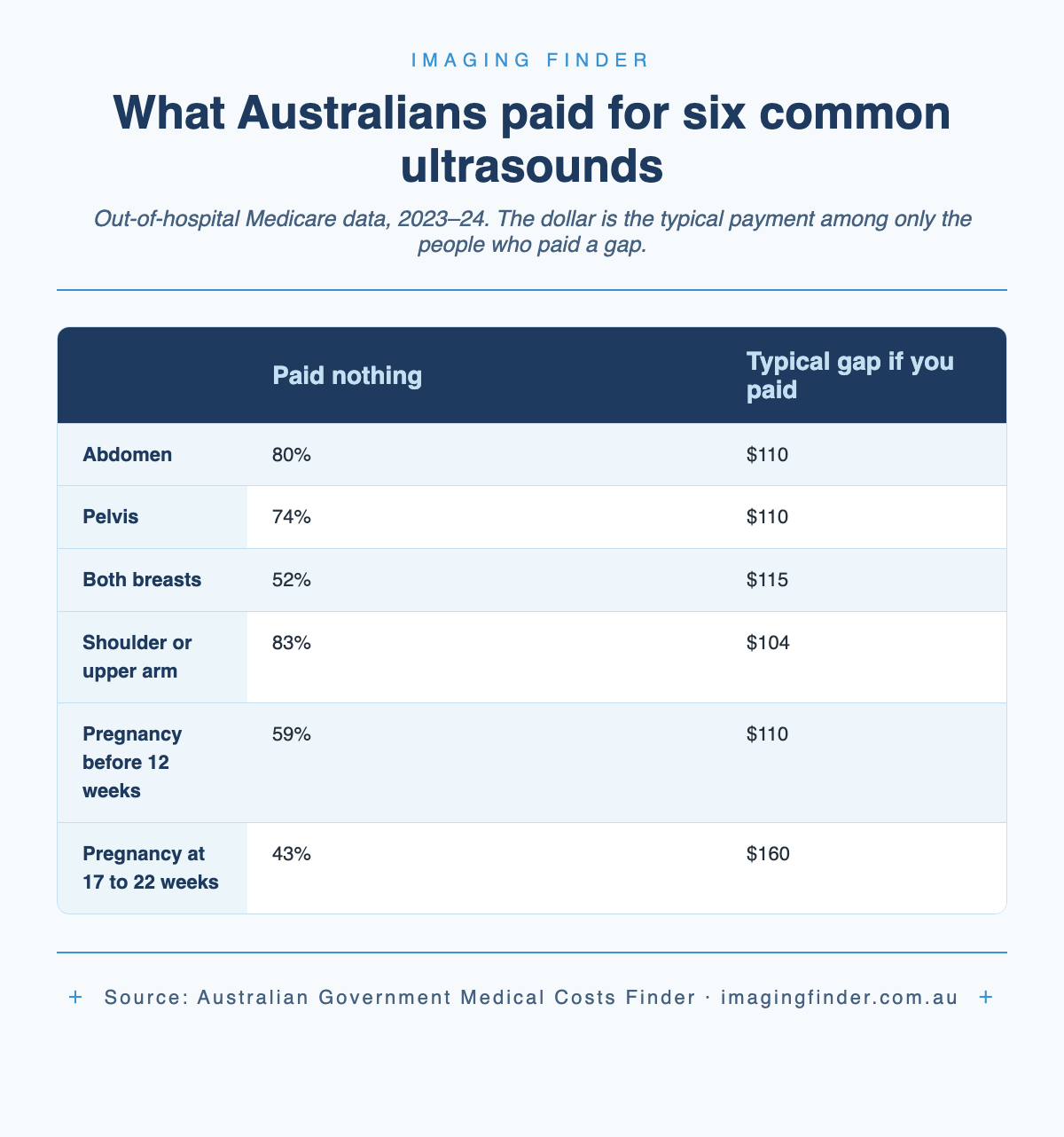
The left column is the share of all patients who had no out-of-pocket cost. The right column applies only to patients who paid a gap; it is not an average across everyone. For shoulder or upper-arm ultrasound, 83% paid nothing and the other group typically paid $104. If you were hoping for a shoulder MRI instead, our shoulder MRI cost guide explains when Medicare pays for one. For ultrasound of both breasts, 52% paid nothing and those who paid typically paid $115.
Pregnancy items show why a single “ultrasound price” is unhelpful. In the same 2023–24 dataset, 59% paid nothing for an ultrasound before 12 weeks, with a typical $110 patient payment among those who paid. For the 17-to-22-week item, 43% paid nothing and the typical payment among those who paid was $160. The after-22-week item recorded 70% paying nothing and a typical $120 payment for the remainder.
These are national historical benchmarks, not a 2026 quote. Compare them with the clinic’s quoted final gap, rather than with the larger amount you might pay before Medicare is claimed.
Why can two ultrasound quotes be different?
The word “ultrasound” covers many MBS items. An abdominal examination, a bilateral breast examination and a pregnancy examination at 17 to 22 weeks have different item descriptions and benefits. A quote should therefore begin with the exact examination written on the request, not a generic price for “an ultrasound”.
BreastScreen Australia provides free screening mammograms for eligible women without symptoms, not diagnostic breast ultrasound. A bilateral breast ultrasound has its own MBS item and request pathway. Our breast ultrasound cost guide compares one breast with both, state by state, with clinic gaps.
Eligibility is the next factor. The shoulder item, for example, lists the conditions it covers. Pregnancy items use gestational age and other item conditions. A request does not by itself confirm that an MBS item matches.
The clinic’s billing decision then sets the final gap. Clinics choose their own fee and whether to bulk bill. One can accept the benefit as full payment; another can charge above it. That difference is a billing choice, not a different Medicare rebate for the same item.
Does Medicare cover an ultrasound?
Medicare contributes when the examination matches an MBS item and its request conditions. Under MBS request guidance, an R-type service generally needs to be requested before it is performed, and the request should identify the service and include enough clinical information. All nine examples in the table above are marked R-type.
A matching item makes a Medicare benefit payable; it does not make bulk billing compulsory. When the clinic does bulk bill, almost all diagnostic-imaging items attract a benefit at 95% of the Schedule fee and the patient pays nothing. When it bills privately, the usual out-of-hospital benefit is 85% of the Schedule fee and a gap can remain.
The ultrasound request guide explains who can request common examinations. The Medicare imaging guide compares ultrasound with X-ray, CT, MRI and nuclear medicine. The bulk-billed radiology guide separates eligibility from a clinic’s billing choice.
Will private health insurance pay?
Not when the ultrasound is an outpatient Medicare service. Private health insurers are not allowed to cover out-of-hospital diagnostic imaging, so hospital cover cannot fill an outpatient ultrasound gap.
The admitted-private pathway is different. For a covered service while you are admitted as a private patient, Medicare pays 75% of the MBS fee and the insurer at least the remaining 25%; charges above the MBS fee and a policy excess can remain. As a public patient in a public hospital, treatment is free, although access follows clinical need. Our public-versus-private imaging checklist explains the practical trade-offs.
How do you get a useful quote before booking?
Have the request in front of you. A figure such as “$210” can mean the full clinic fee before Medicare, while “$110 out of pocket” means the amount left after the benefit. Treat those as different numbers.
Ask the clinic before you book
✓ “Do you bulk bill this exact ultrasound for me?”
✓ “If not, what is the total clinic fee?”
✓ “What Medicare benefit do you expect, and what will my final gap be?”
✓ “How much do I pay on the day before Medicare is claimed?”
✓ “Which MBS item do you expect to use?”
The Australian Government’s informed-financial-consent guidance recommends a written estimate that includes the likely item number, total fee, expected Medicare contribution, out-of-pocket amount and payment timing. That is enough information to compare two clinics on the final amount you pay.
You can take the request to another clinic that performs the examination, even when a particular imaging company is printed on the form. A change of clinic does not change the request or the MBS item conditions, but it can change the fee and bulk-billing decision.
Where can you find an ultrasound clinic?
Start with the ultrasound clinic finder or the national radiology directory. You can also browse ultrasound services in Brisbane, Sydney, Melbourne and Perth.
Use the same request and the five quote questions with two nearby clinics. Once booked, follow the clinic’s instructions; the ultrasound preparation guide explains why some scans need fasting, a full bladder or neither.
What you do not need to compare: radiation dose. Ultrasound uses sound waves rather than ionising radiation, so compare the exact examination, final gap, appointment time and preparation instructions.
Sources and methodology
Sources and methodology
The current item descriptions, Schedule fees and benefits were checked in MBS Online on 6 August 2026. The patient-payment examples come from the Australian Government Medical Costs Finder’s 2023–24 national out-of-hospital claims data. The percentage and dollar in the graphic use different denominators: the percentage covers all patients for the exact item, while the dollar covers only those who paid a gap.
- Department of Health: diagnostic-imaging fees, Medicare and item restrictions
- MBS Online: current items 55036, 55038, 55065, 55076, 55864, 55700, 55704, 55706 and 55718
- Medical Costs Finder: 2023–24 patient data for abdomen, both breasts, shoulder/upper arm, pregnancy before 12 weeks and pregnancy at 17 to 22 weeks
- Services Australia: medical costs and Medicare benefits
- Department of Health: private health insurance boundaries
- healthdirect: ultrasound, safety and preparation
This article is general information, not personal medical advice. Discuss your individual report and next steps with the healthcare professional responsible for your care.

Author: Dr. Mark Bekhit
Dr Mark Bekhit (MBChB, FRANZCR) is a musculoskeletal radiologist practising in Brisbane and an AHPRA-registered specialist in diagnostic radiology (MED0002920947). He spends as much time building software as reading scans: he founded Imaging Finder (Australia) and Radiology Clinics NZ to make imaging easier to find, and builds radiology dictation and pain-tracking tools with one aim — better patient outcomes and a smoother reporting workflow. Outside the reading room he's usually training, bringing the same performance mindset to imaging.


Leave a Reply