Short answer: Take your ultrasound request form to any radiology clinic you like — Medicare rules say a request does not have to be done at the clinic printed on the form. A GP referral is enough for a Medicare rebate on ultrasound, unlike most adult MRI. Every clinic that offers Medicare-funded imaging is already accredited under the national scheme, so your real decisions are practical ones: does the clinic perform your exact scan, will it bulk bill you, and how soon can you be seen. Most ultrasound appointments take about 30 minutes.
- How do you find an ultrasound clinic near you?
- How do you choose between ultrasound clinics?
- Do you need a referral for an ultrasound?
- Pregnancy scans or a general imaging clinic: which do you need?
- Will your ultrasound be bulk billed?
- What should you ask when you book?
- Common questions about finding an ultrasound clinic
- How we know: sources and method
How do you find an ultrasound clinic near you?
Start with the request form, not the map. The form names the exact study — “US right shoulder”, “pelvic ultrasound”, “morphology scan” — and that wording decides which clinics suit you. A shoulder, thyroid or abdominal ultrasound is routine work for a general radiology practice. A 20-week morphology scan needs a longer appointment and a sonographer who does obstetric work every day, so dedicated women’s imaging practices carry a large share of them.
Three rules make the search easier than most people expect:
- You can go anywhere. Under the Medicare requesting rules (MBS note IN.0.6, accessed 7 July 2026), a request does not need to be addressed to a particular clinic — and even when a clinic’s name is printed on the form, the scan does not have to be done there.
- Accreditation is already checked for you. The Department of Health states that only practices accredited under the Diagnostic Imaging Accreditation Scheme can perform Medicare-funded diagnostic imaging. If Medicare pays anything toward your scan at a clinic, that clinic has met the national safety and quality standards.
- Ultrasound is widely offered. The equipment is portable and inexpensive to run compared with CT or MRI, so ultrasound is performed in hospitals, private radiology practices and some specialist rooms (InsideRadiology). Your shortlist will rarely be empty.
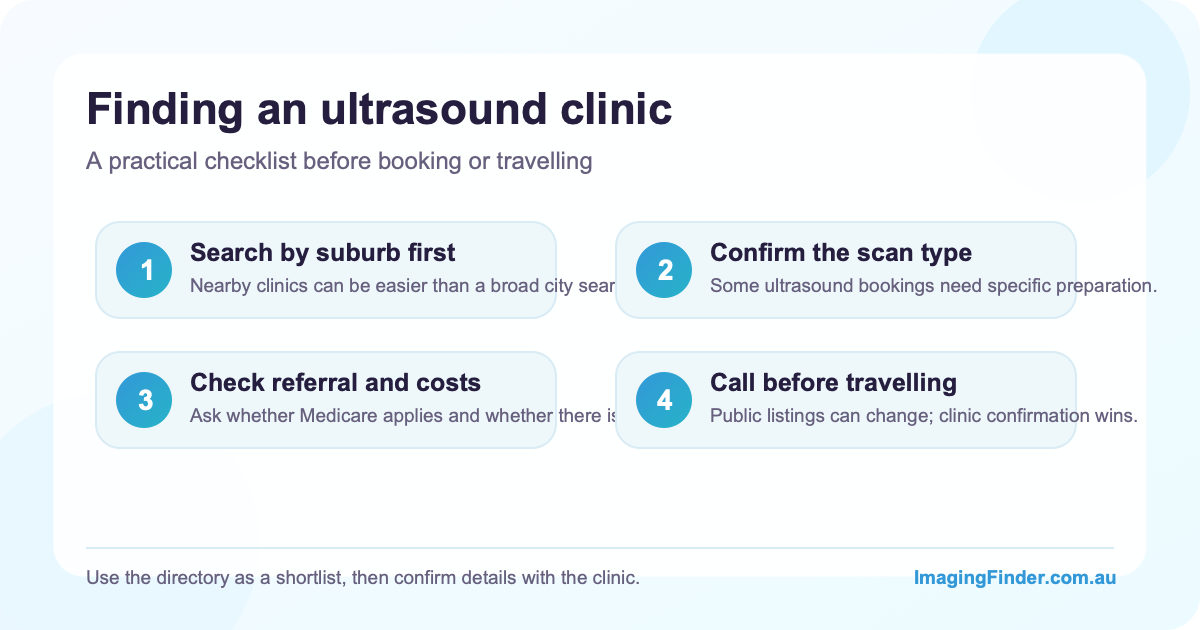
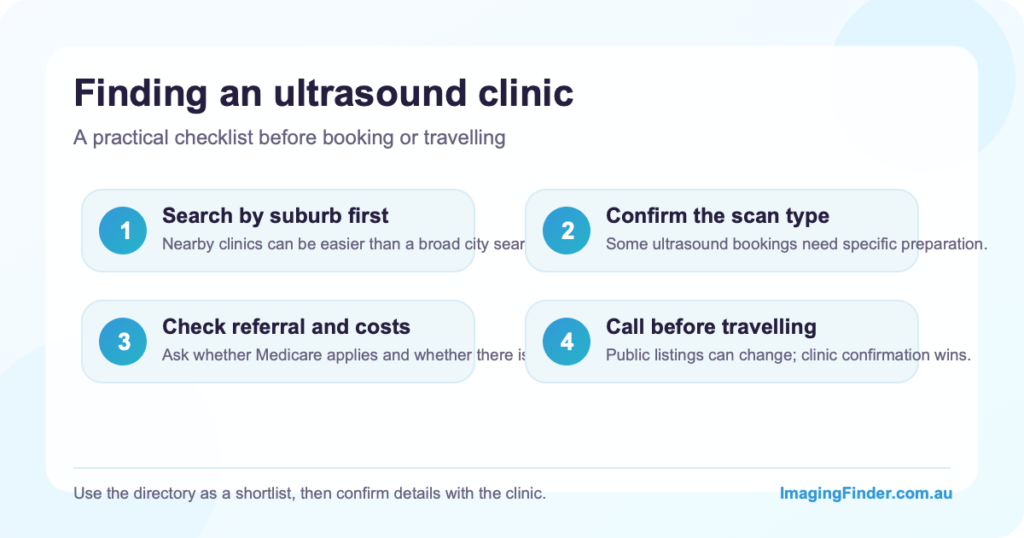
Imaging Finder lists about 940 radiology clinics across Australia as at July 2026. The fastest route is a city ultrasound page — Sydney, Melbourne or Brisbane — narrowed to suburbs you can actually reach on a weekday. Then ring the closest two or three and ask the questions in the booking section below.
How do you choose between ultrasound clinics?
Our local shortlists show ultrasound clinics in Chatswood and ultrasound clinics in Footscray, with addresses and contact details. You can also compare radiology clinic brands, booking options and billing policies.
Once you have a shortlist, the differences that matter are mostly invisible on a map. Five checks separate a smooth appointment from a wasted trip:
| What to check | The question to ask | Why it matters |
|---|---|---|
| The exact study | “Do you perform the scan written on my form, at this branch?” | Two branches of the same network can carry different machines and different sonographer rosters — reception reads your form back word for word to match it against what that site actually offers. |
| Billing | “Will this be bulk billed for me? If not, what do I pay on the day?” | Billing is set clinic by clinic and scan by scan — details in the cost section. |
| Availability | “How soon can I be seen, and do you keep a cancellation list?” | A cancellation list can pull your appointment forward by days. Weighing a public hospital department against a private clinic? Our guide to radiology wait times in Australia compares the two pathways. |
| Radiologist on site | “Is a radiologist on site during scans?” | Sometimes the radiologist needs to attend, scan further and talk to you (InsideRadiology). An on-site radiologist can finish that the same day instead of recalling you. |
| Reporting | “When will the report reach my referrer?” | Your next GP or specialist appointment depends on the report, not the scan. |
Don’t be surprised when the same form gets different responses down the street: one practice bulk bills the scan but can’t see you for a fortnight, while its neighbour charges a gap and has a slot tomorrow. Both answers are legitimate — billing and equipment are decided practice by practice — and a five-minute call surfaces the trade-off before you’ve taken a morning off work for the wrong clinic.
Do you need a referral for an ultrasound?
For Medicare to pay, yes. The MBS factsheet on diagnostic imaging requests (accessed 7 July 2026) is blunt about it: benefits are not payable for requested imaging services unless the clinic receives a written request from an eligible practitioner before the scan starts.
The good news is who counts as eligible. Any medical practitioner — including your GP — can request any ultrasound service under the MBS requesting rules. That is the opposite of MRI, where most adult items need a specialist’s request before Medicare contributes — our MRI and Medicare guide covers the exceptions. A few other professions hold narrow ultrasound requesting rights: podiatrists, for example, can request five specific items, and nurse practitioners, midwives and dentists each have defined lists. The rare exception runs the other way — one specialised obstetric item (55712) can only be requested by someone with obstetric qualifications.
Two practical details from the same factsheet are worth knowing. A diagnostic imaging request has no general expiry date, so a form from months ago is usually still valid. And if one form orders several scans, the first scan is rebatable whenever you have it — but the later ones only attract Medicare benefits if they are done within 7 days of that first scan. Doctors planning repeat scans, such as serial pregnancy ultrasounds, write a separate form for each visit instead.
Pregnancy scans or a general imaging clinic: which do you need?
Pregnancy ultrasounds run to a schedule, and the scan’s timing tells you how specialised the appointment is. The standard windows, per healthdirect (accessed 7 July 2026):
| Scan | Usual timing | What it checks |
|---|---|---|
| Dating scan | 8 to 14 weeks | How far along you are; estimated due date |
| Nuchal translucency | 11 to 13 weeks | Screening for genetic conditions |
| Combined first-trimester screen | 11 to 14 weeks | The nuchal translucency ultrasound plus a blood test |
| Morphology scan | 18 to 22 weeks | Growth and development of organs; position of the placenta |
Early scans are short and widely available — your obstetrician may even do one in their rooms, since small ultrasound systems suit early pregnancy checks (InsideRadiology). The morphology scan is the detailed one. Practices that do obstetric imaging all day book longer appointments for it and keep sonographers in daily obstetric practice, so if you have a choice, a dedicated women’s or obstetric imaging practice is a reasonable preference for that scan; a general radiology clinic that offers morphology scans is also fine.
Whoever you choose, the people are the same two roles: a sonographer — a health professional fully qualified in ultrasound — performs the scan, and a radiologist reviews the images and sends the report to your referrer. For general scans (musculoskeletal, vascular, breast, thyroid, abdominal), any accredited radiology practice that performs the study on your form is a sound choice.
Will your ultrasound be bulk billed?
Bulk billing means the clinic bills Medicare directly and accepts the Medicare benefit as full payment — you pay nothing (Services Australia, accessed 7 July 2026). If a clinic doesn’t bulk bill your scan, you pay its fee and claim the rebate back, leaving a gap. As a concrete example, the ultrasound item for assessing a skin or soft-tissue lump (MBS item 55844) carries a schedule fee of $102.85 and an out-of-hospital benefit of $87.45, as at July 2026 (MBS Online) — a clinic charging $150 for it would leave you about $63 out of pocket.
Whether a scan is bulk billed is the clinic’s decision, made per service. Before contacting clinics, use our ultrasound cost guide to compare the total fee, Medicare benefit and final gap. This varies by clinic, which is exactly why it belongs on your booking call rather than your assumptions. Our bulk-billed radiology guide covers how to find clinics that routinely bulk bill. Most requested ultrasound items attract a Medicare rebate when the referral and clinical indication line up; for how eligibility works across X-ray, CT, ultrasound and the rest, see our Medicare eligibility guide by modality.
What should you ask when you book?
One phone call settles almost everything. With your request form in front of you, ask:
- “I have a referral for [read the scan exactly as written]. Do you perform this at your branch?”
- “Will it be bulk billed for me? If not, what will I pay on the day, and what will Medicare give back?”
- “How soon can I be seen — and can you call me if a cancellation comes up?”
- “What preparation do I need?” Some scans need real preparation — an abdominal ultrasound usually means an 8-hour fast, and a pelvic ultrasound can mean drinking 750 mL of water an hour beforehand. The details per scan type are in our guide to preparing for an ultrasound appointment.
- “Should I bring my old scans?” Yes, almost always — healthdirect advises bringing your referral letter and any previous ultrasound or X-ray images for comparison (healthdirect).
- “When will the report reach my doctor?” Then book your follow-up appointment for after that date, not before.
If the first clinic says no to question 1 or gives an eye-watering answer to question 2, ring the next one on your list. The form in your hand works at every accredited practice in the country.
Common questions about finding an ultrasound clinic
Can I use a different clinic than the one printed on my referral?
Yes. Medicare’s requesting rules state a request does not have to be addressed to a particular clinic, and even when it is, the scan doesn’t have to be done there. Branded request forms must, by rule, tell you the request may be taken to a clinic of your choice (MBS note IN.0.6).
Does an ultrasound referral expire?
There is no general time limit on a diagnostic imaging request, so an older form is usually still usable. The one timing rule: when a single form orders several scans, the first is rebatable regardless, but Medicare only pays benefits on the later ones if they happen within 7 days of the first (MBS factsheet). If your condition has changed since the form was written, see your GP first.
How long does an ultrasound appointment take?
Generally about 30 minutes, though vascular studies can run longer (InsideRadiology). Ask for the expected length when you book, and arrive with any preparation — fasting or a full bladder — already done.
Is ultrasound safe?
Yes. Ultrasound uses high-frequency sound waves, not radiation, and there are no proven harmful effects at the levels used clinically (InsideRadiology). That is a large part of why it is the workhorse test in pregnancy and for children.
Who actually performs the scan and writes the report?
In most clinics a sonographer — a health professional fully qualified in ultrasound — performs the examination. A radiologist reviews the images, sometimes attends to scan further or ask about your symptoms, and writes the report your referring doctor receives (InsideRadiology).
How we know: sources and method
The Medicare rules in this guide — who can request an ultrasound, request portability, validity, and the accreditation requirement — come from MBS Online notes and factsheets and Department of Health pages, all read on 7 July 2026. Clinical facts about how scans are performed and pregnancy scan timing come from healthdirect and InsideRadiology, the patient-information site of the Royal Australian and New Zealand College of Radiologists. The national figure of about 940 clinic listings is from the Imaging Finder directory as at July 2026; it counts published clinic listings, and a listing doesn’t guarantee every ultrasound type is offered at every branch — that is what the booking call is for. Schedule fees are indexed and change, so treat the dollar figures as a July 2026 snapshot.
- MBS Online — Note IN.0.6, requesting diagnostic imaging services (accessed 7 July 2026)
- MBS Online — Factsheet: requests for diagnostic imaging vs referrals (PDF) (accessed 7 July 2026)
- MBS Online — Item 55844 (accessed 7 July 2026)
- Department of Health — About diagnostic imaging in Australia (accessed 7 July 2026)
- Services Australia — Bulk billing (accessed 7 July 2026)
- healthdirect — Ultrasound and Routine antenatal tests (accessed 7 July 2026)
- InsideRadiology (RANZCR) — Ultrasound (accessed 7 July 2026)
Beyond ultrasound, you can browse every imaging clinic we list in Sydney, Melbourne, Brisbane and Perth.
This article is general information, not personal medical advice. Availability, Medicare eligibility, billing and preparation can change — confirm the specifics with your referrer and the clinic.

Author: Dr. Mark Bekhit
Dr Mark Bekhit (MBChB, FRANZCR) is a musculoskeletal radiologist practising in Brisbane and an AHPRA-registered specialist in diagnostic radiology (MED0002920947). He spends as much time building software as reading scans: he founded Imaging Finder (Australia) and Radiology Clinics NZ to make imaging easier to find, and builds radiology dictation and pain-tracking tools with one aim — better patient outcomes and a smoother reporting workflow. Outside the reading room he's usually training, bringing the same performance mindset to imaging.
Leave a Reply