By Dr. Mark Bekhit, Radiologist · Last updated October 2026
Short answer: Australia’s National Lung Cancer Screening Program gives a free low-dose CT of the chest to people who qualify: aged 50 to 70, no symptoms, smoking now or quit in the last 10 years, and at least 30 pack-years of smoking. Your GP or nurse practitioner checks this and says so on the request. The clinic must then bulk bill the scan under Medicare item 57410, so you pay nothing for it. The only likely cost is the GP visit, if your GP doesn’t bulk bill.
On this page
Who qualifies for free lung cancer screening?
Lung cancer is the leading cause of cancer death in Australia, and the program is for people whose age and smoking history put them at higher risk. You need to meet all four of these:
Got symptoms? Don’t wait for a screening scan. A new or changed cough, coughing up blood, breathlessness for no reason, unusual tiredness, unexplained weight loss, or chest or shoulder pain that won’t settle needs a different test. See your doctor now, even if your last screening scan was clear.
A pack-year is packs smoked per day multiplied by years smoked, with a pack counted as 20 cigarettes. Few people can add this up accurately, and they don’t have to. Your GP will help you estimate it.
Your doctor also checks that screening suits you right now. One example is being able to lie flat for the scan. A problem like that may only be temporary.
Once you are in, you can keep screening even after you pass 10 years without a cigarette. You leave at 71, or earlier if a scan finding moves you out of the program and into ordinary care.
Is the scan really free?
Yes, but only through the program. The two program items, 57410 for the screening scan and 57413 for any follow-up scan, each carry a Schedule fee of $347.55 (from July 2026). Both are mandatory bulk-billing items: the clinic accepts that Medicare fee as full payment and cannot charge a co-payment.
The catch is the request form. Item 57410 applies only when the request states that your eligibility has been assessed and confirmed. A request that only says “CT chest” can’t be billed as the free screening item.
Common GP software has a program request form built in, and it tells the clinic you need to be bulk billed. Benson Radiology, for example, asks doctors using its own form to write “Patient is eligible for lung screening”.
Good to know: before you leave the GP, check that your request says you are eligible for lung cancer screening. Without that line, the clinic can’t bill the free screening item.
Two things can still cost money. The first is the GP visit, because doctors who don’t bulk bill may charge for the consultation. The second is not having Medicare: the scan is free because Medicare covers it, and the clinic will ask for your card. Without one, read what scans cost without Medicare first.
If you don’t qualify, Medicare doesn’t fund a check-up scan for someone without symptoms. The general rule is that benefits are not payable for health screening unless the Minister directs otherwise. A diagnostic chest CT (item 56301, Schedule fee $340.65) is a different test, requested because of a symptom or a known problem. Our CT cost guide explains what that costs.
How to book, and where
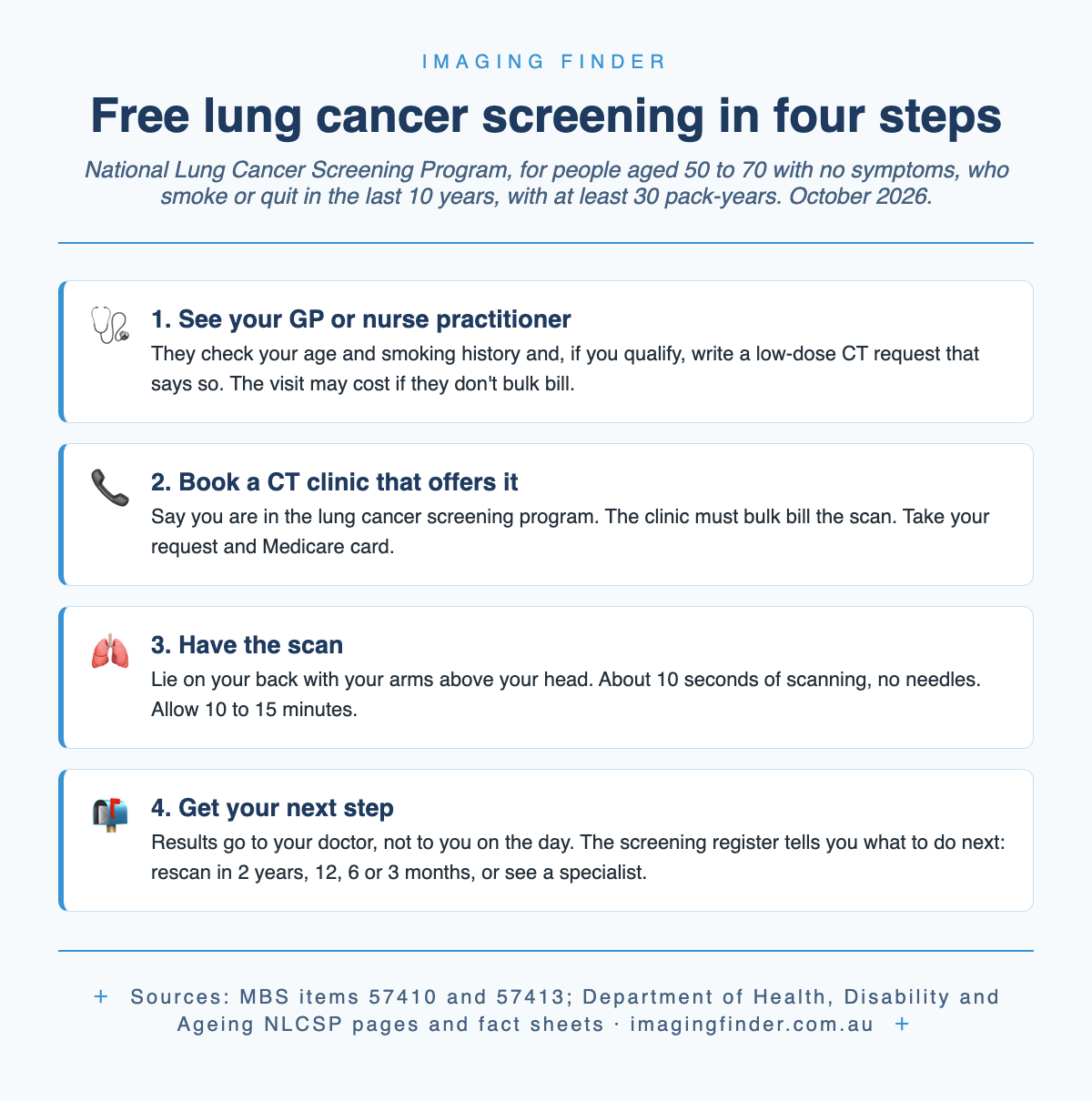
Start with a GP, nurse practitioner, specialist or other qualified clinician; a health worker at an Aboriginal Health Service can also check whether you qualify. Then book the CT yourself, online, by phone or in person. Our guide to imaging referrals explains who can request which scans.
Finding the clinic is the step people get stuck on. The Department doesn’t publish a list of screening clinics. Its advice is to ask your doctor where screening is offered in your area. Radiology practices need no extra accreditation to provide the scan, so any CT practice can choose to offer it, but not every one does.
Our CT search lists clinics with CT in each capital: Sydney, Melbourne, Brisbane, Perth, Adelaide, Canberra, Hobart and Darwin. Three examples of clinic groups that publish a lung screening service, checked on 24 October 2026 (examples, not a ranking or a full list):
- Canberra Imaging Group, Bruce lists CT. The group accepts lung screening requests written on another radiology group’s form.
- Benson Radiology, Adelaide lists CT, and the group publishes its program request guidance.
- I-MED Radiology offers bulk-billed screening scans, with online booking to pick a time and location.
For a group, ask which of its sites do screening; not every branch with CT offers it.
Ask the clinic when you book
✓ “Do you do National Lung Cancer Screening Program scans at this site, bulk billed?”
✓ “My last screening scan was at [clinic]. Can you get those images to compare?”
For remote communities more than 30 km from a fixed radiology service, the program schedules five mobile screening trucks. The Department’s start dates are:
- Mid and north WA, including the Kimberley and Pilbara: from November 2025
- Northern Territory: from May 2026
- Queensland: from September 2026
- NSW, Victoria and Tasmania: from January 2027
- South Australia and southern WA: from May 2027
The communities on each route are subject to change, so ask your GP or health service when the truck is next due.
What happens at the scan
Bring your request and Medicare card, and plan to take off jewellery. You may be asked whether you can keep your arms up for five to ten minutes; if that or getting onto the table is hard, tell the clinic when you book.
On the table you lie on your back with your arms above your head and hold your breath for a few seconds. The scan itself takes about 10 seconds, with no needles and no contrast injection. The whole appointment usually takes 10 to 15 minutes.
If radiation worries you, our CT radiation guide puts CT doses in context.
You won’t get a result on the day. A radiologist reads the scan, and the report goes to your doctor and the National Cancer Screening Register.
Here is the one thing I’d ask every screening patient to do: if you change clinic groups between rounds, tell the new clinic where your last scan was done. On a follow-up scan, the comparison is the most useful information I have. A nodule that hasn’t changed in a year tells me far more than one measurement on one day. The register passes earlier screening reports to the radiologist, but not the images.
What your result means
Results aren’t sent to you directly. Your doctor gets the report, and the register sends you a letter or text message (or an email) with your next step. The category on the report decides what happens next:
Categories and intervals are from the Department’s results fact sheet and program pathway, October 2026.
“Nodule” is the word that frightens people, and it shouldn’t on its own. It means a small lump, not a diagnosis. Nodules turn up in up to half of the people screened, and most are not cancer. Often they are scarring from past lung infections.
The nodule’s size and appearance set the interval, which is why most of the table above is about when to scan again.
Follow-up scans at 3, 6 or 12 months are billed under item 57413, which is also bulk billed. Each scan, including each follow-up, starts with a visit to your GP or nurse practitioner for a suitability check and a new request, which may cost if they don’t bulk bill. After a very low risk result you go back in two years, and your smoking history isn’t reassessed.
The scan also sees the lower neck, the rest of the chest and the upper abdomen. It may show something that isn’t cancer, such as emphysema or heart disease. That goes in the report as an additional finding for your doctor to follow up, and you may still be able to keep screening. If you want help reading the report, our guide to reading a radiology report walks through the usual sections.
Common questions
Can I have my next scan before the two years are up?
Yes, by up to three months. The register sends a reminder three months before your next round is due, and the screening item can be claimed in those three months. There is no deadline after two years: a late scan is still covered, as long as you are under 71, still have no symptoms and have a new request from your GP or nurse practitioner.
Do I have to join the screening register?
No. Joining is optional, and you can still have the free scan if you say no. You just won’t get automatic reminders or next-step letters, so you and your GP will need to keep track of when your next scan is due.
I quit 15 years ago. Can I join?
No. A new participant must smoke now or have quit within the last 10 years. The longer allowance applies only to people already in the program.
How we know: sources and method
Eligibility, item wording and the $347.55 Schedule fee come from Medicare items 57410 and 57413 and explanatory note IN.2.3, read on MBS Online on 24 October 2026; the fee was updated on 1 July 2026. Program steps, results categories and the mobile screening details are from the Department of Health, Disability and Ageing’s program pages, fact sheets and September 2026 leaflet, read the same day. Clinic examples were checked against our directory listing and each clinic group’s own lung screening page on 24 October 2026. Whether a particular branch offers screening can change, which is why the booking question above matters.
This article is general information, not personal medical advice. Discuss your individual report and next steps with the healthcare professional responsible for your care.

Author: Dr. Mark Bekhit
Dr Mark Bekhit (MBChB, FRANZCR) is a musculoskeletal radiologist practising in Brisbane and an AHPRA-registered specialist in diagnostic radiology (MED0002920947). He spends as much time building software as reading scans: he founded Imaging Finder (Australia) and Radiology Clinics NZ to make imaging easier to find, and builds radiology dictation and pain-tracking tools with one aim — better patient outcomes and a smoother reporting workflow. Outside the reading room he's usually training, bringing the same performance mindset to imaging.
Leave a Reply