By Dr. Mark Bekhit, Radiologist · Last updated October 2026
Short answer: A breast ultrasound costs nothing if the clinic bulk bills it. Otherwise, Medicare pays $109.35 towards a scan of both breasts, or $98.45 for one, and you pay the rest. Breast ultrasound is bulk billed less often than abdominal, pelvic or shoulder ultrasound: in 2023–24, about half of people having both breasts scanned paid a gap, typically $115. In price lists we checked in October 2026, the breast ultrasound gap without a concession card started at $90 to $170. You need a written request from your doctor for the full Medicare benefit.
On this page
• How much does a breast ultrasound cost?
• Does one breast cost less than both?
• How often do people pay a gap?
• Why is breast ultrasound bulk billed less often?
• What if you are having a mammogram as well?
• Who can request it, and can BreastScreen do it?
How much does a breast ultrasound cost?
Two things decide it: whether the clinic holds a written request from your doctor, and whether it bulk bills the scan.
The Schedule fee is the amount Medicare sets for each scan; these are the fees from 1 July 2026, for scans outside hospital. Clinics set their own fees, so the Schedule fee is not a price. If the clinic does not bulk bill, expect to pay the full fee on the day; if it can, the clinic will claim your Medicare benefit on the spot, paid back to your card or bank account, so you end up out of pocket only the gap. The 2023–24 figures are from the Department of Health’s Medical Costs Finder, the latest year it publishes.
Does one breast cost less than both?
Barely. Medicare pays only $10.90 more for both breasts than for one. The bigger difference is whether the clinic has your doctor’s request before the scan.
“Medicare pays” is the 85% benefit when the clinic does not bulk bill. A request has to be in writing and reach the clinic before the scan; without it, the clinic can bill only the lower item. A request does not expire, so an old form you never used still counts.
How often do people pay a gap?
More often than for other common ultrasounds. In 2023–24, 52% of people who had both breasts scanned paid nothing, and 64% for one breast. For a pelvic, abdominal or shoulder ultrasound it was 74% to 83%. The typical gap, for those who paid one, was similar across all of them: about $104 to $120.
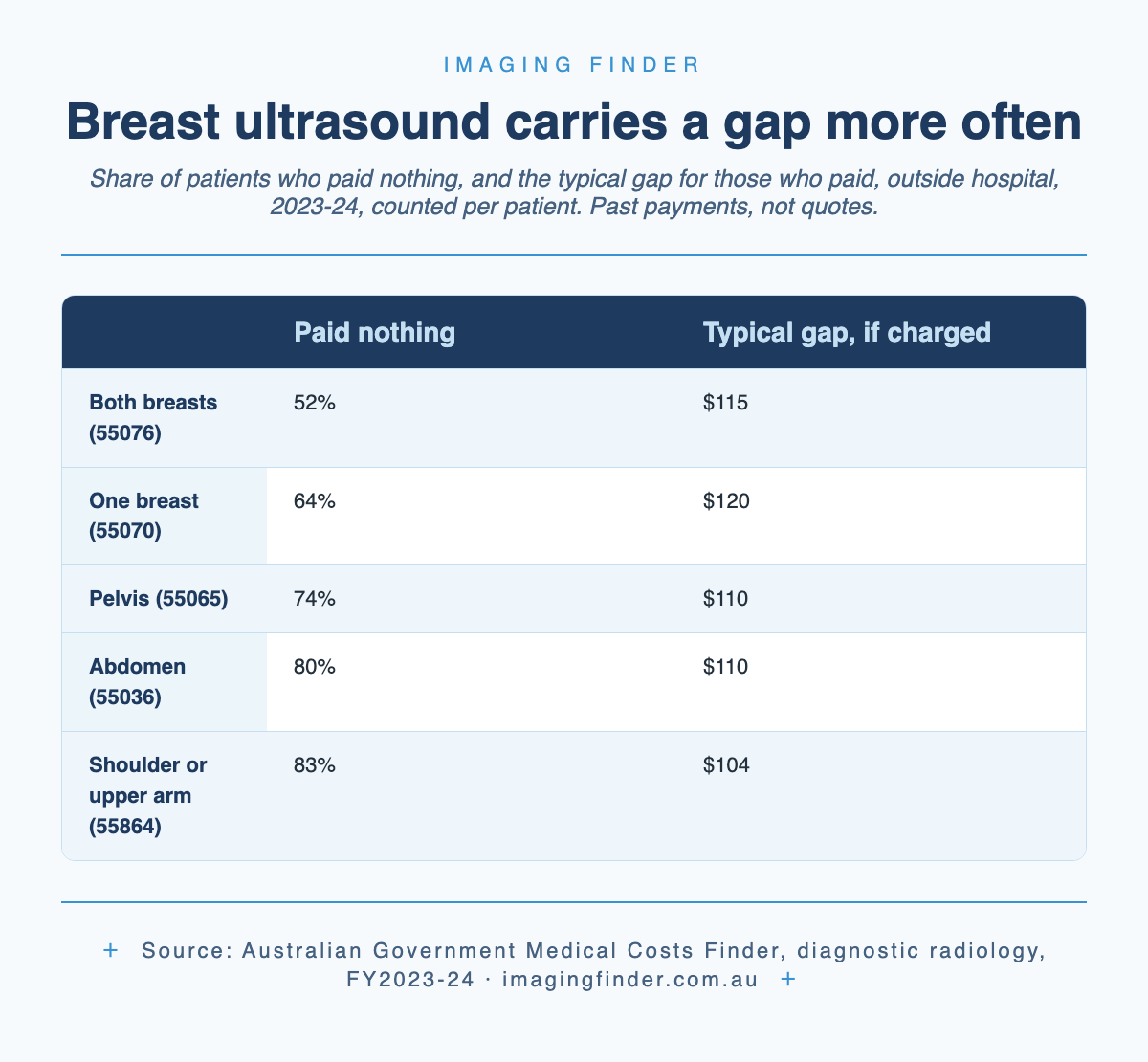
“Paid nothing” is the share of all patients billed that item outside hospital. The typical gap is the middle amount among those who paid, not an average across everyone. Where you live matters too.
Medical Costs Finder, both breasts and one breast, 2023–24. No Northern Territory figure is published. These are past payments, not quotes.
Why is breast ultrasound bulk billed less often?
Clinic price lists show it. Two of the four guides below bulk bill a general ultrasound but list a gap for a breast ultrasound; the other two charge a gap for both. These are published gaps for patients without a concession card (I-MED lists minimums), read on 13 October 2026:
All three I-MED guides bulk bill breast ultrasound and mammograms for pensioners and Health Care Card holders, and Exact bulk bills breast ultrasound for concession and pension card holders. Harbour Radiology lists a $90 gap for a mammogram and ultrasound of both breasts together, and says some of its practices can bulk bill breast imaging.
Why the difference? This is my view as a radiologist, not a published policy.
A breast ultrasound is a careful, whole-organ examination. The examination covers each breast and the armpit beside it, usually over 15 to 30 minutes. Sometimes a radiologist checks the images before you leave, and may come in to watch the scan or examine the breast if you have a lump or skin change. Yet Medicare pays exactly the same for both breasts as for a shoulder ultrasound. Many clinics close that difference with a gap.
Good to know: “We bulk bill ultrasound” may not include breast ultrasound. When you ring, name the scan: “a breast ultrasound, both sides”, and ask about that fee.
What if you are having a mammogram as well?
Then there are two Medicare items and two possible gaps. If you have a lump or another symptom and are having a mammogram, you may also have an ultrasound. A diagnostic mammogram of both breasts is item 59300, when there is a breast symptom found on examination, a past breast cancer, or a significant family history of breast or ovarian cancer: Schedule fee $105.40, Medicare pays $89.60. In 2023–24, 62% of patients paid nothing for it; those who paid typically paid $160.
The clinic examples above show how the two add up. At I-MED’s Chatswood group, the minimum private gaps are $120 for each scan. Harbour lists a $90 gap for the pair. One request form can order both scans, but every scan on it must be done within 14 days of the first. The difference between a free BreastScreen mammogram and a diagnostic one is covered in BreastScreen vs a diagnostic mammogram.
Who can request it, and can BreastScreen do it?
Your GP or a specialist can request a breast ultrasound. So can a participating nurse practitioner, although a nurse practitioner cannot request the Medicare mammogram items. A midwife’s list has no breast items.
BreastScreen Australia is free, but it is a screening mammogram service for women aged 40 and over without signs or symptoms. Extra screening ultrasound, for example for dense breasts, is only available outside the BreastScreen program, after a GP referral, and a Medicare rebate for it is only available in specific circumstances. A screening-only scan may cost the full fee, so ask the clinic whether Medicare will pay anything towards yours before you book. If you notice a breast change, see your GP rather than booking a screen. In younger women with symptoms, ultrasound is often the first test, because denser breast tissue makes a mammogram harder to read. If you have been told you have dense breasts, see whether you need an ultrasound as well.
Where to book, and what to ask
Your request form can go to any clinic you choose, even if it is printed with another clinic’s name. Start with the directory pages for Sydney, Melbourne, Brisbane, Perth or Adelaide ultrasound clinics. If your form also asks for a mammogram, the matching mammography pages (Sydney mammography, Melbourne mammography, Brisbane mammography, Perth mammography, Adelaide mammography) list clinics with mammograms; ask whether they do the ultrasound at the same visit. Our directory has no breast ultrasound filter yet.
Five directory listings whose clinic group publishes a breast imaging price, checked on 13 October 2026. They are examples, not a ranking or a full list:
- I-MED Radiology Chatswood (breast ultrasound from $120)
- I-MED Radiology Newtown (from $90)
- I-MED Radiology Craigieburn (from $170)
- Exact Radiology Springfield ($100)
- Harbour Radiology North Sydney (the group lists a $90 gap for a mammogram and ultrasound together; some of its practices bulk bill)
Ask the clinic when you book
✓ “Do you bulk bill a breast ultrasound, not just general ultrasound?” If you have a concession card, say so.
✓ “If not, what is the fee, and how much will Medicare pay back?” Medical Costs Finder suggests asking for a written estimate.
✓ “My form also asks for a mammogram. Can you do both on the same day, and what is the total?”
✓ “Can I have a female sonographer?” You can ask, and someone can stay with you.
For other scans, the ultrasound cost guide compares abdominal, pelvic, pregnancy and shoulder prices, and our bulk-billing guide explains how clinics decide.
Common questions
Does private health insurance pay for a breast ultrasound?
No, not as an outpatient. By law, private health insurance cannot cover out-of-hospital diagnostic imaging; Medicare covers it. Hospital cover helps only when you are treated as a private patient in hospital.
What does a breast biopsy cost if I need one?
Ultrasound is commonly used to guide a biopsy needle, and it has its own fee. In the same price guides, the imaging clinic’s minimum private gap for an ultrasound-guided core biopsy is $160 to $195 at I-MED’s Sydney groups, and Exact Radiology lists $250 for a breast core biopsy or fine needle aspiration. Your doctor will explain whether you need one.
Do I need to prepare, and how long does it take?
No preparation is needed. Wear a two-piece outfit, so you only remove your top. You lie on a bed while gel and a small probe are moved over each breast and armpit, usually for 15 to 30 minutes. It has no after effects, and the report goes to your doctor.
How we know: sources and method
Item wording, Schedule fees and benefits come from the Medicare Benefits Schedule, read on 13 October 2026 (fees updated 1 July 2026). The requester lists and the 14-day rule are from note IN.0.6; the written-request rule is from Services Australia. What patients paid is the Department of Health’s Medical Costs Finder, filtered to diagnostic radiology, out of hospital, 2023–24, counted per patient, the same filter as our ultrasound cost guide and pelvic ultrasound cost guide. Clinic gaps are from each group’s own published price guide or page, read on 13 October 2026; guides change. The description of the scan is from InsideRadiology, the patient site of the Royal Australian and New Zealand College of Radiologists. The reason breast ultrasound carries a gap more often is my judgement as a radiologist.
This article is general information, not personal medical advice. Discuss your individual report and next steps with the healthcare professional responsible for your care.

Author: Dr. Mark Bekhit
Dr Mark Bekhit (MBChB, FRANZCR) is a musculoskeletal radiologist practising in Brisbane and an AHPRA-registered specialist in diagnostic radiology (MED0002920947). He spends as much time building software as reading scans: he founded Imaging Finder (Australia) and Radiology Clinics NZ to make imaging easier to find, and builds radiology dictation and pain-tracking tools with one aim — better patient outcomes and a smoother reporting workflow. Outside the reading room he's usually training, bringing the same performance mindset to imaging.
Leave a Reply