By Dr. Mark Bekhit, Radiologist · Last updated August 2026
The quick answer
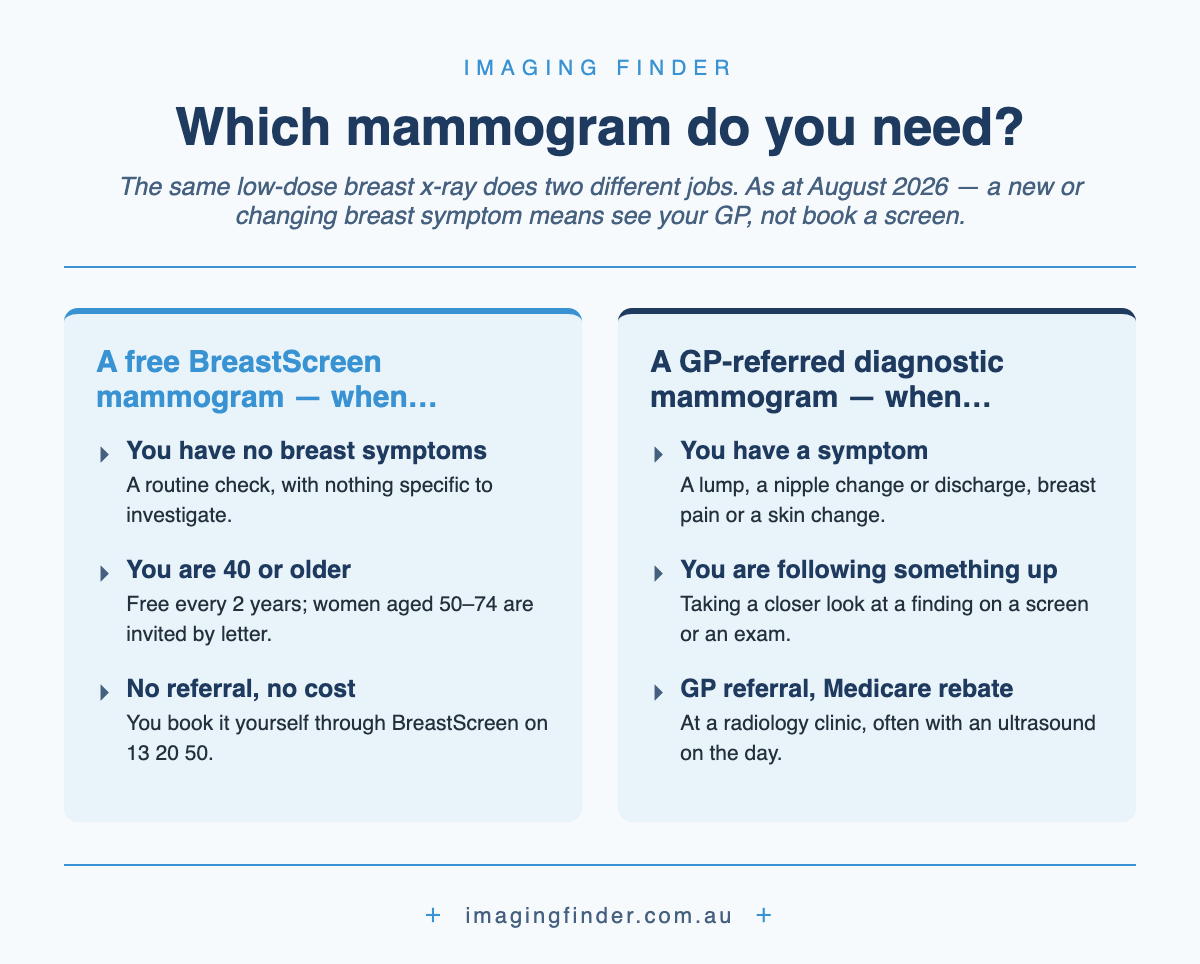
Short answer: A BreastScreen mammogram and a diagnostic mammogram are the same low-dose breast x-ray doing two different jobs. If you have no breast symptoms, the right test is a free screening mammogram through BreastScreen Australia — no referral, free, every two years from age 40. If you have a symptom or a finding to check — a lump, a change in the nipple, breast pain — that is a diagnostic mammogram — GP-referred, with a Medicare rebate. The one rule to remember: a new or changing breast symptom means see your GP, not book a screen.
On this page
- The one difference that decides which you need
- Side by side: BreastScreen vs diagnostic
- The free pathway: a BreastScreen mammogram
- The referred pathway: a diagnostic mammogram
- What a diagnostic mammogram costs
- How to prepare and what to tell the clinic
- Find a mammography clinic near you
- Common questions
- How we know: sources and method
The one difference that decides which you need
Both tests are a mammogram — a low-dose x-ray of the breast that finds changes too small to see or feel. Same machine, same few seconds of compression. What separates them is not the picture; it is the question being asked.
A screening mammogram goes looking for a hidden cancer in someone who feels perfectly well. It is a fishing expedition, by design, in people who do not have any symptoms. A diagnostic mammogram is the opposite: it investigates something specific — a lump, tenderness, nipple discharge or a skin change that you or your doctor have already noticed — to sort out whether it is harmless or needs more work.
That distinction is not just wording. It sets who can order the test, where you go, and who pays. The single point worth holding onto is this: if you have found a lump or noticed a change, a free screening appointment is not the fast way to get it checked. Screening is built for people without symptoms. A symptom needs the diagnostic pathway, which starts with your GP.
Side by side: BreastScreen vs a diagnostic mammogram
Found a lump or a change? See your GP — don’t book a screen. A new or changing lump, breast pain, a change in the nipple or discharge, or puckering of the skin all mean you should see your doctor as soon as possible; they will arrange a diagnostic mammogram, usually with an ultrasound. BreastScreen is for people without symptoms, and Medicare’s own rule says the diagnostic items are not for screening people who have no symptoms — the two pathways really are separate.
The free pathway: a BreastScreen mammogram
BreastScreen Australia is the national screening program, run by every state and territory. It exists because breast cancer is common — about 1 in 7 Australian women develop it in their lifetime — and because catching it before it can be felt gives the best chance of successful treatment.
The eligibility is generous and the rules are simple. Women aged 50 to 74 are invited by letter to a free mammogram every two years; that is the age band where the benefit is clearest. If you are 40 to 49, or 75 and over, you can still be screened free of charge — you simply will not get an invitation in the mail, so you book yourself. You do not need a doctor’s referral, and there is no preparation. You call BreastScreen on 13 20 50, attend, and your result is posted to you about two weeks later.
One honest caveat, because screening is a numbers game rather than a guarantee. A screening mammogram can occasionally return a false positive — a result that looks suspicious but turns out fine after more tests — and, less often, can miss a cancer that is present. That is normal for any screening test, and it is a reason to keep going back on schedule rather than to skip it. If you are 40 to 49, or you have a family history and are wondering whether to start earlier, that is worth a conversation with your GP, who can weigh your own risk.
The referred pathway: a diagnostic mammogram
A diagnostic mammogram is what happens when there is something to explain. Your doctor refers you because you have a lump or another breast change, or to take a closer look at something a screening mammogram flagged. In practice it is a more tailored study: the radiographer takes at least two views of each breast and often extra, targeted pictures of the area of concern, and you will often have an ultrasound on the same visit. If anything needs sampling, your doctor may arrange a biopsy — but that is a separate step, decided on what the images show.
Here the radiologist earns their place. A screening service is set up to sort a large number of well people into “clear” or “come back for a closer look”. A diagnostic service is set up to answer a specific question about one person on the day, with the extra views, the ultrasound and the radiologist’s read all in one place. That is why a symptom belongs here and not in the screening queue — not because BreastScreen is careless, but because it is built for a different task.
What a diagnostic mammogram costs
Screening through BreastScreen is free, so cost only really comes up on the diagnostic side. When your GP refers you, Medicare pays a set rebate and the clinic decides whether to bulk bill or charge a gap on top. The Schedule fee is the government’s benchmark price; the 85% benefit is what Medicare pays back for an out-of-hospital service. These figures are current as at the 1 July 2026 Schedule.
What you actually pay depends on the clinic. Many bulk bill a referred diagnostic mammogram, in which case you pay nothing; others charge a gap above the rebate, and you may also have an ultrasound on the day with its own item (see what a breast ultrasound costs). If your mammogram reported dense breasts, see whether you need an ultrasound as well. The only reliable way to know your number is to ask the practice when you book — the checklist below has the exact questions.
How to prepare and what to tell the clinic
A screening mammogram needs no preparation at all. For a diagnostic mammogram, a few small things make the visit easier and the images clearer:
Ask the clinic when you book
✓ “Do you bulk bill this on my GP’s referral, and if not, what is the gap?”
✓ “I have breast implants” — if you do, say so, as they book a longer appointment.
✓ “Should I book about a week after my period starts?” — the breasts are less tender then, if that applies to you.
✓ Bring any previous mammograms, and skip deodorant, perfume, lotion or talc on the day — they can show up as shadows.
None of this changes the result; it just avoids a repeat picture or a rebooking. And a practical note on the compression everyone asks about: it is firm and can be uncomfortable, but it lasts only a few seconds per view, and it is what lets a low dose of x-ray see through the tissue clearly.
Find a mammography clinic near you
If your GP has referred you for a diagnostic mammogram — or your doctor has referred you to a private clinic for a screening mammogram outside BreastScreen — you can choose any radiology practice that offers mammography. To find one nearby, use Imaging Finder’s national radiology directory, or go straight to mammography clinics in Sydney, Melbourne, Brisbane or Perth (examples listed in our directory as at August 2026), and ring ahead with the questions above. These are examples, not a ranked list, and services change, so confirm the clinic still offers mammography before you go.
For a free screening mammogram, you do not use the directory at all — you book straight through BreastScreen Australia on 13 20 50. If you are still sorting out the referral, our guide to getting a referral for scans explains how that works, and Medicare-eligible scans by modality sets mammography alongside the other tests Medicare helps pay for. After the visit, how to read your radiology report helps you make sense of the wording.
Common questions
I’ve found a lump — should I book a BreastScreen appointment?
No. See your GP as soon as you can. A lump or any new breast change needs a diagnostic work-up, which your doctor arranges — usually a diagnostic mammogram and an ultrasound together. BreastScreen is designed for people without symptoms and is not set up to investigate a specific lump, so going there first can slow things down. Your GP is the fastest route.
Do I need a referral for a mammogram?
It depends which one. A screening mammogram through BreastScreen needs no referral — you book it yourself from age 40. A diagnostic mammogram, and any mammogram at a private radiology practice with a Medicare rebate, does need a referral from your GP or another doctor.
I’m 45. Can I get a free mammogram?
Yes. Women aged 40 to 49 can be screened free through BreastScreen, you just will not receive an invitation letter — so you book yourself on 13 20 50. If you have a family history or another reason to think your risk is higher, it is worth asking your GP whether you should start regular screening now.
Is a mammogram safe?
Yes. It uses a low dose of x-ray radiation, and for the ages screening targets the benefit of finding cancer early clearly outweighs that small dose. When there is a symptom, the value of getting a clear answer about it is greater still.
How we know: sources and method
The eligibility ages, the two-yearly interval, the free-screening rule and the “no symptoms” scope of screening are from the Australian Government’s BreastScreen Australia program pages and from healthdirect. The referral rules, what each test involves and how to prepare are from InsideRadiology, the patient-information service of the Royal Australian and New Zealand College of Radiologists (RANZCR), and from healthdirect. The diagnostic item numbers, the “not for screening” rule, the $105.40, $63.55 and $238.00 Schedule fees and their 85% benefits are taken directly from the Medicare Benefits Schedule, current as at the 1 July 2026 Schedule. The screening pathway and eligibility describe program rules; whether you should start screening at a given age, and any decision about a symptom, are for your GP.
- Australian Government, Department of Health and Aged Care: About the BreastScreen Australia program — eligibility, interval, funding, results
- healthdirect: mammography — the two uses, screening ages, cost, risks and when a diagnostic mammogram is needed
- InsideRadiology (RANZCR): screening mammography and diagnostic mammography — referral rules, what happens, preparation and the symptom rule
- Medicare Benefits Schedule: diagnostic mammography items 59300, 59303 and 59302 — descriptors, the no-screening note, fees and benefits
This article is general information, not personal medical advice. Discuss your individual report and next steps with the healthcare professional responsible for your care.

Author: Dr. Mark Bekhit
Dr Mark Bekhit (MBChB, FRANZCR) is a musculoskeletal radiologist practising in Brisbane and an AHPRA-registered specialist in diagnostic radiology (MED0002920947). He spends as much time building software as reading scans: he founded Imaging Finder (Australia) and Radiology Clinics NZ to make imaging easier to find, and builds radiology dictation and pain-tracking tools with one aim — better patient outcomes and a smoother reporting workflow. Outside the reading room he's usually training, bringing the same performance mindset to imaging.
Leave a Reply