By Dr. Mark Bekhit, Radiologist · Last updated August 2026
The quick answer
Short answer: It depends on the scan. Ultrasound and MRI use no radiation, so they are the tests your doctor prefers in pregnancy. X-ray, CT and nuclear-medicine scans use a small amount — but almost all imaging exposes a baby to such low levels that it is not a cause for concern, and a single needed scan sits well below the level at which harm would be expected. The one thing you must do is tell the clinic if you are, or might be, pregnant, and let your doctor choose the test.
On this page
- Which scans use radiation, and which use none
- The scans your doctor prefers in pregnancy
- X-ray, CT and nuclear medicine: how worried to be
- Already had a scan before you knew?
- Contrast dye when you are pregnant or breastfeeding
- What to tell the clinic when you book
- Find an ultrasound or MRI clinic near you
- Common questions
- How we know: sources and method
This guide is about scan safety in pregnancy. For what each pregnancy ultrasound costs and which Medicare item pays for it, see our guide to pregnancy ultrasound costs and Medicare.
Which scans use radiation, and which use none
Almost every worry about imaging in pregnancy comes down to one question: does this test use ionising radiation — the same kind of exposure as an ordinary X-ray — or not? It is the first thing a radiologist checks too. Two of the common scans use none at all. Ultrasound and MRI do not use or produce any ionising radiation; an MRI works with strong magnets and radio waves instead of X-ray radiation. X-rays, CT scans and nuclear-medicine tests do use radiation, more for a CT than for a plain X-ray.
Knowing which column a test sits in is most of the answer. If your doctor can get what they need from an ultrasound or an MRI, that is usually the path in pregnancy. When a scan that uses radiation is the right test, the sections below explain how small that radiation really is — and why a scan a doctor has asked for is worth having.
The scans your doctor prefers in pregnancy
Ultrasound is the workhorse of pregnancy for good reason. It uses high-frequency sound waves rather than radiation, which is what makes it so safe, and there are no proven harmful effects of sound waves at the levels used in a proper clinical setting. It is considered safe even during pregnancy and is used routinely — the familiar dating and growth scans at 11–14 weeks and 18–22 weeks are ultrasounds. It is also the first test for many unrelated problems that crop up while you are pregnant, from a sore gallbladder to a swollen leg.
MRI is the other radiation-free option. Because it uses magnets and radio waves and no X-ray radiation, it is an alternative your doctor may choose when an ultrasound cannot show enough — for example to look closely at the brain, spine or abdomen. Two practical points: some people cannot have an MRI, such as those with a pacemaker or certain metal implants, so the clinic will screen you; and if the scan would normally use a gadolinium contrast injection, that is usually avoided in pregnancy unless it is absolutely essential. Many MRI scans in pregnancy are done without any dye at all.
Good to know: “No radiation” does not mean “book it yourself”. Even an ultrasound should be the test your doctor has decided you need — the pregnancy still shapes how the scan is done and what the person scanning you is looking for.
X-ray, CT and nuclear medicine: how worried to be
This is where the real fear lives, so let me be plain about it. Yes, X-rays, CT and nuclear medicine use ionising radiation, and it is best to avoid exposing your abdomen to radiation while you are pregnant where another test will do. But two facts should take the edge off the panic.
First, the amount is genuinely small. Everyone is exposed to radiation all the time: the natural background radiation each of us receives every year in Australia is equivalent to about 50–100 ordinary chest X-rays. Against that everyday backdrop, almost all imaging tests expose a baby to such low levels of radiation that they are not a cause for concern. The international body that sets radiation-safety limits (the ICRP) puts the threshold below which harm to a baby would not be expected at 100 mGy — and even the highest-dose examinations give a foetus a dose, from a single scan, that is well below that threshold.
Second, being pregnant does not make you more vulnerable to the radiation: a pregnant woman is no more sensitive to radiation than any other woman of the same age. The care taken is about the baby, and it is precautionary, not a sign of real danger from one scan.
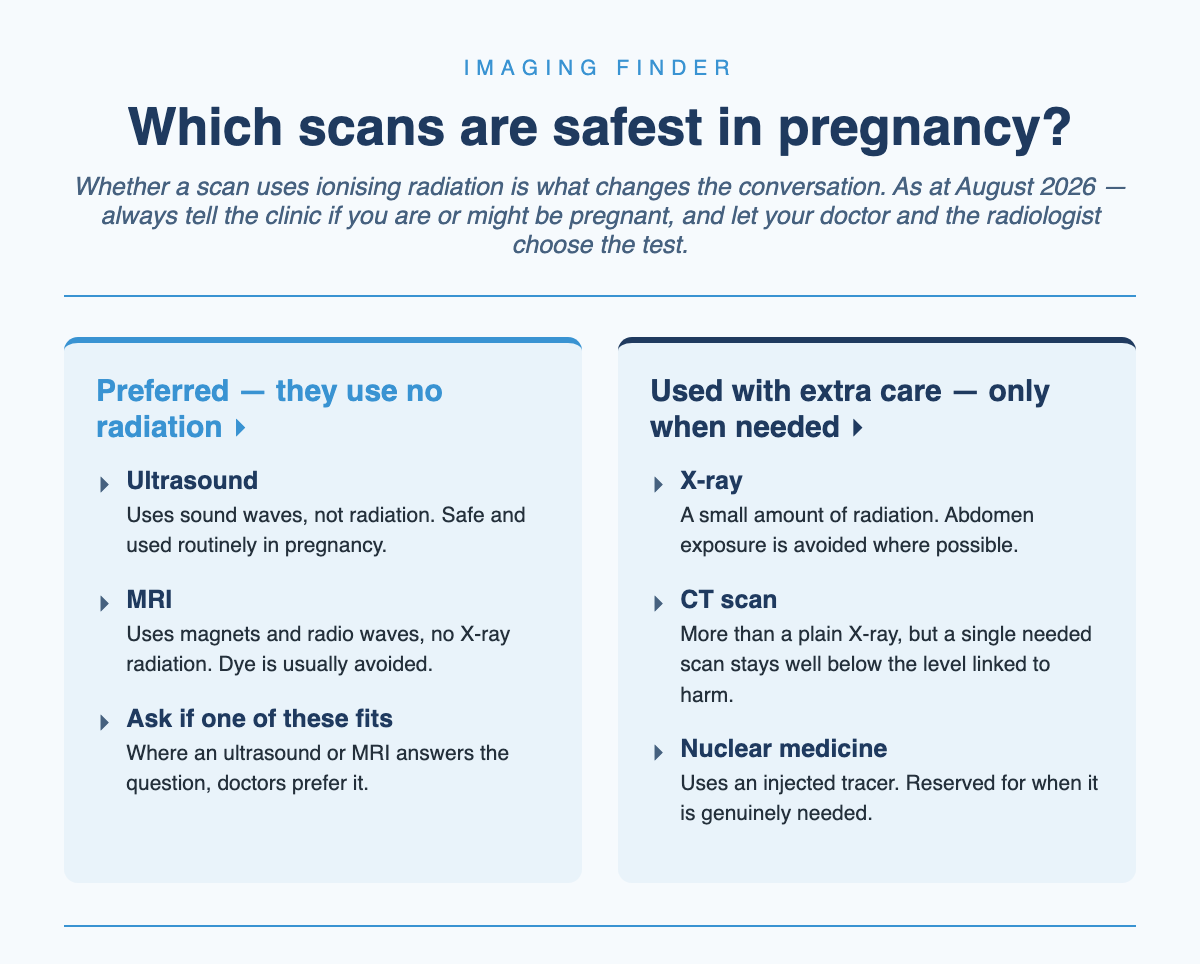
What a radiologist will not do is hand you a personal number. Radiation risk cannot be calculated for any one person — the estimates are averages across whole populations, and everyone’s sensitivity differs. So the honest framing is the one your doctor uses: the risk of a needed scan is very small, and it is weighed against the risk of not finding out what is wrong. A serious problem in the mother that goes undiagnosed is itself a danger to the pregnancy. When a CT or X-ray is genuinely the right test, having it is the safe choice, because the risk of the scan should be outweighed by the benefit of finding out what is wrong. (Nuclear-medicine scans are the one type that briefly makes you slightly radioactive for a short time, because they use an injected tracer; these are used in pregnancy only when clearly needed.)
Already had a scan before you knew?
This is the message I most often give in person, so I will give it here too. If you had an X-ray or a CT before you realised you were pregnant, the odds are overwhelming that everything is fine. The dose from a single examination is well below the level at which harm would be expected, and even after one of the higher-dose tests, experts are clear this would not, on its own, be a reason to consider ending a pregnancy over fears about the baby.
If you are worried about a scan you already had: take the details — which scan, which part of the body, roughly how many weeks pregnant — to your doctor. Any concern at all about radiation exposure in pregnancy is worth discussing with your doctor, who can look at your actual test rather than a worst case, and reassure you properly.
Contrast dye when you are pregnant or breastfeeding
“Contrast” is the dye that makes certain scans clearer, and there are two different kinds — they are not the same, and they follow different rules. It is worth keeping them apart.
Gadolinium is the dye used with some MRI scans. If you are pregnant or might be, you are unlikely to be given a gadolinium injection unless it is absolutely essential, and the clinic screens for pregnancy before any MRI. If you are breastfeeding, though, you can relax: it is safe to keep breastfeeding normally after gadolinium — there is no need to express and throw milk away, because the amount that could reach your baby is far too small to matter.
Iodinated contrast is the dye used with some CT scans. It does not itself give off radiation — it is a chemical that shows up on X-rays. In pregnancy the picture is reassuring but honest: there is no medical evidence that it harms an unborn baby, though there are no large studies that prove it is completely safe, and there is a small possibility it could affect the baby’s thyroid function. Because of that, a newborn’s thyroid may be checked in the first week — which already happens routinely for every baby born in an Australian hospital as part of the standard newborn screening. Breastfeeding is fine here too: less than a thousandth of the dose passes into breast milk, so there is no need to stop.
Both contrast questions come up as separate decisions from the scan itself. If you want the fuller picture, our guides to gadolinium (MRI) contrast safety and CT contrast dye safety go through kidneys, reactions and more.
What to tell the clinic when you book
The single most useful thing you can do is speak up early. If you are scheduled for any kind of medical imaging and you are, or might be, pregnant, tell your doctor and the practice — it can change which test is done, or whether it waits. A few things are worth saying out loud:
Tell the clinic when you book
✓ “I am pregnant” — or “there is a chance I could be”, and roughly how many weeks.
✓ “Is there an ultrasound or MRI that could answer the same question instead?”
✓ “Will this scan use contrast dye, and is that still needed if I’m pregnant?”
✓ “I am breastfeeding” — so staff can reassure you it is safe to keep feeding if any contrast dye is used.
✓ For an MRI: any pacemaker, metal implant or previous surgery with metalwork.
Find an ultrasound or MRI clinic near you
When your doctor has decided the test — and in pregnancy that is often an ultrasound — you can search ultrasound clinics near you on Imaging Finder, with clinics across the metros including Melbourne, Brisbane and Perth, so you can compare locations and call ahead. If your doctor has asked for an MRI, you can search MRI clinics the same way. It is worth a quick call to check the clinic offers the exact scan on your request. Our guide to preparing for an ultrasound covers what to bring, and if cost is on your mind, see what an ultrasound costs in Australia. To understand why a doctor picks one modality over another, the MRI-versus-CT guide and the Medicare guide to scans by type are good next reads.
Common questions
I had an X-ray before I knew I was pregnant — is my baby OK?
Almost certainly, yes. The dose to a baby from a single X-ray or CT is well below the level at which harm would be expected, and experts are clear that even a higher-dose test done before you knew would not, on its own, be a reason to consider ending a pregnancy. Take the details of the scan to your doctor, who can reassure you about your specific test.
Is an ultrasound safe in early pregnancy?
Yes. An ultrasound uses sound waves, not radiation, and is considered safe even during pregnancy — it is used routinely, including the early dating scan. As with any scan, have it because your doctor has recommended it rather than for a keepsake.
Can I have an MRI while pregnant?
Often, yes, when it is the test your doctor needs, because an MRI uses no X-ray radiation. The clinic will screen you for things like a pacemaker or metal implants, and any gadolinium dye is usually avoided in pregnancy unless it is essential. The decision rests with your doctor and the radiologist.
Is contrast dye safe if I am pregnant or breastfeeding?
The two dyes differ. Gadolinium (MRI) is usually avoided in pregnancy unless essential; iodinated (CT) dye has no evidence of harming a baby, with a small possible effect on the newborn’s thyroid that routine newborn screening already checks. If you are breastfeeding, you can continue normally after either dye.
How we know: sources and method
Every decisive statement here is drawn from current Australian sources, read on 25 August 2026: healthdirect, the Australian Government health-information service, on ultrasound, MRI and X-rays; and InsideRadiology, the patient-information service of the Royal Australian and New Zealand College of Radiologists (RANZCR), on the radiation risk of medical imaging during pregnancy, ultrasound, gadolinium and iodinated contrast. Radiation is described against the Australian background figure rather than overseas numbers, and no personal risk figure is quoted, because — as the sources explain — that number cannot be calculated for an individual. For the health effects of radiation, healthdirect points readers to ARPANSA, the national radiation-safety body.
This article is general information, not personal medical advice. Discuss your individual report and next steps with the healthcare professional responsible for your care.

Author: Dr. Mark Bekhit
Dr Mark Bekhit (MBChB, FRANZCR) is a musculoskeletal radiologist practising in Brisbane and an AHPRA-registered specialist in diagnostic radiology (MED0002920947). He spends as much time building software as reading scans: he founded Imaging Finder (Australia) and Radiology Clinics NZ to make imaging easier to find, and builds radiology dictation and pain-tracking tools with one aim — better patient outcomes and a smoother reporting workflow. Outside the reading room he's usually training, bringing the same performance mindset to imaging.
Leave a Reply