By Dr. Mark Bekhit, Radiologist · Last updated August 2026
The quick answer
Short answer: For most people, CT contrast dye is very safe. A metallic taste and a warm flush during the injection are normal and pass in a minute or two. Serious allergic reactions are rare — fewer than 1 in 25,000 people. If your kidneys work normally the dye is quite safe, and there is no need to stop metformin. The main things to tell the clinic when you book are any past reaction to contrast, any kidney problem, whether you take metformin, and whether you are or might be pregnant — then bring your most recent kidney blood-test result.
On this page
- What is CT contrast dye, and why is it used?
- How safe is CT contrast dye?
- Allergic-type reactions: how likely, and what happens
- Contrast dye and your kidneys
- Do I need to stop metformin?
- Contrast in pregnancy and breastfeeding
- What to tell the clinic when you book
- Common questions about CT contrast dye
- How we know: sources and method
What is CT contrast dye, and why is it used?
A CT scan is a type of X-ray that builds detailed pictures in fine slices through the body. The x-ray radiation itself is a separate question from the dye, which our guide to whether a CT scan is safe answers. For many scans, the radiologist needs an iodine-based dye, called contrast, to make blood vessels and organs stand out clearly — a CT coronary angiogram of the heart uses this same iodine dye. It is given by injection into a vein, or sometimes as a drink, and it is not radioactive — it simply changes what the pictures can show. Without it, some problems in the blood vessels, bowel or solid organs are hard or impossible to see.
One quick clarification, because the two are often confused: this article is about the iodine-based dye used for CT. MRI uses a completely different dye called gadolinium, which follows its own rules. If your scan is an MRI, the contrast points below do not apply to you.
When the dye goes in, a radiographer or nurse places a small plastic tube (a cannula) in a vein in your arm or the back of your hand. Because many contrast scans need you to fast, most clinics ask you not to eat for a couple of hours beforehand — fasting for 2–4 hours is common, and you can usually still drink water. The dye then leaves your body in your urine over the hours after the scan, which is why staff may encourage you to drink plenty of fluids afterwards.
How safe is CT contrast dye?
The honest, reassuring answer is that the injected dye is considered very safe, and the vast majority of people who have a CT scan have no after-effects at all. The precautions that do exist matter mostly for two groups: people with poor kidney function and people with diabetes. Both of those questions get their own sections below.
What almost everyone feels is not a reaction at all. As the dye is injected, most people get a strange metallic taste and a warm sensation spreading through the body. It often settles around the groin and can feel briefly as though you have wet yourself, even though you have not. This is completely normal and usually goes within a couple of minutes — it is the single most common thing patients are surprised by, and it is nothing to worry about.
A separate, minor event is a leak of dye out of the vein into the nearby tissue, which happens in about 2% of injections. It is more likely with a mechanical pump injector or when a vein is difficult, can cause local swelling and stinging, and usually settles with simple measures. Tell the radiographer straight away if your arm feels sore or tight during the injection.
Allergic-type reactions: how likely, and what happens
Allergic-type reactions to contrast are the risk people worry about most, so it helps to see the actual numbers. Allergic-type reactions occur in fewer than 3 in every 100 people, and the great majority of those are mild and brief. Reactions are unpredictable — anyone can have one, and having had contrast before without trouble does not guarantee you will be fine next time — which is exactly why every radiology practice and hospital department is set up at all times to treat them.
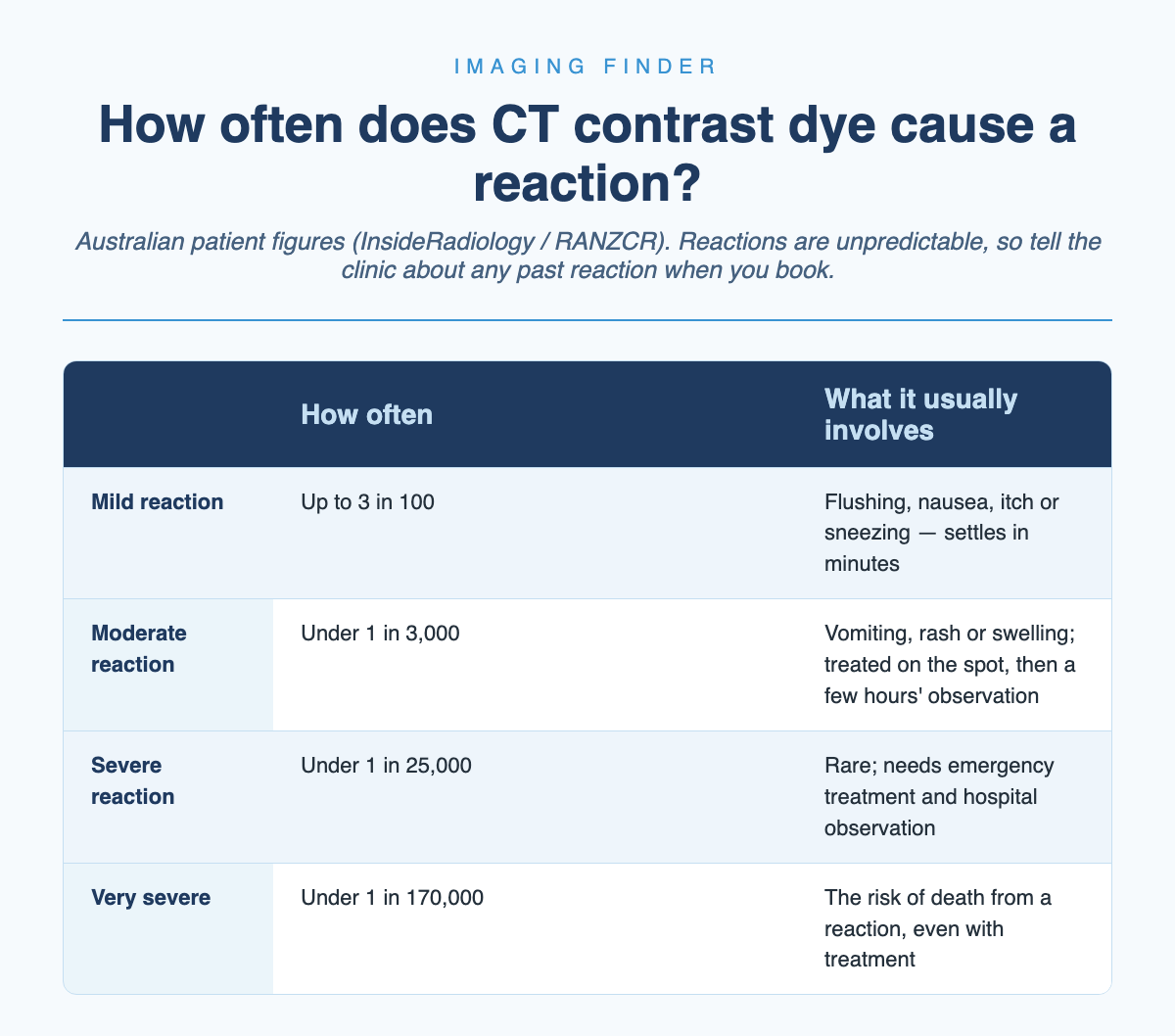
Figures are the InsideRadiology (RANZCR) patient-information rates, current as at August 2026. They describe reactions across everyone who has the dye — not a prediction for any one person.
The one action that matters here is history. If you have ever had a mild, moderate or severe reaction to contrast, tell the radiology facility when you make your appointment — not on the day. If contrast still needs to be given, the radiologist may prescribe corticosteroid tablets taken over several hours beforehand to lower the chance of another reaction. Those tablets take a few hours to work and do nothing if swallowed right before the injection, so the timing only works if the clinic knows in advance. It also helps to mention any other serious allergies to the radiographer or nurse.
Contrast dye and your kidneys
This is where most of the worry — and most of the outdated advice — sits. The key fact is simple: for people with normally functioning kidneys, contrast is quite safe. The concern applies to a smaller group. If kidney function is already severely reduced before the dye is injected, there is a risk of temporarily worsening it, and that risk is greatest with a large amount of dye — for example a heart or blood-vessel angiogram, or several contrast scans within a few days.
The everyday CT scans most people have use much smaller volumes, and some contrast carries almost no kidney risk at all: the small amounts used for joint or spinal-fluid studies, and dye that is swallowed or given into the bowel, have little or no effect on the kidneys. Occasionally the reduction in kidney function is prolonged and may need dialysis, but that generally happens in people who already have severely reduced kidney function — not in someone whose kidneys are working normally.
Because of this, the clinic will often want to know how your kidneys are working. You will probably need your most recent kidney function result available when you schedule a contrast scan — a simple blood test your GP can organise. That test reports your eGFR (estimated glomerular filtration rate), a measure of how well your kidneys filter waste. If your kidney function is low, the radiologist may give extra fluids through a drip before and after the scan to help your kidneys clear the dye. None of this should stop a genuinely urgent scan — in an emergency, the team weighs it up and can check your kidneys afterwards.
Good to know: the single most useful thing you can do before a contrast CT is have a recent kidney blood test and bring the result. It lets the clinic plan any precautions in advance, and it usually saves a delay on the day. If you cannot remember whether you have had one, ask your GP or the clinic when you book.
Do I need to stop metformin?
Metformin is a common medicine for type 2 diabetes, and the question of whether to pause it before a contrast scan causes a lot of confusion — partly because overseas advice and older rules differ. The safe way to think about it is that the decision follows your kidney function, and it is made by your doctor or the imaging practice, not by a fixed number you should apply yourself.
In practice it usually comes down to two situations. If your kidney function is normal before the contrast injection, there is no need to stop metformin at all. If your kidney function is very poor, you may be asked to stop metformin after the injected scan, wait a few days, and have your kidney function rechecked — and once it is back to your normal level, your doctor will generally advise it is safe to restart. Notice that any pause happens after the scan, not by skipping doses on your own beforehand.
What you can do to make this smooth is straightforward: because your doctor is probably already checking your kidney function regularly if you take metformin, bring your most recent result, and expect that the clinic may want it checked again close to the appointment. Do not change your diabetes medicines on your own before a scan — ask the clinic or your GP, and let them make the call for your situation.
Contrast in pregnancy and breastfeeding
Breastfeeding is the easy one. Less than one-thousandth of the dye given to the mother passes into breast milk, so there is no need to stop breastfeeding or to express and discard milk after a contrast scan. You can feed your baby as normal.
Pregnancy calls for more care, and the honest position is a measured one. There is no medical evidence that iodine contrast harms an unborn baby, but there are no large studies that conclusively prove it is safe, so giving any medicine in pregnancy is weighed carefully. There is a small theoretical concern about the baby’s thyroid; as a precaution, newborn thyroid function is checked in the first week of life — already a routine part of newborn screening in Australia. If you are or might be pregnant, tell your doctor and the clinic; the decision about whether contrast is needed is theirs to make with you. (Separately, a CT itself uses X-rays, so for anyone who is pregnant the clinic will also weigh whether a scan without radiation, such as ultrasound or MRI, could answer the question — a point our guide to MRI versus CT explains.)
What to tell the clinic when you book
Almost every precaution above works best when the clinic knows in advance. A contrast CT is not something to sort out at the reception desk on the day — a two-minute phone call when you book lets staff prepare, and often prevents a wasted trip. Have your request form in front of you and raise these points.
Tell the clinic when you book
✓ “I have had a reaction to contrast dye before” — if so, describe what happened.
✓ “I have a kidney problem” or “I’m not sure — do you need a recent kidney blood test?”
✓ “I take metformin for diabetes” — and ask what, if anything, they want you to do.
✓ “I am, or might be, pregnant” — or breastfeeding.
✓ “Do I need to fast, and can I take my usual medicines with water?”
After the scan, most people simply go back to normal eating, drinking and activity. If you develop a rash, itch, swelling or wheeze once you are home, return to the clinic if it is nearby and open, or go to your nearest emergency department. A severe allergic reaction (anaphylaxis) — trouble breathing, throat tightness or feeling faint — is a medical emergency: call triple zero (000) and ask for an ambulance. Late reactions are uncommon, but knowing the plan means you never have to guess.
When you are ready to book, start with the national radiology clinic directory, or go straight to CT clinics in Brisbane, Sydney, Melbourne or Perth, and use the questions above with each clinic. For the money side of the same scan, see our guide to what a CT scan costs in Australia; for who can request one, our guide to referrals for an X-ray, ultrasound or CT; and for what Medicare covers across scans, our guide to Medicare-eligible scans by modality. Once the results are back, our guide to reading your radiology report helps you make sense of them.
Common questions about CT contrast dye
Is CT contrast dye safe?
For most people, yes — the injected iodine dye is considered very safe, and the vast majority of people have no after-effects at all. Reactions of any kind happen in fewer than 3 in 100 people, and most of those are mild and brief. Serious reactions are rare, and clinics are equipped to treat them. The main precautions apply to people with poor kidney function or diabetes, so the clinic asks about those when you book.
Can I have contrast dye if I have kidney problems?
Often yes, but it depends on how reduced your kidney function is and how much dye is needed. With normal kidneys the dye is quite safe; with severely reduced function there is a risk of temporarily worsening it, especially with large volumes. The clinic will usually want a recent kidney blood test and may give extra fluids through a drip. The radiologist decides based on your kidney function — so give the clinic your most recent result when you book.
Do I have to stop metformin before a CT with contrast?
Not usually. If your kidney function is normal before the injection, there is no need to stop metformin. If it is very poor, you may be asked to stop metformin after the scan and have your kidney function rechecked before restarting. It is an individual decision made by your doctor or the imaging practice, not a fixed rule to apply yourself — so bring your most recent kidney result and do not change your diabetes medicines on your own.
What does the contrast injection feel like?
Most people feel a metallic taste and a warm sensation spreading through the body as the dye goes in. It can briefly feel as though you have wet yourself, even though you have not. This is completely normal and usually passes within a couple of minutes — it is not an allergic reaction.
Can I have contrast dye if I’m pregnant or breastfeeding?
Breastfeeding is not a barrier: less than one-thousandth of the dose reaches breast milk, so you do not need to stop feeding. In pregnancy, there is no evidence the dye harms the baby, but no large studies proving it is fully safe, so the decision is made carefully with your doctor. Tell the clinic if you are or might be pregnant.
What should I do if I feel unwell after the scan?
Minor sensations settle quickly. If a rash, itch, swelling or wheeze comes on after you get home, go back to the clinic if it is open and nearby, or to your nearest emergency department. For a severe reaction with trouble breathing or throat tightness, call triple zero (000) for an ambulance — anaphylaxis is a medical emergency.
How we know: sources and method
The figures in this guide come from Australian patient-information sources, not overseas rules of thumb. The reaction frequencies, kidney and metformin guidance, and pregnancy and breastfeeding advice are from InsideRadiology, the patient-information service of the Royal Australian and New Zealand College of Radiologists (RANZCR). The kidney-test explanation and the emergency advice are from the Australian Government’s healthdirect service. Reaction-frequency figures are quoted from the InsideRadiology patient page and are not mixed with the different figures used in clinician guidelines. Where Australian authorities differ on an exact metformin threshold, this guide deliberately states the general rule and defers the individual decision to your doctor or imaging practice.
- InsideRadiology (RANZCR): iodine-containing contrast medium — reactions, kidney function, metformin, pregnancy and breastfeeding
- InsideRadiology (RANZCR): computed tomography (CT) — how the dye is given, normal sensations and after-care
- healthdirect: CT scan and kidney function tests (eGFR)
- healthdirect: metformin and anaphylaxis
This article is general information, not personal medical advice. Discuss your individual report and next steps with the healthcare professional responsible for your care.

Author: Dr. Mark Bekhit
Dr Mark Bekhit (MBChB, FRANZCR) is a musculoskeletal radiologist practising in Brisbane and an AHPRA-registered specialist in diagnostic radiology (MED0002920947). He spends as much time building software as reading scans: he founded Imaging Finder (Australia) and Radiology Clinics NZ to make imaging easier to find, and builds radiology dictation and pain-tracking tools with one aim — better patient outcomes and a smoother reporting workflow. Outside the reading room he's usually training, bringing the same performance mindset to imaging.
Leave a Reply