Short answer: Medicare pays for PET scans, but only for the situations listed on the Medicare Benefits Schedule — almost all of them cancer-related — and only when a specialist or consultant physician requests the scan. A GP referral is not enough for the rebate. If your scan qualifies and the clinic bulk bills, you pay nothing. Finding a scanner takes more planning than for other imaging: about 140 clinics in our directory list PET-CT, against about 486 for MRI, and the Department of Health’s official list names 139 PET units nationally, as at July 2026.
- Is a PET scan covered by Medicare?
- Which cancers qualify for a Medicare PET rebate?
- Where can I get a PET scan in Australia?
- What will a PET scan cost?
- What to have ready when you call a PET-CT clinic
- What happens on scan day?
- How is a PET-CT different from a normal CT?
- Common PET scan questions
- How we know: sources and method
Is a PET scan covered by Medicare?
Yes — for a defined list of indications, and with one rule that surprises most patients: the MBS explanatory notes for PET state that a rebatable PET service is “only provided following a request from a specialist or consultant physician”. Your GP cannot order a Medicare-rebatable PET scan for you directly.
In practice the pathway looks like this: your GP refers you to the relevant specialist — an oncologist, haematologist, urologist or respiratory physician, depending on the question — and that specialist requests the PET scan. If you already have a specialist involved in your care, the request usually comes from them without you needing to arrange anything.
If you are holding a GP referral for a PET scan right now, the scan can still go ahead, but Medicare will not contribute — you would pay the clinic’s full private fee. Before booking privately, it is worth asking your GP whether a specialist referral is the better first step; for a listed cancer indication it usually is.
MRI runs on the opposite logic for a short list of items — a GP can request certain head, cervical spine and acute knee scans with a rebate — which is why the two scans feel so different to book. Our guide to MRI scans and Medicare covers that list.
Which cancers qualify for a Medicare PET rebate?
Each PET item on the schedule names the tumour type, the treatment stage and, for some items, a lifetime limit. These are the most commonly used examples, with the item numbers linked so you can read the exact wording your specialist and the clinic will be checking against.
| What the PET scan is for | MBS item | Schedule fee |
|---|---|---|
| Staging non-small-cell lung cancer before planned curative surgery or radiotherapy | 61529 | $953 |
| First staging of newly diagnosed Hodgkin or non-Hodgkin lymphoma | 61620 | $953 |
| PSMA PET: first staging of intermediate or high-risk prostate cancer (once per lifetime) | 61563 | $1,300 |
| PSMA PET: restaging prostate cancer that has returned after treatment (twice per lifetime) | 61564 | $1,300 |
| Working out whether a solitary lung nodule is cancer when a needle biopsy is not possible or has failed | 61523 | $953 |
| Checking for melanoma spread or recurrence after initial treatment | 61553 | $999 |
| Staging locally advanced (Stage III) breast cancer | 61524 | $953 |
| First staging of other typically FDG-avid cancers, where there is at least a 10% likelihood the result will significantly change management (once per cancer diagnosis) | 61612 | $953 |
Item wording and fees were read on MBS Online on 7 July 2026. The list is not static: the PSMA prostate items were added on 1 July 2022, while the lung cancer staging item has been on the schedule since 2001. Item wording changes over time, and the clinic checks your specialist’s request against the current schedule — not against what a website said last year.
PET sits alongside quite different rules for MRI, CT, ultrasound and X-ray. If you want the whole picture in one place, see our guide to which scans are Medicare-eligible by modality.
Where can I get a PET scan in Australia?
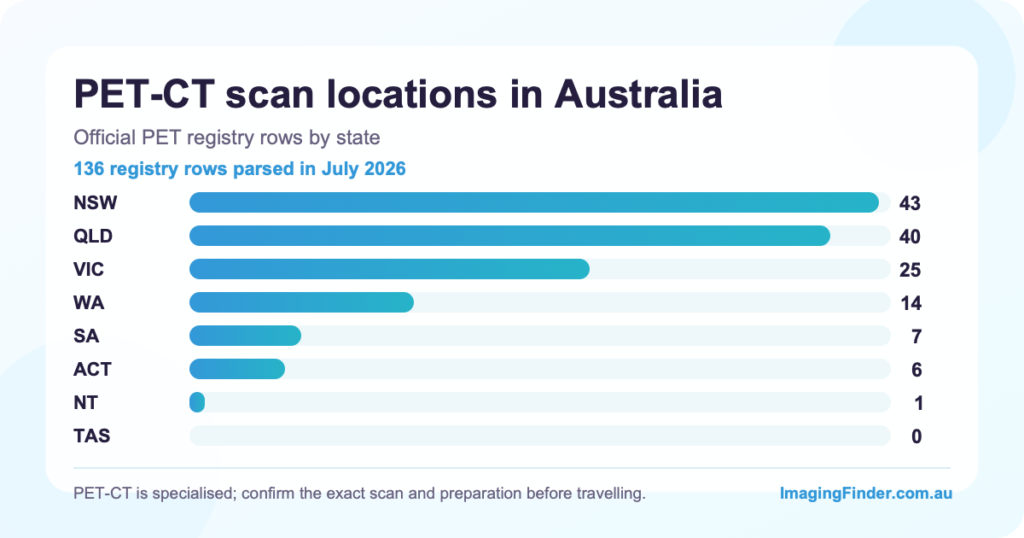
The Department of Health, Disability and Ageing publishes an official list of PET units in Australia — practice names and street addresses, state by state. On the version published 22 May 2026, it names 139 locations:
| State or territory | PET units on the official list |
|---|---|
| New South Wales | 43 |
| Queensland | 40 |
| Victoria | 25 |
| Western Australia | 14 |
| South Australia | 7 |
| Australian Capital Territory | 6 |
| Tasmania | 3 |
| Northern Territory | 1 |
Counts are from the Department of Health list as published 22 May 2026, checked 7 July 2026. A unit on the list means the equipment and accreditation are in place; each site sets its own appointment availability and tracer schedule.
PET is concentrated in hospitals and larger practices for a regulatory reason, not a commercial one. The MBS notes require PET to be provided in a “comprehensive practice” — a practice or hospital department that also offers X-ray, ultrasound and CT — on accredited equipment, supervised and reported by a PET-credentialled specialist. A suburb with several imaging clinics can easily have no PET scanner, and that is the scarcity behind the numbers: about 140 clinics in our directory list PET-CT, against about 486 for MRI, as at July 2026. Outside the major centres that scarcity turns into distance — our study of MRI and PET access in rural and regional Australia finds fewer than 1% of people in remote Australia are within an hour of a PET scanner.
For the phone numbers and maps to go with the official addresses, start with the city pages: Sydney has about 24 PET-CT listings, and Brisbane and Melbourne 20 each — see PET-CT clinics in Sydney, Brisbane, Melbourne and Adelaide. The official list tells you where the machines are; the directory gives you someone to call.
What will a PET scan cost?
There are three price outcomes, and which one you get depends on your referral, not your postcode.
Bulk billed: you pay nothing. Services Australia defines bulk billing as the clinic billing Medicare directly and accepting the benefit as full payment — and for out-of-hospital diagnostic imaging that is bulk billed, Medicare pays the clinic 95% of the schedule fee. Whether a particular clinic bulk bills a particular item is the clinic’s decision, so ask when you book whether yours will be. Our bulk-billed radiology guide sets out the three cost questions to ask before booking.
Medicare-eligible but privately billed: you pay the gap. The out-of-hospital Medicare benefit shown on MBS Online is $848.50 for the $953 items and $1,195.50 for the $1,300 PSMA items (as at July 2026); whatever the clinic charges above the benefit is yours to pay.
Not Medicare-eligible: you pay the clinic’s full private fee, with no Medicare contribution. No official source publishes private PET prices. The schedule fee is the government’s benchmark for each item; clinics set their own fees, so get the exact fee in writing before you book. The official unit list also includes many public hospital departments — Royal Prince Alfred, Westmead, the Royal Melbourne among them — where your specialist can direct the request through the public system instead; the trade-off is usually time, which we cover in public vs private radiology wait times.
What to have ready when you call a PET-CT clinic
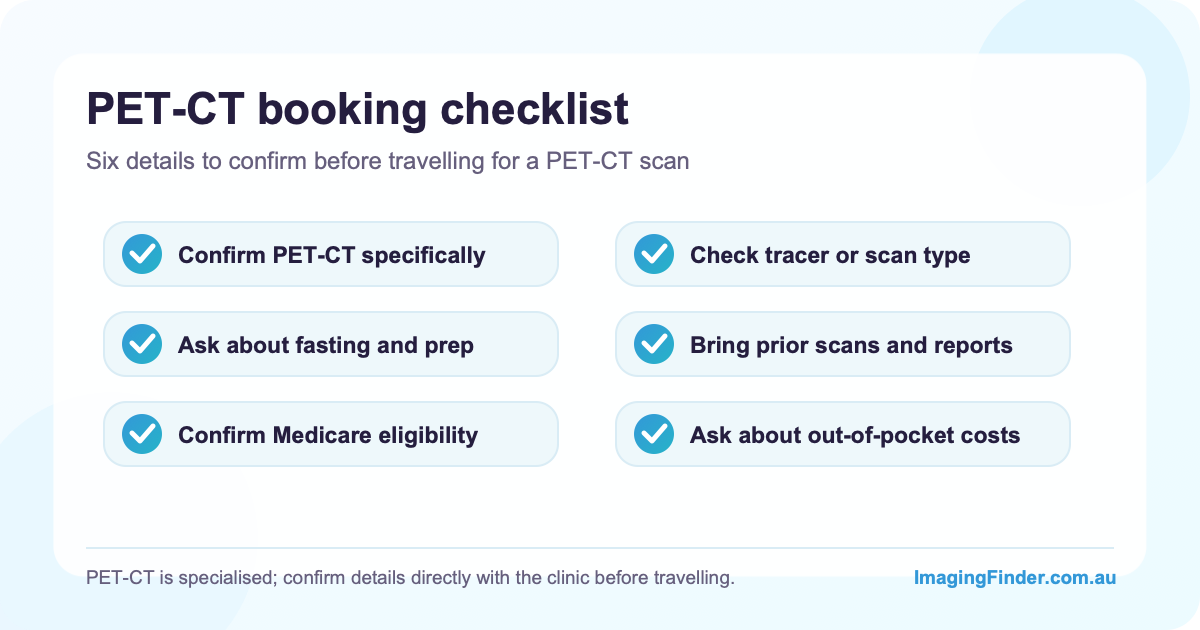
PET bookings involve more checking than other scans because the clinic must match your request to an item, a tracer and a production schedule. One prepared phone call usually settles all of it.
| Have this ready | Why the clinic asks for it |
|---|---|
| Referral or request form | The indication and the requester’s details determine whether a Medicare item applies. |
| Cancer type or clinical question | Different PET items and tracers answer different clinical questions. |
| Recent imaging reports | Prior CT, MRI or PET-CT helps with comparison and triage. |
| Diabetes medication list | Preparation changes for insulin and glucose-lowering medicines. |
| Treatment dates | Recent surgery, chemotherapy, radiotherapy or infection affects scan timing. |
A worked example. Two Brisbane patients call the same clinic on the same morning. The first has an oncologist’s request for staging newly diagnosed lymphoma — that matches item 61620, the scan is rebatable, and the clinic can quote a bulk-billed or small-gap price on the spot. The second has a GP referral that says “PET scan — investigate fatigue”. No item matches, the requester is not a specialist, and the honest answers are a full private fee or a suggestion to see a specialist first. Same scanner, same map pin, different answers — and the difference was decided before either patient picked up the phone.
If the booking team asks you to send the referral through before they will confirm eligibility or price, that is normal — PET is one of the scan types where the referral details genuinely change the answer. When they call back, ask two things: is the item on my request Medicare-rebatable here, and what will I pay on the day?
What happens on scan day?
For a standard FDG PET-CT, InsideRadiology (the RANZCR patient site) and healthdirect describe the same routine. You fast for several hours beforehand — the clinic tells you the exact window — and drinking water is encouraged. If you have diabetes, say so when booking: you will get specific instructions and may need to pause some medicines.
On arrival, staff place a small cannula in your arm, check your blood sugar and inject the tracer. Then comes the part nobody warns you about: you rest quietly for about 90 minutes while the tracer distributes, without talking or moving around much. The scanning itself is quick — the CT portion takes under 2 minutes and the PET portion roughly 15 to 20 minutes. Plan for 2 to 3 hours in the department from arrival to leaving.
Afterwards you can drive and go back to normal activities, and drinking plenty of water helps flush the tracer, which leaves your body within a few hours. One precaution is worth quoting directly from InsideRadiology: “Women who are breast-feeding and people who are the primary or sole carer for small children may need to make special preparations for after the test, to stop breast-feeding for a short time and to avoid close contact with young children.” The clinic gives exact timeframes on the day.
How is a PET-CT different from a normal CT?
A CT scan shows structure — detailed X-ray slices of anatomy. PET shows activity. The tracer, FDG, is a radiolabelled sugar, and cells that burn a lot of energy take up more of it; cancer cells are among the hungriest, so active tumour deposits appear as bright spots. The machine does both scans in one visit and overlays them, so a bright spot can be pinned to an exact anatomical location. CT answers “what does it look like?”; PET answers “is it active, and has it spread?” — which is why specialists reach for it when staging cancer or checking whether treatment worked.
Common PET scan questions
Can a GP refer me for a Medicare-rebatable PET scan?
Usually not. The MBS notes require rebatable PET scans to be requested by a specialist or consultant physician — for example, staging lymphoma or non-small-cell lung cancer. If your referral is from a GP, expect to pay privately, or ask your GP whether a specialist referral makes sense first.
Which cancers qualify for a Medicare PET rebate?
The schedule names specific situations rather than cancers in general: staging non-small-cell lung cancer, initial staging of Hodgkin and non-Hodgkin lymphoma, PSMA PET for intermediate and high-risk or recurrent prostate cancer, suspected melanoma recurrence, Stage III breast cancer and several others. The item wording — linked in the table above — decides, not the diagnosis alone.
How long does a PET scan take?
Plan for 2 to 3 hours at the facility. Most of that is the roughly 90-minute quiet rest after the tracer injection while it distributes through your body. The scanning itself takes about 15 to 20 minutes, plus a CT portion of under 2 minutes.
Is the PET tracer safe, and how much radiation is involved?
The tracer is a small amount of radiolabelled sugar that leaves your body within a few hours, helped along by drinking water. InsideRadiology puts the radiation dose at the equivalent of several years of natural background radiation and notes the substances used are not associated with side effects — you should feel no different after the scan.
Can I be near children after a PET scan?
For most people, normal contact is fine and no isolation is needed. The specific advice applies to people who are breastfeeding or are the primary carer of small children: they may need to pause breastfeeding briefly and avoid close contact with young children for a short period, because the body releases a small amount of radioactivity for a while after the test. The clinic sets the exact timeframes.
What if my scan isn’t Medicare-eligible?
You can still have it — you pay the clinic’s full private fee, with no Medicare contribution. As a benchmark, the schedule fees for listed PET items run from $953 to $1,300, as at July 2026. Before paying, ask your GP or specialist whether a specialist request would bring the scan under a listed item, or whether a public hospital pathway suits your situation.
How we know: sources and method
The Medicare rules, item wording and fees in this article were read directly on MBS Online on 7 July 2026; the state-by-state unit numbers come from the Department of Health’s PET locations list as published 22 May 2026 and checked the same day. Clinic counts come from the clinics listed in our directory in July 2026. Scan-day details come from RANZCR’s InsideRadiology and healthdirect. Together they are a reliable guide to how PET funding and access work — not a guarantee about your specific scan, because item wording and clinic billing policies change; the clinic checks your request against the current schedule when you book.
- Department of Health: PET units in Australia (published 22 May 2026; accessed 7 July 2026)
- MBS Online: items 61523, 61529, 61553, 61563, 61564, 61612, 61620 and PET explanatory notes (accessed 7 July 2026)
- MBS Online: PET for breast cancer factsheet (items 61524, 61525) (accessed 7 July 2026)
- InsideRadiology (RANZCR): PET scan (accessed 7 July 2026)
- healthdirect: PET scan (last reviewed December 2025; accessed 7 July 2026)
- Services Australia: bulk billing (accessed 7 July 2026)
PET-CT is concentrated in the capital cities, so the city pages are the quickest way in: radiology clinics in Sydney, Melbourne, Brisbane and Perth.
This article is general information, not personal medical advice. Availability, Medicare eligibility, billing and preparation can change — confirm the specifics with your referrer and the clinic.

Author: Dr. Mark Bekhit
Dr Mark Bekhit (MBChB, FRANZCR) is a musculoskeletal radiologist practising in Brisbane and an AHPRA-registered specialist in diagnostic radiology (MED0002920947). He spends as much time building software as reading scans: he founded Imaging Finder (Australia) and Radiology Clinics NZ to make imaging easier to find, and builds radiology dictation and pain-tracking tools with one aim — better patient outcomes and a smoother reporting workflow. Outside the reading room he's usually training, bringing the same performance mindset to imaging.
Leave a Reply