By Dr. Mark Bekhit, Radiologist · Last updated October 2026
Short answer: Without Medicare you pay the clinic’s whole fee, not just a gap. Medicare’s own fee for a CT of the brain is $225.20 (from July 2026), and in 2023–24 clinics that did not bulk bill charged Medicare patients a typical $360. A simple self-funded MRI starts at about $250. Before you pay, check whether a reciprocal agreement covers you, and remember that Overseas Student Health Cover (OSHC) must pay back at least 85% of Medicare’s fee. A public hospital is not free either, though student cover pays its emergency charges in full.
On this page
• How much does a scan cost without Medicare?
• Are you sure Medicare will not help?
• International students: what OSHC pays back
• Visitors and other temporary visas
• Is a public hospital cheaper?
How much does a scan cost without Medicare?
For most Australians, Medicare pays most of a scan’s fee and many clinics bulk bill, so the patient pays nothing. Take Medicare away and you pay the clinic’s fee for the whole scan. Clinics set their own fees, so there is no national price list. What I can give you is two yardsticks for common scans. “Medicare’s fee” below is the Schedule fee Medicare sets for the scan, not the amount it pays.
Medicare’s fees are those set on 1 July 2026, and the OSHC column is 85% of each. The last column, from the Australian Government’s Medical Costs Finder, is the typical total fee for Medicare patients who were charged a gap in 2023–24. They were the minority: between 74% and 96% of Medicare patients paid nothing for these scans. Fees may have risen since, so treat both columns as yardsticks, not a quote.
MRI splits in two. A specialist’s request under a Medicare item has a Medicare fee like any other scan, so the OSHC minimum applies. An MRI outside Medicare’s items has no listed fee at all; the clinics’ published prices behind our cost calculator put a simple one at $250 to $400 in total.
The spread matters more than the decimals. In Medicare’s own fees, a chest X-ray is $55.50 and a CT of the abdomen and pelvis with contrast is $554.25. If you are paying yourself, it is fair to ask the doctor who wrote the request whether a simpler test would answer the question first. Ask too whether contrast (a dye injected into a vein) is planned. Medicare lists a brain CT with contrast as a separate item, at $288.65 rather than $225.20.
Are you sure Medicare will not help?
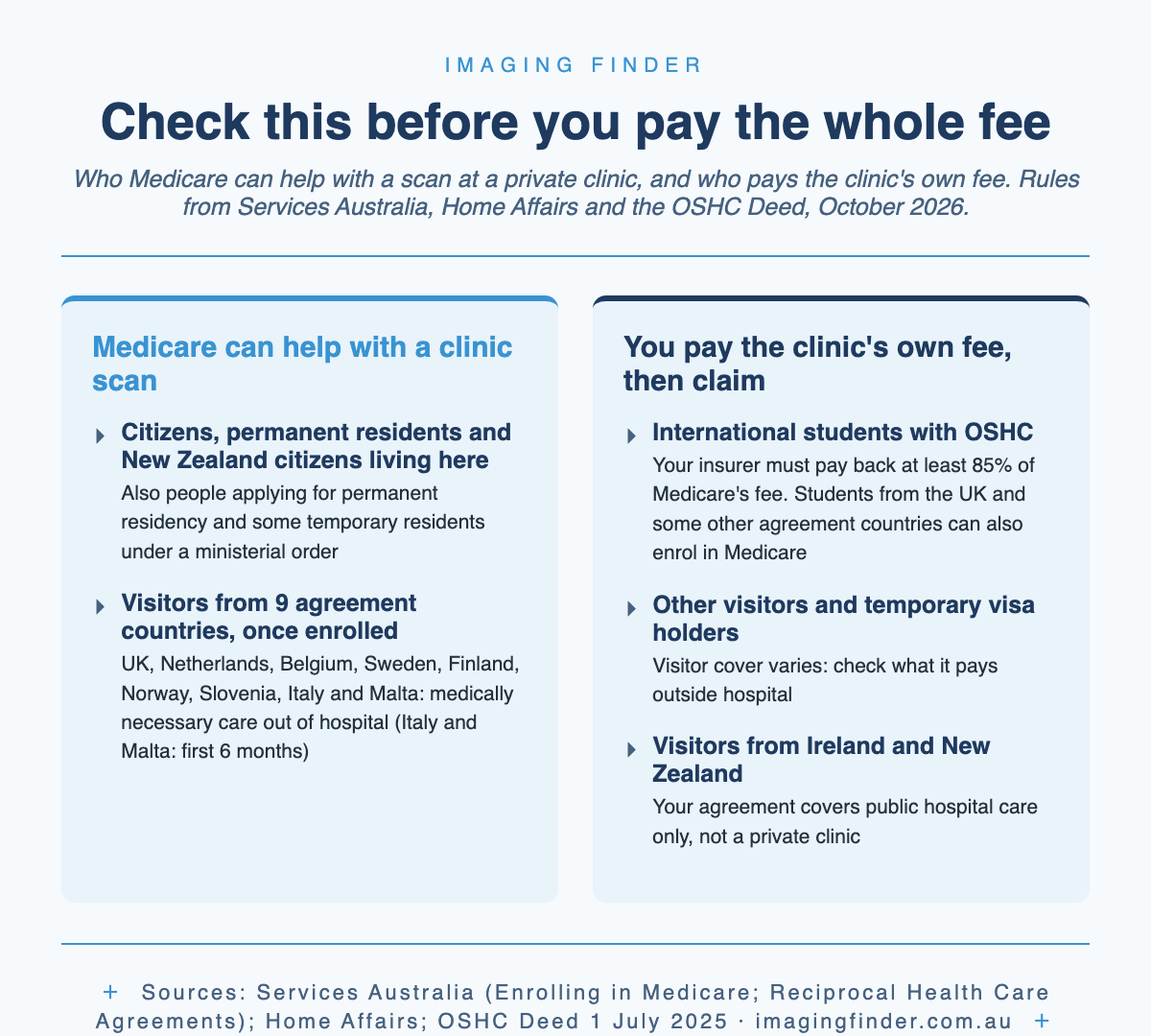
Check this before you pay, because some people who think they are uninsured are not. You can enrol in Medicare if you live in Australia and are an Australian or New Zealand citizen, a permanent resident, applying for permanent residency, or a temporary resident covered by a ministerial order.
Visitors may be covered too. Australia has reciprocal health care agreements with 11 countries. For visitors from nine of them, the agreement covers medically necessary care out of hospital as well as public hospital care. That means a Medicare benefit, so your scan is billed like any Medicare patient’s and a gap may still apply. You need to enrol. If you paid before enrolling, enrol and then submit a claim; Services Australia will tell you whether the agreement covers it. It does not apply if you came to Australia for medical treatment.
The exceptions catch people out. Visitors from Ireland and New Zealand are covered for public hospital care only, with no Medicare benefit at a private clinic. Cover from Italy and Malta ends after 6 months. And students from Norway, Finland, Malta and Ireland are not covered on a student visa.
International students: what OSHC pays back
A student visa requires Overseas Student Health Cover for the whole visa. The rules for every policy are set in a government deed, and for medical services outside hospital the insurer must pay at least 85% of Medicare’s fee. Insurers apply that to radiology: nib pays 85% of the fee for radiology outside hospital, and Bupa says up to 100%.
Whatever the clinic charges above that is your gap. A worked example: if a clinic charged the typical $360 for a CT of the brain, the minimum OSHC payment of $191.45 would leave you $168.55. A policy cannot have an excess, but it can apply a waiting period of up to 2 months for scans after your cover starts, so check your start date. Pregnancy scans have their own rule: a policy shorter than 2 years can make you wait up to 12 months.
Some clinics bill your insurer directly, so you pay only the gap on the day. Lake Imaging does this for eligible scans, except obstetric ultrasound and MRI. Students from the UK, Sweden, the Netherlands, Belgium, Slovenia, Italy and New Zealand can also apply for Medicare under their country’s agreement, in addition to OSHC rather than instead of it. A New Zealand citizen staying longer than 6 months may be able to enrol in Medicare outright, which helps at a private clinic as well.
Visitors and other temporary visas
Many temporary visas carry condition 8501, which means you must keep adequate health insurance while you are in Australia. It comes automatically with student (subclass 500), subclass 482 work and temporary graduate (subclass 485) visas, and can be added to a working holiday visa. Overseas Visitor Health Cover is the usual product, but every policy differs; most cover hospital admissions and a portion of doctors’ fees. Read the out-of-hospital section of yours, or ring the insurer, before the scan rather than after.
Expect to pay on the day and claim back. One South Australian group, Benson Radiology, asks overseas patients without a valid Medicare card to pay in full on the day and says its fees are billed in line with Medicare’s schedule; a Melbourne group, FMIG, bills visitors at full cost.
Is a public hospital cheaper?
Not reliably, and it is not free. Without Medicare you are a private patient in public hospitals too. The Royal Melbourne Hospital charges patients without a Medicare card 150% of the Medicare fee for radiology, plus $725 upfront for an emergency visit. In Perth, the North Metropolitan hospitals list 2026–27 overseas patient fees of $220 to $4,365 for CT and $2,108 to $4,280 for an MRI study.
The picture changes when you genuinely need hospital care, such as an emergency or an admission. OSHC must pay 100% of a public hospital’s emergency department and outpatient charges for a student without Medicare, and emergency treatment has no waiting period; if you pay upfront, keep the receipt and claim it. For visitors from an agreement country, public hospital care is exactly what the agreement covers. That is not a back door to a cheaper routine scan, though. In my experience a scan your GP requests for a non-urgent problem is booked at a private clinic, and that is where the table above applies.
In an emergency, cost is the second question. Go to an emergency department. One New South Wales health district states that emergency and life-threatening illnesses will always be treated regardless of your country of origin. Sort out the bill once you are safe.
If you have Medicare but no rebate applies
Having a Medicare card does not guarantee a rebate. A GP can request a Medicare MRI only for a short list of scans and reasons; outside that list you pay the clinic’s fee, just as a visitor would. Private health insurance cannot fill the gap, because by law it does not cover out-of-hospital diagnostic imaging. Our guides to an MRI without a referral and full-body MRI costs cover those cases.
Where to book, and what to ask
Shortlist clinics near you: CT in Sydney, CT in Melbourne or CT in Brisbane; X-ray in Sydney, X-ray in Melbourne or X-ray in Brisbane; ultrasound in Sydney, ultrasound in Melbourne or ultrasound in Brisbane; and MRI in Sydney, MRI in Melbourne or MRI in Brisbane. For a self-funded MRI, the scan cost calculator gives an estimate from clinics’ published prices.
Four examples from our directory that explain their billing for people without Medicare, checked on 20 October 2026; they are examples, not a ranking. In Melbourne, Lake Imaging North Melbourne CBD direct bills OSHC and FMIG Footscray charges visitors its full fee. In Sydney, Synergy Radiology Randwick is part of a group that accepts eligible OSHC policies with nib, Allianz, ahm or Medibank, and visitor cover with nib or Allianz, with exceptions. In South Australia, Benson Radiology’s clinics take payment on the day.
Ask the clinic when you book
✓ “I don’t have Medicare. What is your fee for this scan, and can I have a written estimate with the Medicare item number?” Your insurer pays back against that item.
✓ “Do you bill [your insurer] directly? If so, what gap will I pay on the day?”
✓ “Is contrast planned?” It changes the item and the fee.
✓ Keep the receipt with the item number on it, and claim from your insurer straight after the scan.
If you do have Medicare, the cost guides for CT, MRI, X-ray and ultrasound are the better read, and our public hospital or private clinic checklist helps you choose where to go.
How we know: sources and method
Item wording and fees come from the Medicare Benefits Schedule, read on 20 October 2026; every fee quoted was updated on 1 July 2026. What clinics charged comes from the Department of Health’s Medical Costs Finder, filtered to diagnostic radiology, out of hospital, 2023–24, national. Eligibility and reciprocal agreement rules are from Services Australia and the Department of Home Affairs; the OSHC minimum is from the 1 July 2025 OSHC Deed. Hospital fees are from the Royal Melbourne Hospital and the WA North Metropolitan Health Service. Clinic billing policies were read on each clinic’s website on 20 October 2026.
This article is general information, not personal medical advice. Discuss your individual report and next steps with the healthcare professional responsible for your care.

Author: Dr. Mark Bekhit
Dr Mark Bekhit (MBChB, FRANZCR) is a musculoskeletal radiologist practising in Brisbane and an AHPRA-registered specialist in diagnostic radiology (MED0002920947). He spends as much time building software as reading scans: he founded Imaging Finder (Australia) and Radiology Clinics NZ to make imaging easier to find, and builds radiology dictation and pain-tracking tools with one aim — better patient outcomes and a smoother reporting workflow. Outside the reading room he's usually training, bringing the same performance mindset to imaging.
Leave a Reply