By Dr. Mark Bekhit, Radiologist · Last updated August 2026
The quick answer
Short answer: A bone density scan (a DXA or DEXA scan) is a quick, very low-radiation test of how strong your bones are. Medicare pays for it only in set situations — you are 70 or over, you have broken a bone from a minor fall, or you have a condition or medicine that weakens bone — and your GP confirms which one fits and writes the referral. If Medicare covers you the scan is often bulk billed; if not, Medicare rebates $104.20 of the $122.55 fee. There are no needles or tunnel, and you take your medicines as usual.
On this page
What a bone density scan is (and what it is not)
A bone density scan is a medical test used to help diagnose osteoporosis — the thinning of bone that makes it break more easily. It matters because it is common and largely silent: an estimated 853,600 people in Australia were living with osteoporosis or low bone density in 2022, and the real figure, counting people who have never been tested, is higher. Most people feel perfectly well right up until a wrist or hip breaks after a small stumble. A scan is how that risk gets measured before it becomes a fracture.
The scan itself is undramatic. It uses a special x-ray called dual-energy x-ray absorptiometry — DXA or DEXA for short — and takes about 20 minutes while you lie on a padded table, usually measuring your lower spine and hip. The radiation dose is extremely small — far less than an ordinary x-ray, so small that the technologist stays in the room with you. There is no injection, nothing enclosed, and no after-effects.
Not the same as a “body-fat DEXA”: some gyms and health clinics sell a body-composition DEXA that measures muscle and body fat. It uses the same type of machine, but it is a different test for a different purpose, and Medicare does not rebate it. The scan this guide is about measures bone at the spine and hip to assess fracture risk. If bone health is the goal, make sure that is what you are booking.
Who Medicare covers — and how often
This is the part that trips people up, because Medicare does not fund a bone density scan simply on request. It funds it for a defined list of situations, each with its own item number and its own rule on how often you can repeat it. You do not have to work out which item applies — that is your GP’s job when they write the referral — but it helps to recognise your own situation in the list, because it tells you whether a rebate is likely at all.
Situations and repeat rules from the Medicare Benefits Schedule bone densitometry items (12306, 12312, 12315, 12320, 12321, 12322) and explanatory note DN.1.18, current as at August 2026. Your GP confirms which item applies to you.
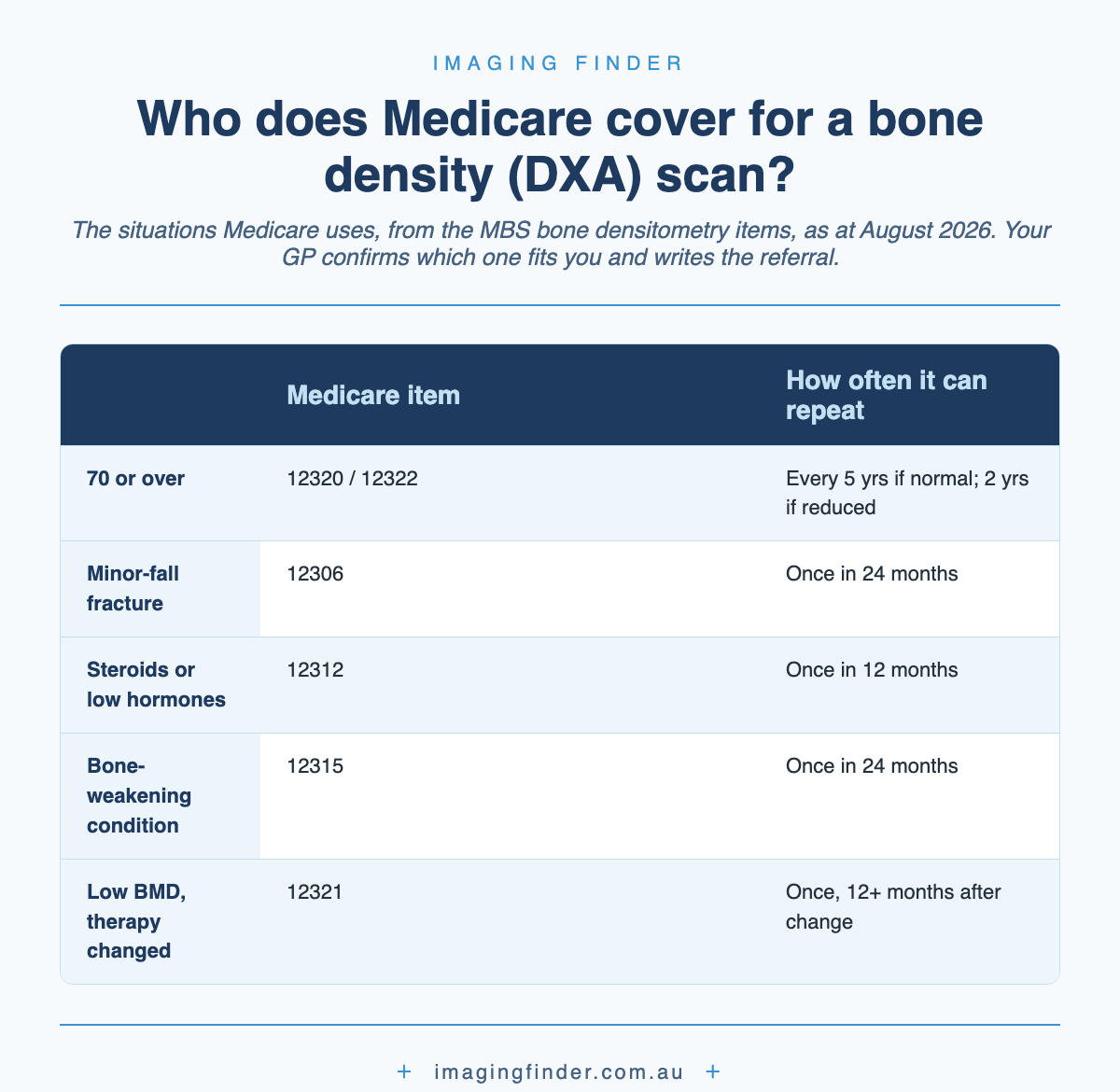
Two practical points come out of that table. First, the age-70 pathway is a genuine screening entitlement: you do not need a broken bone or a diagnosis first, just to be 70 or over. Second, Medicare ties the repeat interval to your last result — five years apart if your bones were normal, two years if they were already thinning. That is why a repeat scan asked for too soon may not attract a rebate, and it is worth checking the timing with your GP before you rebook.
Good to know: if none of these situations fits you — for instance you are under 70, feel well and just want a baseline — the scan can still be done, but you pay the full fee yourself rather than claiming through Medicare. Whether that is worthwhile is a conversation for your GP, who can weigh your personal fracture risk.
What it costs
The cost of a bone density scan is sometimes covered by Medicare, and when your situation matches one of the items above, many clinics bulk bill it — meaning no cost to you. Bulk billing is each clinic’s own choice, though, not a guarantee.
If the scan is not bulk billed, or your situation does not qualify for a rebate, the numbers are modest by imaging standards. The Medicare Schedule fee is $122.55, and where an item applies the Medicare benefit is $104.20 — 85% of that fee. What you actually pay comes down to the clinic’s own fee. An eligible patient claims the $104.20 benefit against it; someone with no eligible item pays in full. A clinic can also set its fee above the Schedule fee, so ask for the exact price and any gap before you book. If you are weighing up the cost of scans, our guides to what an MRI or a CT costs give some context, and our guide to bulk-billed radiology explains how clinics decide.
What your result means
Your result comes back as a T-score, which compares your bone density with that of a healthy young adult of the same sex. In plain terms:
You may also see a Z-score, which compares you with people of your own age and sex. A number on a page is not a diagnosis, though. The score has to be read alongside your age, your history and your other fracture risks, and that interpretation — and any decision about treatment — belongs to your doctor. By law the scan is reported by a specialist, and your GP will talk you through what it means for you.
How to prepare and what to tell the clinic
Preparation is refreshingly simple: there is essentially none. You do not need to fast, and you take all your medications as usual. The one small thing that helps is clothing — loose, comfortable clothes without metal buttons, zips or buckles, because metal shows up on the scan; if what you are wearing has metal, the clinic gives you a gown.
A couple of things are genuinely worth mentioning when you book. The scan uses a little radiation, so it is not done if you are or might be pregnant. And if you have had a hip replacement or spinal surgery with metal work, tell the clinic, because metal at the usual measuring sites means they will measure a different site, such as the forearm, instead.
Ask the clinic when you book
✓ “Do you bulk bill this scan on my Medicare referral, and if not, what is the cost?”
✓ “It is a bone-health DXA of my spine and hip, not a body-fat scan” — so the right test is booked.
✓ “I have a hip replacement / spinal metalwork” — if you do, mention it.
✓ “There is a chance I am pregnant” — if that is possible, tell them before the scan.
Find a bone density clinic near you
Once your GP has given you a referral, you can choose any clinic that offers bone densitometry. To find one nearby, use Imaging Finder’s national radiology directory, or go straight to bone density clinics in Sydney, Melbourne, Brisbane or Perth (examples listed in our directory as at August 2026), and ring ahead with the questions above. These are examples, not a ranked list, and services change, so check the clinic still offers bone densitometry before you go.
If you are sorting out the referral itself, our guide to getting a referral for scans explains who can request what, and Medicare-eligible scans by modality sets bone density alongside the other tests Medicare helps pay for. After the scan, how to read your radiology report helps you make sense of the wording.
Common questions
Do I need a specialist referral, or can my GP refer me?
Your GP can refer you. Medicare funds bone densitometry on a referral from a medical practitioner — which includes your GP. You do not need to see a specialist first. The scan is then reported by a specialist at the imaging practice, but that happens behind the scenes; you deal with your GP.
Will the scan explain why my bones are thinning?
Not on its own. A bone density scan measures how dense your bones are, which helps your doctor estimate your fracture risk and track any bone loss over time — but it does not show the cause. If your result is low, that is where your GP comes in: they look at the wider picture and may arrange blood tests, or check for conditions and medicines that affect bone, to work out why and what to do next.
How we know: sources and method
The eligibility situations, item numbers, repeat intervals, the $122.55 Schedule fee and the $104.20 benefit are taken directly from the Australian Government’s Medicare Benefits Schedule bone densitometry items and their explanatory note, current as at August 2026. What the scan involves, the radiation and preparation, and the T-score meanings are from the Government’s healthdirect service and from InsideRadiology, the patient-information service of the Royal Australian and New Zealand College of Radiologists (RANZCR). The prevalence figure is from the Australian Institute of Health and Welfare. Eligibility here describes the situations Medicare uses; your GP confirms which one applies to you and writes the referral, and a specialist interprets your result.
- Medicare Benefits Schedule: bone densitometry items 12306, 12312, 12315, 12320, 12322 and note DN.1.18 — eligibility, repeat intervals, fee and benefit
- healthdirect: bone density scan — what it is, radiation, T-score meanings, Medicare
- InsideRadiology (RANZCR): bone mineral density (BMD) scan — duration, dose, preparation, pregnancy and implants
- Australian Institute of Health and Welfare: osteoporosis — prevalence
This article is general information, not personal medical advice. Discuss your individual report and next steps with the healthcare professional responsible for your care.

Author: Dr. Mark Bekhit
Dr Mark Bekhit (MBChB, FRANZCR) is a musculoskeletal radiologist practising in Brisbane and an AHPRA-registered specialist in diagnostic radiology (MED0002920947). He spends as much time building software as reading scans: he founded Imaging Finder (Australia) and Radiology Clinics NZ to make imaging easier to find, and builds radiology dictation and pain-tracking tools with one aim — better patient outcomes and a smoother reporting workflow. Outside the reading room he's usually training, bringing the same performance mindset to imaging.
Leave a Reply