
By Dr. Mark Bekhit, Radiologist · Last updated August 2026
The quick answer
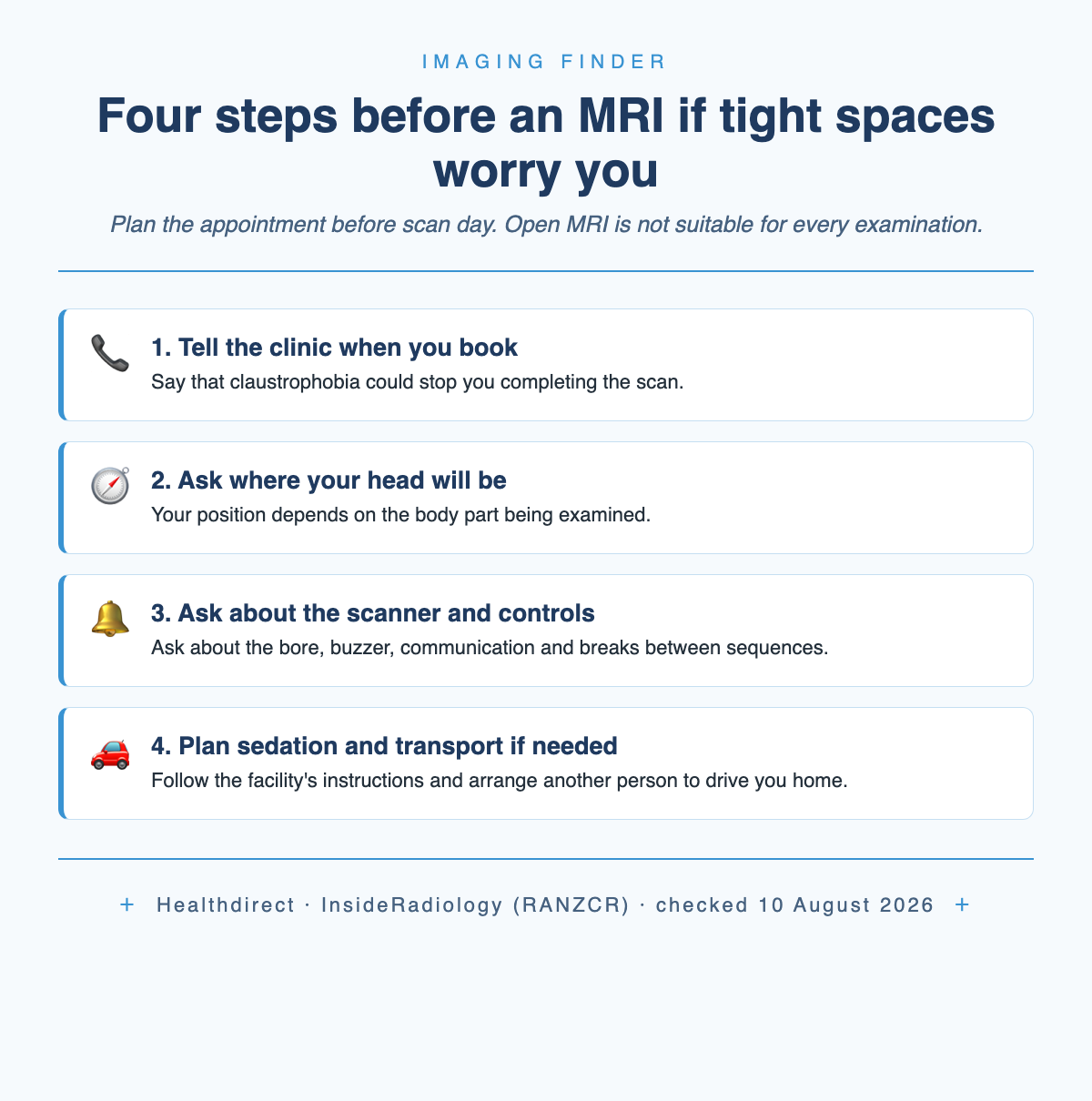
Short answer: Tell your doctor and the MRI clinic about claustrophobia when you make the appointment. Ask where your head will be for this body part, whether a wider or open scanner is suitable, and how the buzzer and communication work. A wide-bore scanner is still a tunnel; a true open MRI has open sides and is not suitable for every examination. If those changes are unlikely to be enough, sedation must be arranged before scan day, with another person available to drive you home.
On this page
What should you do if you are claustrophobic before an MRI?
Tell the referring doctor and MRI facility as soon as you know that tight spaces could stop you completing the scan. Raise it when you make the appointment, not when the scanner is ready. Early notice gives the team time to explain the scanner, consider a different machine where clinically suitable, or arrange sedation.
Do not judge the appointment only by the word “MRI”. Your experience changes with the body part, the position, the scanner and the length of the examination. A complete MRI can take 10 minutes to more than 1 hour, and some examinations take 2 hours or more. Ask for the expected time for your exact request.
A previous failed scan is useful information, not a reason to feel embarrassed. Tell the clinic what stopped it: seeing the tunnel, having your head inside, the coil near your face, the noise, or the need to stay still. That detail helps staff explain which practical change could matter for this appointment.
Start with one concrete question: “For the body part on my request, where will my head be during the scan?” The answer often matters more than the scanner label.
Is wide-bore or open MRI better for claustrophobia?
There is no single best design for every patient or every examination. A wide-bore scanner gives more room but remains tunnel-shaped. A true open scanner has open sides and greater visibility. Open MRI can feel less enclosed, but some examinations or clinical indications need a different MRI system. The referral must be assessed before a clinic can offer it.
MRI uses strong magnetic fields and radio waves, not X-ray radiation. That principle is the same across these designs. The scanner shape tells you how it surrounds you. It does not tell you whether that system can perform the examination your doctor requested.
How enclosed will you be during the scan?
Your head can be inside or outside the scanner, depending on the body part being examined. A special receiving coil is placed around or near the target body part. Even on the Lumus open system, much of the upper body enters the scanner for a head MRI.
The radiographer remains in the control room but can see you throughout the scan. You receive a buzzer, and you can speak between scan sequences or ask to come out. Earplugs or headphones protect against loud scanner noise. Ask the radiographer to explain those controls before the first sequence begins.
The examination is not usually one uninterrupted block. Individual sequences often last about 1 minute to several minutes, with a break between them. Ask the radiographer to tell you when each sequence has finished.
When is sedation used for MRI claustrophobia?
Sedative medicine can be given for claustrophobia, but it changes the appointment. It must be discussed before scan day so the doctor and MRI facility can decide what support is suitable and give the correct preparation instructions. Do not take extra medicine or borrow another person’s medicine to get through an MRI.
If sedation is planned, follow the facility’s instructions about food, drink and regular medicines. Some MRI examinations require fasting even without sedation, and the facility gives that requirement when the appointment is made. The safe instruction is the one issued for your examination and sedation plan.
After sedation, you must remain at the facility until you are fully awake and have another person drive you home. InsideRadiology advises arranging for a friend or relative to bring you when sedation may be needed. Organise that transport before the appointment rather than hoping to solve it on the day.
Sedation is a planned pathway: the clinic gives the preparation and recovery instructions. This is not a medicine or dose to choose for yourself.
What should you ask when you book?
Use one short script: “I am worried that claustrophobia could stop me completing this MRI. For the body part on my request, where will my head be, which scanner would you use, and what support can we arrange before the appointment?”
Ask the clinic when you book
✓ Where will my head be for this body part?
✓ Is a wide-bore or open system suitable for this request?
✓ How do the buzzer, communication and breaks work?
✓ If I might need sedation, what must be arranged before scan day?
✓ What preparation instructions and transport plan apply?
You can use Imaging Finder to find MRI services in Sydney, Melbourne, Brisbane and the Gold Coast, or search the national clinic directory. The directory does not identify every scanner by bore or design, so use the questions above when you contact a clinic.
If the practical problem is cost or Medicare, use the separate guides to MRI costs in Australia and Medicare rebates for MRI. The guide to MRI versus CT explains why the examinations answer different questions. Your doctor decides which modality is clinically appropriate; scanner anxiety does not make CT an automatic substitute.
Where are open and wide-bore MRI examples in Australia?
These are local examples checked on 10 August 2026, not a complete list of Australian scanners. Lumus Imaging offers a true open MRI at Robina Home Hub in Queensland. The clinic states that some examinations need another MRI system.
Current wide-bore examples include a 70 cm wide-bore MRI at Melbourne Radiology in East Melbourne, wide-bore MRI at Qscan Clayfield, and wide-bore scanners at Sydney Imaging Specialists. These clinic pages establish local availability only. They do not prove that the scanner is suitable for your referral or that the service remains available at every appointment.
Common questions about MRI claustrophobia
Can I stop an MRI if I panic?
Yes. You receive a buzzer and can ask to come out at any time. The radiographer can see you from the control room and can speak with you between scan sequences. Ask staff to explain the signal and what will happen if you press it before the scan begins.
Is open MRI the same as wide-bore MRI?
No. A wide-bore MRI is still tunnel-shaped, but the opening is wider. A true open MRI has open sides. Open MRI may feel less enclosed, but it is not suitable for every examination or indication. The clinic needs to assess the request before offering a machine.
Can my head stay outside the MRI scanner?
Sometimes. Your head can be inside or outside depending on the body part being examined. A head or upper-body examination usually places your head closer to the magnet centre. Ask about the position for the exact body part on your request.
Can I have sedation for MRI claustrophobia?
Sedative medicine can be given for claustrophobia, but it needs advance planning. Tell the referring doctor and MRI facility when you make the appointment. They will decide what is suitable and give the preparation instructions. Do not choose a medicine or dose yourself.
Can I drive after MRI sedation?
No. After sedation, you need to stay until fully awake and have another person drive you home. Arrange the driver before scan day. The facility will give you its specific preparation and recovery instructions.
Can someone stay with me in the MRI room?
Ask the facility whether a support person can enter for your examination. Anyone who enters the room must complete an MRI safety questionnaire. The radiographer still watches and communicates with you from the control room.
Sources and limits
The clinical information comes from Australian patient guidance published by healthdirect and InsideRadiology, the patient-information service of RANZCR. The open and wide-bore examples come from current clinic pages checked on 10 August 2026. They show that those local services advertised the stated scanner design on that date; they are not a national census or a guarantee that a machine is suitable for a specific request.
- healthdirect: magnetic resonance imaging (MRI)
- InsideRadiology (RANZCR): MRI and MRI of the prostate
- Current local scanner information: Lumus open MRI, Melbourne Radiology wide-bore MRI, Qscan Clayfield and Sydney Imaging Specialists
This article is general information, not personal medical advice. Discuss your individual report and next steps with the healthcare professional responsible for your care.

Author: Dr. Mark Bekhit
Dr Mark Bekhit (MBChB, FRANZCR) is a musculoskeletal radiologist practising in Brisbane and an AHPRA-registered specialist in diagnostic radiology (MED0002920947). He spends as much time building software as reading scans: he founded Imaging Finder (Australia) and Radiology Clinics NZ to make imaging easier to find, and builds radiology dictation and pain-tracking tools with one aim — better patient outcomes and a smoother reporting workflow. Outside the reading room he's usually training, bringing the same performance mindset to imaging.
Leave a Reply