By Dr. Mark Bekhit, Radiologist · Last updated September 2026
The quick answer
Short answer: “Heart CT” usually means one of two tests, with different costs. A coronary calcium score is a screening scan for people with no symptoms; it has no Medicare item, so you pay the clinic’s own fee, quoted when you book. A CT coronary angiogram (CTCA) is for people with symptoms and has Medicare items (57360 and 57364), on a specialist’s request. Most people pay nothing for a rebated CTCA — in 2023–24, 77% of patients had no out-of-pocket cost — and those who did pay typically paid about $200. Your doctor decides which test suits you.
On this page
- What you’ll pay: the costs at a glance
- Which “heart CT” do you mean?
- The Medicare rules behind those numbers
- The calcium score: what happens on the day
- The CT coronary angiogram: what happens on the day
- Radiation, pregnancy and safety
- Getting your result
- Find a CT clinic near you
- Common questions
- How we know: sources and method
What you’ll pay: the costs at a glance
The two tests sit in different financial worlds: a CTCA is Medicare-rebated (on a specialist’s request) and most patients pay nothing for it, while a calcium score has no Medicare item at all, so the whole fee is yours. The gap figures below are not my estimates — they come from the Australian Government’s Medical Costs Finder, which reports what patients actually paid in 2023–24 Medicare claims.
The mechanics behind the CTCA column, in one breath: Medicare’s benefit is worked out from the $808.10 Schedule fee. If the clinic bulk bills, it accepts 95% of the Schedule fee as full payment and you pay nothing. If it doesn’t, Medicare pays the 85% out-of-hospital benefit ($703.60) and the rest of the clinic’s fee is your gap — $104.50 if the clinic charged exactly the Schedule fee, more if it charges above it. In 2023–24, clinics that did charge a gap on item 57360 typically charged about $860, Medicare paid $660, and the patient typically paid about $200.
Where you live matters more than most people expect. Here is the same government data split by state — the difference between Western Australia and South Australia is striking.
And the calcium score? There is no table of gaps to show you, because with no Medicare item there are no claims to count — every dollar is private. Clinics set their own fee and don’t always advertise it — Queensland X-Ray, for example, quotes the price at the time of booking. Among clinics that do publish a fee, Harbour Radiology in Sydney advertises $200 (checked 1 September 2026) — treat that as one example, not a national rate, and get your own clinic’s total price in writing before you book.
Which “heart CT” do you mean?
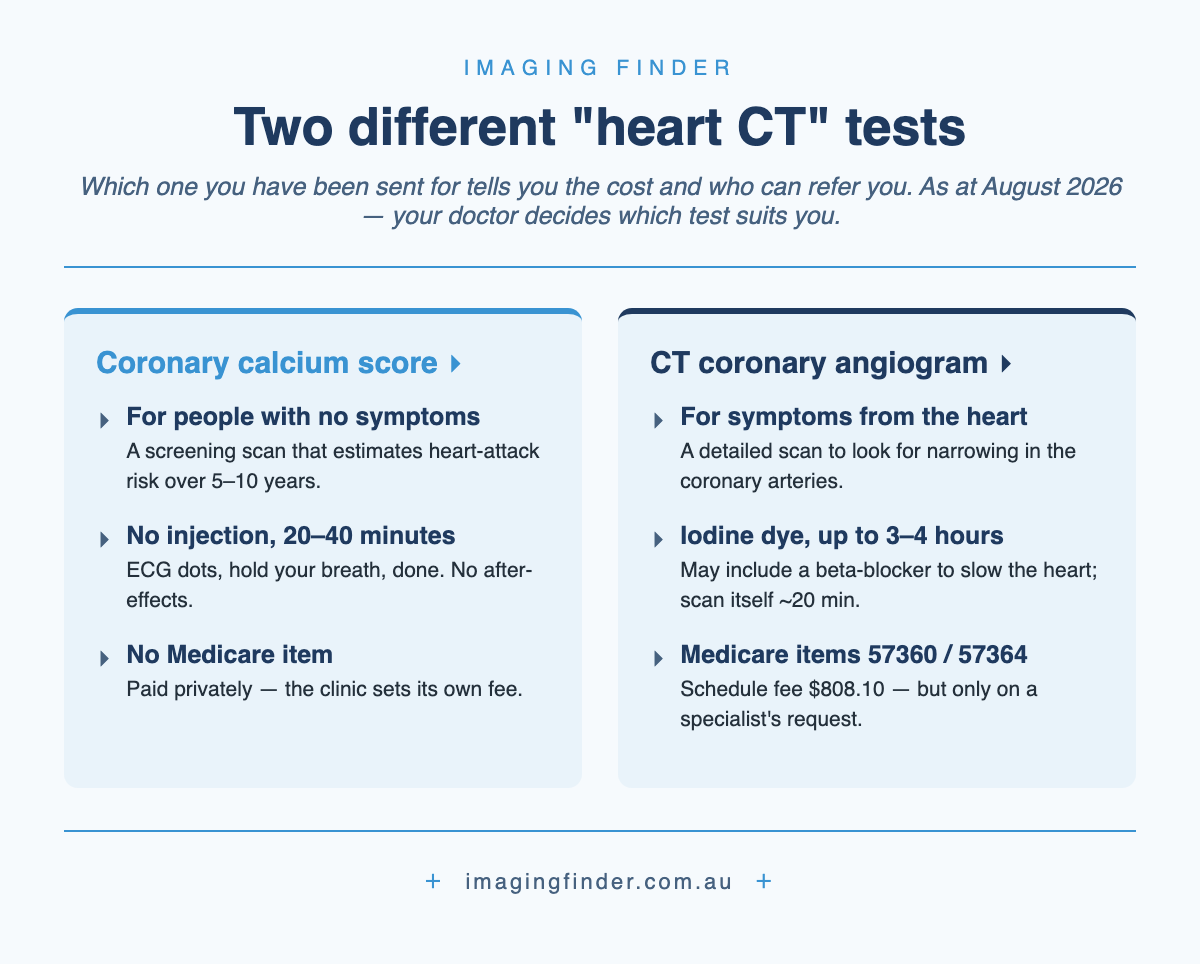
When someone tells me they have been sent for a “heart scan” or a “CT of the heart”, my first job is to work out which test they actually mean, because two very different scans hide behind those words — and the answer changes both what happens in the room and what it costs.
A coronary artery calcium score measures the amount of calcium in the walls of the arteries that supply the heart muscle, using a quick CT scan with no injection. The score is used to estimate the risk of a heart attack or stroke over the next 5–10 years. Crucially, it is a screening test — one you have when you do not have any symptoms.
A CT coronary angiogram (CTCA) is a more detailed test that uses CT to picture the coronary arteries of the beating heart, with an iodine-containing dye injected into a vein so the vessels show up clearly. A doctor refers you for a CTCA to find out whether narrowing of the coronary arteries could be causing your symptoms. It is a symptom-driven test, not a screen.
Neither is the same as a plain coronary angiogram (also called cardiac catheterisation), which is an invasive test where a doctor passes a thin tube into an artery in your wrist or groin, up to the heart, and injects dye while taking X-rays — and can treat a narrowing with a stent in the same sitting. That one happens in a cath lab, not a radiology CT scanner. The table below keeps the two CT tests apart.
A third thing people sometimes mean is a full-body screening scan that includes the heart. That is a different purchase again, and our full-body MRI cost guide explains the price and the radiologists’ college position on it.
The Medicare rules behind those numbers
The rebate rules are where the two tests part ways, and they catch people out, so let me be exact about them.
A CT coronary angiogram has two Medicare item numbers. Item 57360 covers a CTCA when the request is made by a specialist or consultant physician, and the patient has stable or acute symptoms consistent with reduced blood flow to the heart, at low to intermediate risk of a heart event. Item 57364 covers other specific situations — for example checking a bypass graft as an alternative to an invasive angiogram. Both carry a Schedule fee of $808.10 (updated 1 July 2026). Two things follow from those rules. Your GP cannot order a rebatable CTCA — it must come from a specialist or consultant physician; and there is a five-year wait before Medicare pays again if an earlier scan found no significant disease.
What you actually pay for a CTCA depends on the clinic — the tables above show how that played out across the country.
A coronary calcium score is a different story. There is no Medicare item number for a standalone calcium score, and the reason is not red tape: the coronary-CT items above are written for symptomatic patients referred by a specialist, whereas a calcium score is a screening test for people with no symptoms. With no item to bill, there is simply nothing for Medicare to pay.
Good to know: in my experience, a clinic advertising a low “heart scan” price is usually quoting the private calcium score, not a CT coronary angiogram. They are different tests for different situations — check which one your doctor actually requested before you compare prices. For how bulk billing and gaps work across imaging, see our guide to bulk-billed radiology and what a CT scan costs in Australia.
The calcium score: what happens on the day
A calcium score is one of the quicker scans in radiology. There is no injection and no drink — a few ECG dots go on your chest so the scanner can time its pictures to your heartbeat, you hold your breath for a few seconds, and it is done. Most people are in and out of the department in about 20 to 40 minutes, with no after-effects and no restrictions on the rest of your day. The one bit of preparation that matters: on the day of the scan you are asked not to smoke or drink coffee, tea, cola or other caffeine drinks, because caffeine can lift your heart rate.
Whether the test is worth doing at all is a conversation for your doctor, and there are real limits on who it helps. Calcium scores are most informative for women aged 35 to 70 and men aged 40 to 60; outside those ages the number adds little. And a calcium score is of no use to someone who has already had a heart attack, bypass surgery or a stent — the risk question has already been answered.
The CT coronary angiogram: what happens on the day
A CTCA asks more of you, mostly because a still, slow heart makes clearer pictures. Expect the whole visit — preparation, scanning and recovery — to take up to 3 to 4 hours, even though the scan itself is about 20 minutes. As with a calcium score you avoid caffeine beforehand. On the day, staff may give you a beta-blocker to slow your heart rate if it is above 60 beats a minute, and a nitroglycerin spray under the tongue to widen the arteries; then an iodine dye is injected through a small cannula in your arm while the scan runs.
Because of the dye and the medicines, a CTCA needs a little screening first. Tell the clinic when you book if you have asthma, diabetes, any kidney problems, an irregular heart rhythm, or a past reaction to X-ray contrast. If you take metformin for diabetes, you may or may not need to adjust it around the test depending on your kidney function, so bring a recent kidney-function result. Our guide to CT contrast dye safety covers the kidney and metformin questions in full.
Ask the clinic when you book
✓ “Is this a calcium score or a CT coronary angiogram?” — so you know what to expect and what it costs.
✓ “What is the total price, and is there a gap after Medicare?” — ask for it in writing.
✓ For a CTCA: “Do you need a recent kidney-function test, and should I change my diabetes medicine?”
✓ “Do you do cardiac CT here?” — not every CT clinic offers it.
Radiation, pregnancy and safety
Both tests use a small amount of X-ray radiation, as any CT does. It is worth keeping that in proportion: a scan a doctor has recommended is chosen because the information it gives is expected to outweigh the very small radiation risk, and if that risk worries you, the radiologist supervising the scan is the right person to talk it through. Our guide to CT radiation safety explains how small the dose really is against the radiation everyone gets from nature each year.
One firm rule: neither test is done in pregnancy as a routine. A calcium score should not be carried out if you are pregnant or trying to conceive, and a CTCA would not normally be done in pregnancy because of the radiation to the baby. If you are breastfeeding and have a CTCA, you can keep feeding normally — the amount of iodine dye that reaches breast milk is far too small to affect your baby.
Getting your result
For both scans, a radiographer runs the scanner and a radiologist checks the images and writes a report for the doctor who referred you. The number itself needs interpreting, not just reading. This is the part I most want people to hear: a high calcium score does not mean you will have a heart attack, and a score of zero does not rule one out. Your doctor puts the score together with your blood pressure, cholesterol, family history and the rest of the picture, and uses it to decide whether you are at low, normal or high risk and what to do about it — which is why the result belongs in a conversation with them, not on a fridge magnet.
Find a CT clinic near you
Once your doctor has settled which test you need, both a calcium score and a CT coronary angiogram are done at CT clinics. Imaging Finder lists CT clinics across the metros — you can search Sydney, Melbourne, Brisbane and Perth. Cardiac CT is a sub-speciality, so check the clinic does the exact test on your request. If your cardiologist has asked for a heart MRI instead, see our heart MRI cost guide. If a specialist referral is part of the puzzle, our guide to referrals for imaging explains who can request what, and the Medicare guide to scans by type puts the heart tests in the wider picture.
Common questions
Do I need a referral for a coronary calcium score?
Medicare’s referral rules do not apply, because there is no item to claim — but that does not always mean you can book one yourself. Some clinics still ask for a doctor’s request first: ClinRad, a Brisbane-area group, requires a referral from your doctor, for example (checked 1 September 2026). Ask when you book.
Is a CT coronary angiogram the same as an angiogram?
No. A CT coronary angiogram is a CT scan with dye injected into a vein in your arm — no tubes into the heart. A plain coronary angiogram (cardiac catheterisation) is an invasive test where a catheter is threaded through an artery in your wrist or groin to the heart, and a narrowing can be treated with a stent at the same time. Your doctor chooses between them based on your symptoms and risk.
Does a zero calcium score mean my heart is fine?
Not on its own. A low or zero score is reassuring and points to lower risk, but it is not a guarantee — even someone with a score of zero could have a heart attack. Treat it as one useful number for your doctor to act on, not an all-clear.
How we know: sources and method
The funding facts here come straight from the current Medicare Benefits Schedule, read on 30 August 2026: items 57360 and 57364 for the CT coronary angiogram, with the Schedule fee and the bulk-billing and five-year rules from their explanatory notes. The bulk-billing percentages, typical fees and typical gaps are the Australian Government’s own 2023–24 Medicare claims figures from the Department of Health’s Medical Costs Finder (items 57360 and 57364), read on 1 September 2026 — note those claims figures describe 2023–24, while the $808.10 Schedule fee dates from 1 July 2026. The description of each test is drawn from InsideRadiology, the patient-information service of the Royal Australian and New Zealand College of Radiologists (RANZCR), on the coronary artery calcium score and the CT coronary angiogram, and from healthdirect for the invasive coronary angiogram. No national price exists for a calcium score; the clinic examples given — an advertised price, a quote-at-booking policy and a referral requirement — were each checked on the named clinic’s own page on 1 September 2026.
This article is general information, not personal medical advice. Discuss your individual report and next steps with the healthcare professional responsible for your care.

Author: Dr. Mark Bekhit
Dr Mark Bekhit (MBChB, FRANZCR) is a musculoskeletal radiologist practising in Brisbane and an AHPRA-registered specialist in diagnostic radiology (MED0002920947). He spends as much time building software as reading scans: he founded Imaging Finder (Australia) and Radiology Clinics NZ to make imaging easier to find, and builds radiology dictation and pain-tracking tools with one aim — better patient outcomes and a smoother reporting workflow. Outside the reading room he's usually training, bringing the same performance mindset to imaging.
Leave a Reply