By Dr. Mark Bekhit, Radiologist · Last updated October 2026
Short answer: Medicare pays towards a heart MRI only when a specialist’s request matches one of six listed reasons, such as suspected myocarditis. On those items, six or seven in ten patients paid nothing in 2023–24; those charged typically paid around $300. Any other heart MRI, such as a scan of the heart’s blood supply, has no Medicare item, so the whole fee is yours unless you have it free as a public hospital patient. For Medicare heart MRIs with a gap, the middle fee charged was $658 to $1,112: a rough guide, not a quote.
On this page
• How much does a heart MRI cost?
• Which heart MRIs does Medicare pay for?
• Why do so many heart MRIs have no Medicare item?
• What did people actually pay?
How much does a heart MRI cost?
It comes down to two questions, in this order. Does the reason on your request match a Medicare item? Then, does the clinic bulk bill it?
The Schedule fee is the amount Medicare sets for each scan, from 1 July 2026. The 2023–24 figures are from the Department of Health’s Medical Costs Finder.
On the middle row, the gap is rarely small. For the main item, 63395, Medicare’s benefit leaves $104.50 if a clinic charges exactly the $983.75 Schedule fee. The typical gap in 2023–24 was $306, because clinics set their own fees.
The bottom row is where most of the uncertainty sits. The closest published guide is the same government data. When these Medicare items carried a gap in 2023–24, the middle fee charged ran from $658 for an aorta scan and $726 for a congenital or tumour scan to $1,112 for the longer ARVC scan, and Medicare paid most of it.
Those are fees for Medicare scans, not quotes for a scan with no item. With no item, nobody shares the fee, so get the figure in writing first.
Which heart MRIs does Medicare pay for?
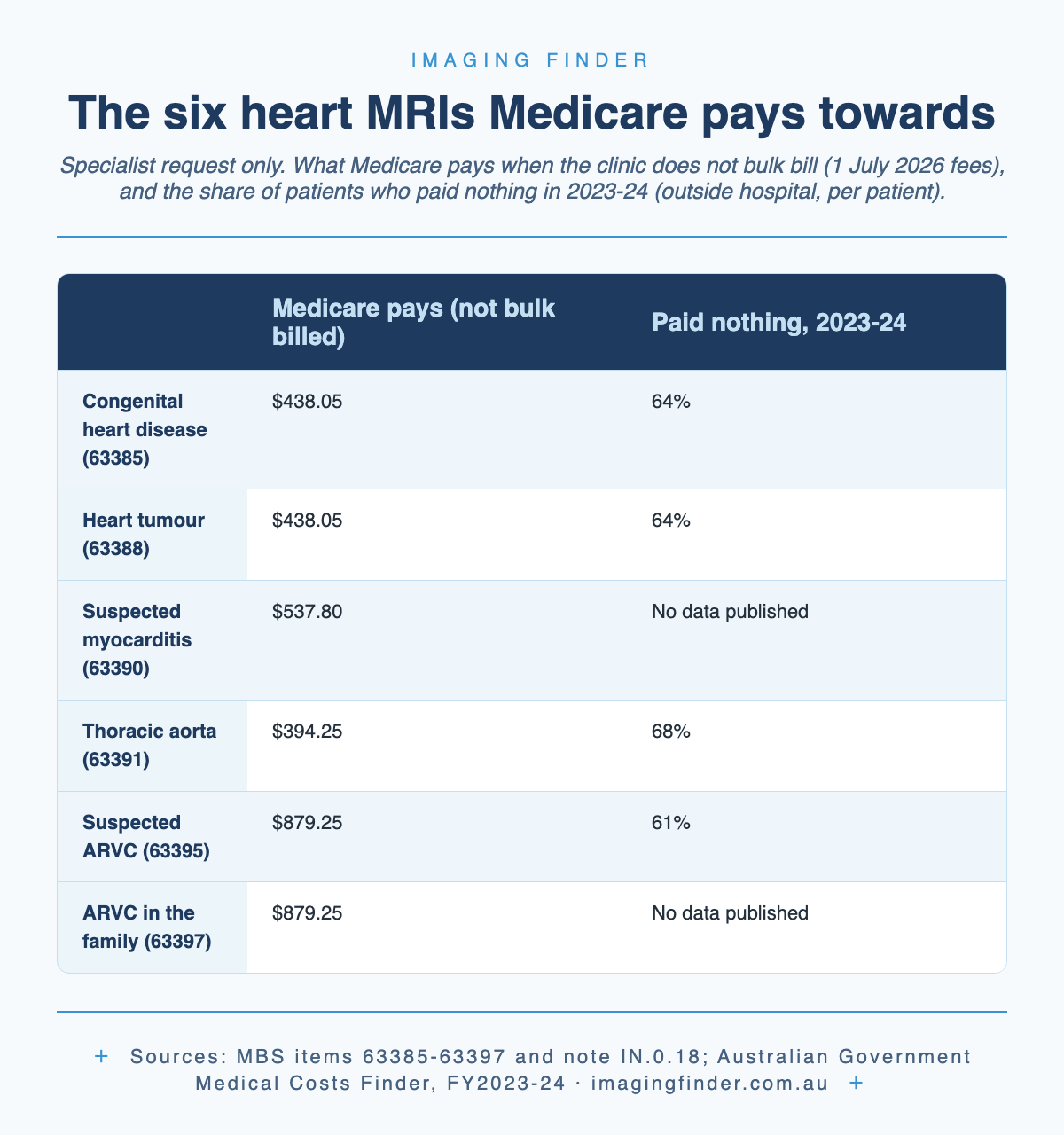
Six. All of them need a written request from a recognised specialist or consultant physician that names the clinical reason. In practice that is usually your cardiologist, often after your GP has referred you for further tests. No Medicare item lets a GP request an MRI of the heart.
Fees from 1 July 2026, for scans outside hospital. The “Medicare pays” column is the benefit when the clinic does not bulk bill. It is usually 85% of the Schedule fee; for the ARVC items it is higher, leaving a $104.50 gap at the Schedule fee. *Items 63385 to 63391 share one limit: two scans in any rolling 12 months across the group.
ARVC, arrhythmogenic right ventricular cardiomyopathy, is a heart-muscle disease in which part of the muscle is replaced with scar tissue, which can cause irregular heart rhythms; some cardiomyopathies are inherited, which is why a family history counts. For both ARVC items, the request must say ARVC is suspected on criteria endorsed by the Cardiac Society of Australia and New Zealand. The myocarditis item is narrower than its name suggests. It covers three situations: heart failure that began less than three months ago, or an unexplained rhythm problem, where the alternative would be a heart-muscle biopsy; or suspected drug-related myocarditis after a troponin blood test, chest X-ray and heart ultrasound have all been inconclusive.
Why do so many heart MRIs have no Medicare item?
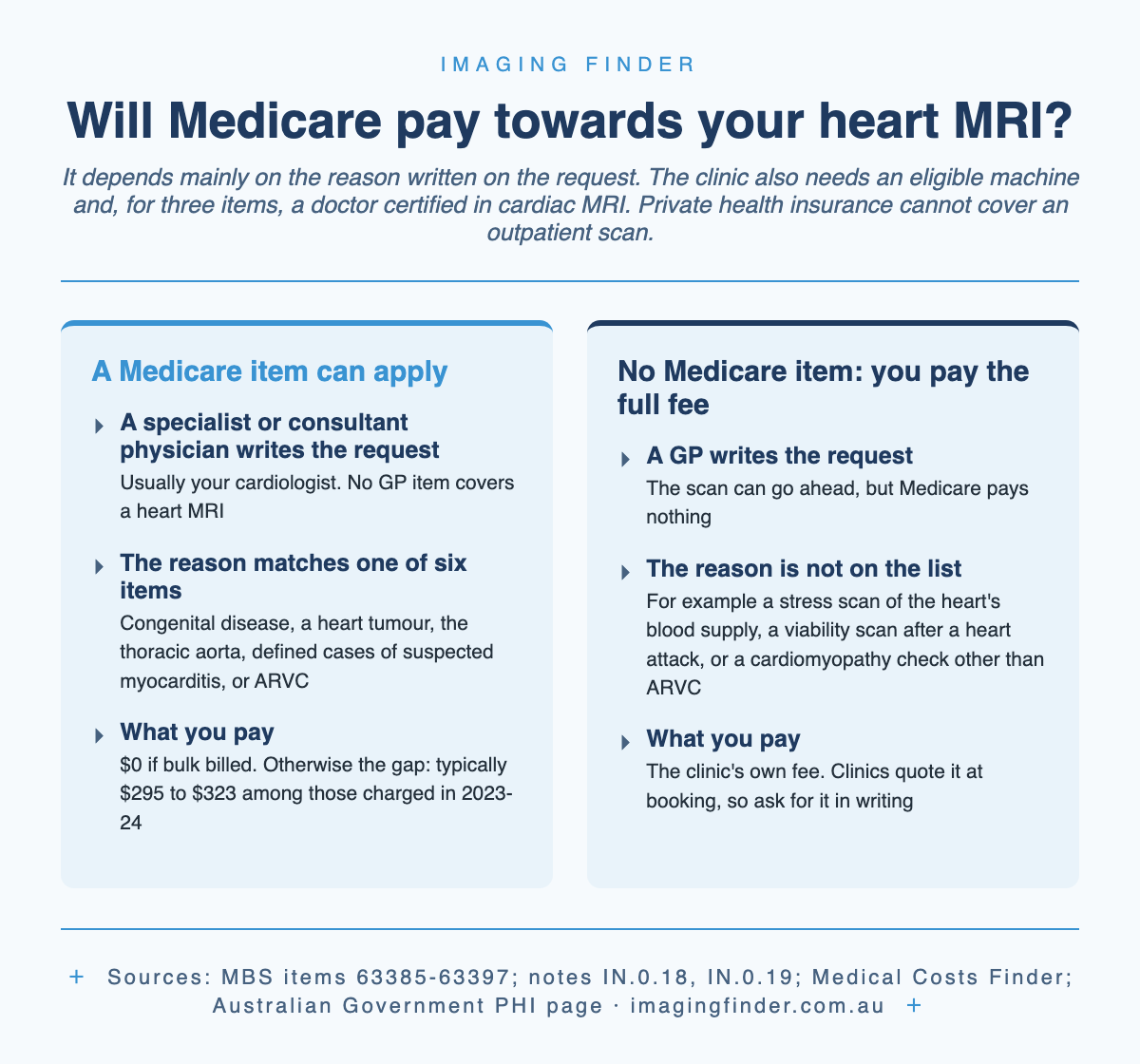
Because the list names conditions, and many reasons for a heart MRI are not on it. A heart MRI is not one test. It can measure how well each side of the heart pumps, show scarring after a heart attack, check blood supply to the heart muscle under a stress medicine, or map the heart’s structure. Medicare lists only a few of these jobs: heart disease present from birth, heart tumours, the aorta, defined cases of myocarditis, and ARVC.
So no Medicare heart MRI item covers a stress perfusion scan for narrowed coronary arteries. None covers a viability scan to see which muscle could recover after a heart attack. And none covers a cardiomyopathy work-up other than ARVC or the defined myocarditis cases. Your cardiologist can still request any of these, and the scan can go ahead. Medicare simply pays nothing towards it.
The wording on the form matters: a request that just says “cardiac MRI” cannot be matched to an item. If your cardiologist thinks your scan fits one of the six, ask them to write the exact reason. If it does not fit, ask them before you book, so the full fee does not come as a surprise.
The scan itself explains part of the price. As a radiologist, I would put a heart MRI among the more demanding MRI scans. ECG leads go on your chest, you hold your breath for short periods many times, and contrast may be injected. One Brisbane clinic says you will lie on the table for about an hour. For three of the items, Medicare also requires the doctor supervising the scan to be certified in cardiac MRI by a joint radiology and cardiology committee. My view is that this mix of time, staff and expertise is why fewer clinics offer it, and why it costs more than a knee or brain MRI.
What did people actually pay?
Most paid nothing. Those who were charged typically paid about $300, and a gap was more common than for a GP head MRI or a foot MRI. These are the latest government figures, for scans billed to each item outside hospital in 2023–24.
Latest published year as at October 2026. “Paid nothing” is the share of all patients billed that item; the typical gap is the middle figure among those who paid. Items 63390 (new from January 2025) and 63397 have no published figures, and no state breakdown exists for any heart item.
Read plainly: on a Medicare heart MRI, a third or more of patients paid a gap, and the typical gap was about double a GP-requested head MRI. None of these figures covers a heart MRI with no Medicare item, where the whole fee is yours.
Where can you have one, and what should you ask?
Not every MRI clinic does heart MRI, and Medicare pays only for a scan on a Medicare-eligible MRI machine. Start with MRI clinics in Sydney, Melbourne, Brisbane, Perth or Adelaide, The city pages list the MRI clinics in our directory, not only heart MRI sites, and none of our checked examples below is in Sydney, Melbourne or Perth. So in those cities, ask your cardiologist which clinics they use for heart MRI, then use the checklist below.
Five examples from our directory, each confirmed on the clinic’s own cardiac MRI page on 10 October 2026. They are examples, not a ranking or a full list.
- Queensland X-Ray, Mater Hospital Brisbane runs a purpose-built cardiac MRI centre and gives the cost at booking. Its billing guide excludes cardiac MRI from its concession-card bulk billing.
- Queensland X-Ray, Mater Private Hospital Hyde Park in Townsville is on the same cardiac MRI location list.
- Queensland Radiology Specialists, Springwood, where the clinic says cardiac MRI is not bulk billed and has an out-of-pocket fee.
- PRP Diagnostic Imaging, Gosford, which lists Gosford for cardiac MRI and allows 40 to 60 minutes.
- Benson Radiology, Ashford, one of three Adelaide clinics where Benson does cardiac MRI.
Ask before you book
✓ Your cardiologist: “Does my scan fit one of the six Medicare items? If so, please write the reason on the request.”
✓ The clinic: “Do you do cardiac MRI at this site, and which Medicare item will you bill?”
✓ “Do you bulk bill it? If not, or if there is no item, what is the fee and what will Medicare pay back?” Medical Costs Finder calls this a written estimate.
✓ “Should I avoid caffeine or fast beforehand?” Instructions differ: one clinic asks for a two-hour fast, and a stress scan means no caffeine.
If your cardiologist suggests a CT of the heart instead, our guide to heart CT, calcium score and CT coronary angiogram costs covers those prices. For other MRI scans, see the MRI cost guide or which MRI scans Medicare covers.
Common questions
Does private health insurance cover a heart MRI?
Not as an outpatient. By law, private health insurance cannot cover out-of-hospital diagnostic imaging. Hospital cover helps only with treatment as a private patient in hospital, so a fund comes into it only if the scan is done during a private hospital admission.
Can I have it free in a public hospital?
Yes, as a public patient. Anyone with a Medicare card can choose public hospital services free of charge, provided on the basis of clinical need and within a clinically appropriate period. Ask your cardiologist whether a public hospital can do your scan, and how long that is likely to take.
How should I prepare, and how long does it take?
The scan itself takes 20 to 45 minutes, and up to an hour for complex heart conditions; one clinic allows 40 to 60 minutes and asks for a two-hour fast. Many scans use contrast through a small needle (cannula) in a vein in your arm, so if you have kidney disease your doctor may check a blood test before gadolinium contrast. For a stress scan you will be asked to avoid caffeine, including decaffeinated coffee and cola, for 24 to 48 hours. If enclosed spaces worry you, read our guide to MRI claustrophobia.
How we know: sources and method
Item wording, Schedule fees and benefits come from the Medicare Benefits Schedule, read on 10 October 2026 (every fee quoted was updated on 1 July 2026). The requester, certification and frequency rules are from note IN.0.18; the list of six comes from searching the Schedule for MRI scans of the cardiovascular system. What patients paid per item is the Department of Health’s Medical Costs Finder, filtered to diagnostic radiology, out of hospital, 2023–24, counted per patient, the same filter as our foot and ankle MRI cost guide and brain MRI cost guide. Clinic details and billing statements are from each clinic’s own pages, read on 10 October 2026. The description of the scan types and preparation is from InsideRadiology, the patient site of the Royal Australian and New Zealand College of Radiologists. Where I give a view on why heart MRI costs more, that is my judgement as a radiologist; your cardiologist’s advice about which test you need comes first.
This article is general information, not personal medical advice. Discuss your individual report and next steps with the healthcare professional responsible for your care.

Author: Dr. Mark Bekhit
Dr Mark Bekhit (MBChB, FRANZCR) is a musculoskeletal radiologist practising in Brisbane and an AHPRA-registered specialist in diagnostic radiology (MED0002920947). He spends as much time building software as reading scans: he founded Imaging Finder (Australia) and Radiology Clinics NZ to make imaging easier to find, and builds radiology dictation and pain-tracking tools with one aim — better patient outcomes and a smoother reporting workflow. Outside the reading room he's usually training, bringing the same performance mindset to imaging.
Leave a Reply