
By Dr. Mark Bekhit, Radiologist · Last updated September 2026
Short answer: The Medicare Schedule fee for the standard head MRI items is $463.80 (from 1 July 2026), and outside hospital Medicare pays $394.25 of it, but only when your doctor’s request matches one of those items. When it does, most people pay nothing: in 2023–24, 87% of patients scanned under the GP item had no gap; the rest typically paid $150. A request that fits no item means a private scan at the practice’s price. Who makes the request, and why, decide whether Medicare pays; the practice decides whether there is a gap.
On this page
• How much does a brain MRI cost in Australia?
• Who can request a brain MRI that Medicare pays for?
• Your GP says Medicare will not cover it: the five routes
• Will your brain MRI be bulk billed?
How much does a brain MRI cost in Australia?
There are three prices. The request decides whether Medicare contributes at all; the practice decides whether it bulk bills. If the practice bulk bills, it accepts the Medicare benefit as full payment: you pay $0 and Medicare pays the practice 95% of the Schedule fee, $440.61 for the standard head items. If the practice charges its own fee, you usually pay the whole fee up front and claim the Medicare benefit back.
Among patients who were charged in 2023–24, the typical fee was $513 for the GP item (63551) with a typical gap of $150, and $523 for the specialist tumour item (63001) with a typical gap of $160. If the request fits no item, the practice sets its own fee and Medicare pays nothing.
Each head MRI item is tied to a condition and to a type of requester, and the fee is $463.80 for almost all of them. What changes between rows is who can sign the form and how often people were charged.
Schedule fees are the values on MBS Online as at September 2026, updated 1 July 2026; “Medicare pays” is the 85% out-of-hospital benefit. The last two columns are the Department of Health’s Medical Costs Finder figures for patients scanned at radiology practices outside hospital in 2023–24; the fee and the gap are medians among those who were charged, not quotes. Three head items carry a lower fee: acoustic neuroma (63040) and stereotactic surgical planning (63010) at $386.55 (Medicare pays $328.60), and pituitary tumour (63043) at $412.25 (Medicare pays $350.45).
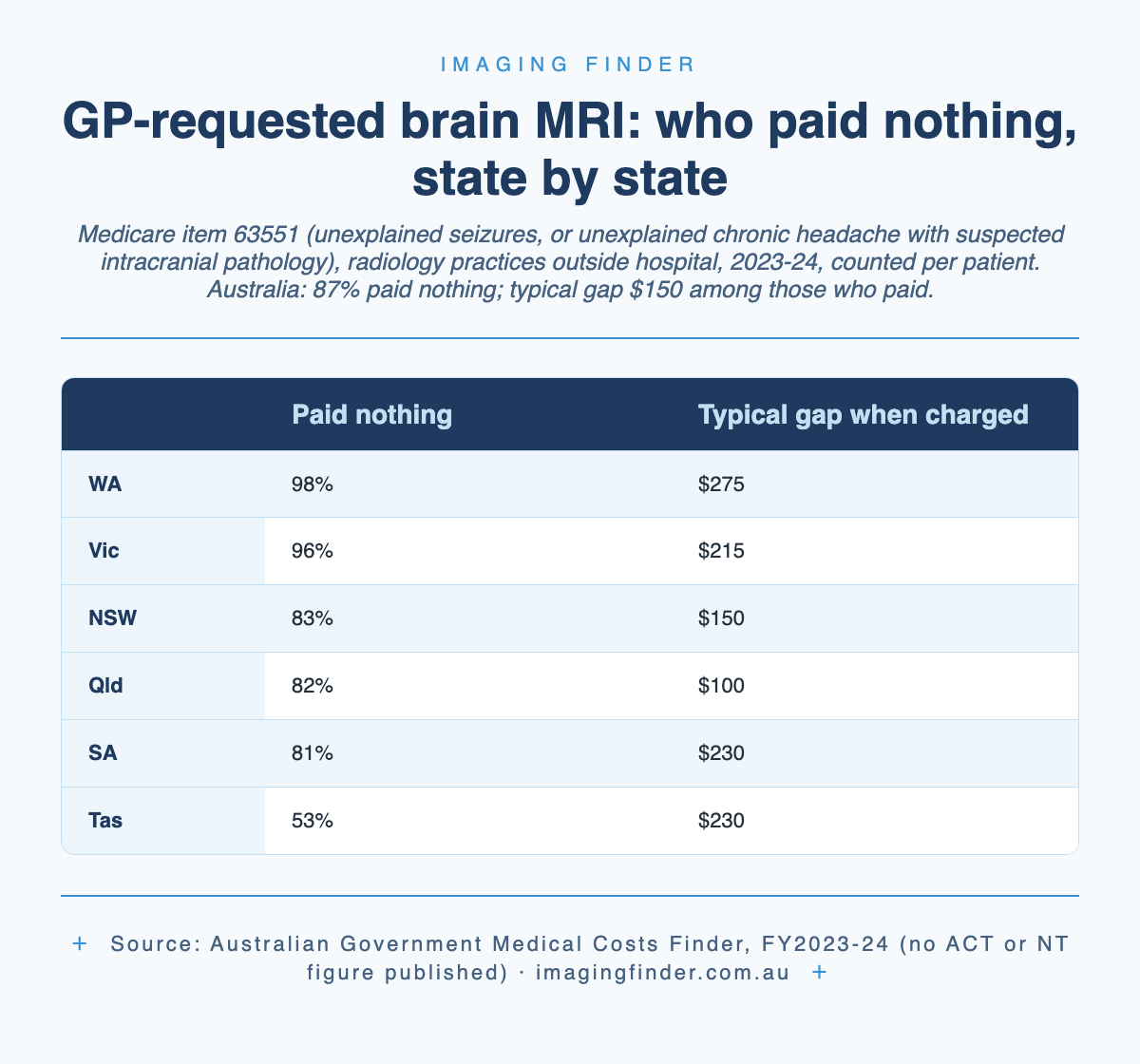
Where you live moves the odds more than the item does. Among patients scanned under the GP item in 2023–24, 98% in Western Australia and 96% in Victoria paid nothing, against 53% in Tasmania, and the median gap among those who did pay ran from $100 in Queensland to $275 in Western Australia.
Who can request a brain MRI that Medicare pays for?
Medicare is stricter about MRI than about CT. MRI services can only be requested by a recognised specialist or consultant physician, in writing, naming the clinical indication, with two exceptions that matter here. There are 18 specialist-only head items, almost all tied to a named condition: tumour, inflammation, demyelinating disease, epilepsy, stroke, aneurysm, head trauma, pituitary and acoustic tumours, and nine others. Every one of them says “including MRA, if performed”, so pictures of the blood vessels, when they are done, come inside the same fee.
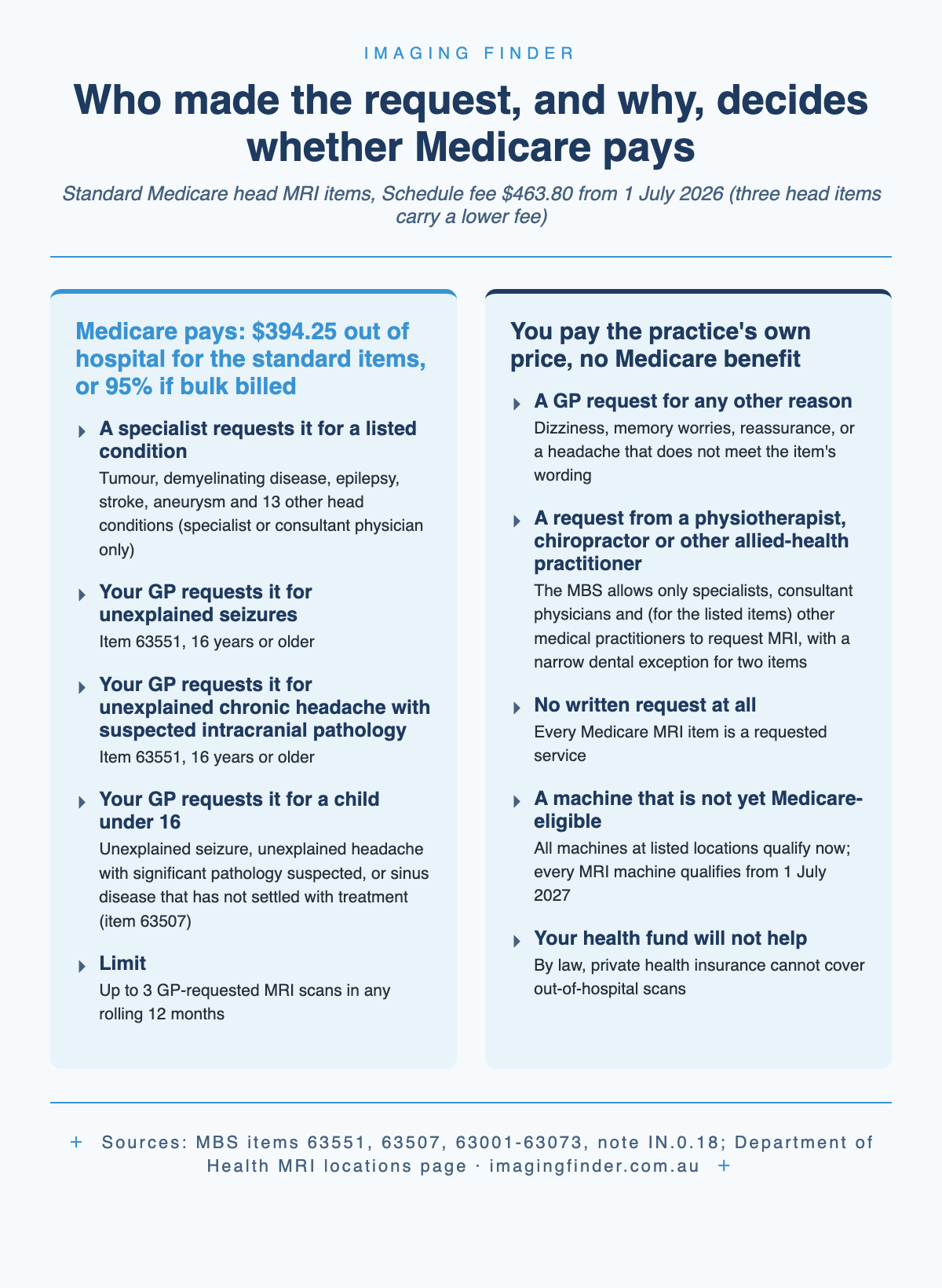
The exceptions are the general-practice items. Your GP can request a Medicare brain MRI for an adult only under item 63551: unexplained seizures, or unexplained chronic headache with suspected intracranial pathology. For a child under 16, item 63507 has its own three reasons, listed in the table above, including sinus disease that has not responded to non-surgical treatment. Medicare allows at most three GP-requested MRI scans in any rolling 12 months, counted across all the GP items together (head, spine, knee and the child limb items); the knee MRI cost guide explains the knee rules. Only doctors can request a Medicare MRI, with a narrow dental exception for two items.
What the request has to say: the item is claimed against the indication written on the form. A GP request that reads “headache” is not item 63551; one that reads “unexplained chronic headache, suspected intracranial pathology” is, if that is the genuine clinical picture. The requesting doctor is responsible for deciding the scan is clinically relevant, and in my experience the radiology practice will not re-word a request after the fact. Ask your GP whether the item’s criteria fit your situation; that decision, and the indication they write, is theirs.
One more rule saves an argument at the front desk: Medicare pays for only one head MRI scan per attendance. If the request lists two conditions, the practice normally claims the item with the higher fee, once; a second item is claimed only when the request states why a separate scan is needed. The request itself does not expire, can be emailed if the practice accepts electronic requests, and can be taken to any practice, whatever brand is printed on it.
Your GP says Medicare will not cover it: the five routes
A GP wants a brain MRI for dizziness, memory worries, a headache that does not fit the item wording, or to settle a fear, and there is no GP item for it. Neither the GP nor the front desk is being difficult; the schedule simply has no row for that request. From here there are five routes, and the request decides whether Medicare pays at all.
Check the reason. If unexplained seizures, or chronic unexplained headache with a real concern about something inside the skull, is the honest clinical picture, item 63551 exists for exactly that and your GP can use it. That is a judgement for your doctor, not a form of words to negotiate.
A specialist referral. A neurologist, neurosurgeon or other specialist can request the scan under the specialist item that matches the condition, but only if the reason is one of the 18 listed conditions. A specialist request for dizziness or a memory concern with no matching item is still a private scan. A specialist appointment is an extra step, and most specialist head items carry the same cap of three scans in 12 months.
A CT of the brain instead. A GP can request a CT of the brain under item 56001 (Schedule fee $225.20, Medicare pays $191.45; with contrast, item 56007 at $288.65 and $245.40), and 85.1% of Medicare CT services were bulk billed between April and June 2026. My caveat as a radiologist: CT is a good test for bleeding, a skull fracture or a large mass. It is the wrong first test for some conditions that have their own MRI items, such as demyelinating disease, pituitary problems and an epilepsy work-up. A normal CT does not always close the question; our MRI versus CT guide and CT cost page cover the trade-off.
The public hospital. With a Medicare card you can receive public hospital services free of charge as a public patient, provided on clinical need and within a clinically appropriate period; you do not choose the doctor, and the hospital sets the timing.
Pay privately. A practice can scan you on a doctor’s request at its own price, and by law private health insurance cannot cover out-of-hospital diagnostic imaging, so the fee is entirely yours. As one dated example, Exact Radiology’s January 2026 price guide lists a Medicare-non-eligible MRI “from $250”; that is a starting price for that practice’s cheapest MRI rather than a brain MRI quote. If you are considering a scan with no symptoms at all, our full-body MRI guide covers that separately.
Will your brain MRI be bulk billed?
More often than not. The Department’s Medicare quarterly statistics, published 10 August 2026, count every MRI service claimed under Medicare, in and out of hospital. Between April and June 2026, 80.8% of 463,553 services were bulk billed, and when a fee was charged outside hospital the average patient contribution was $200.43. Regional centres (80.8%) match the cities (81.1%), the rural and very remote groups sit between 79.0% and 81.6%, and remote communities are the lowest, at 75.9%. The state spread is wider than the city-country one.
These are per-service figures for the whole MRI group, from the same June-quarter workbook; the rate covers all settings and the gap column out-of-hospital services only. Fewer than half of the ACT’s MRI services were bulk billed; in Western Australia and Victoria, about nine in ten were. They describe the market as a whole; the practice you are about to phone may sit anywhere in that spread.
One trap remains: not every MRI machine is Medicare-eligible. In the metropolitan areas a machine at a full-service practice (one with X-ray, ultrasound and CT on site) also needs a Commonwealth deed to qualify; at full-service practices in regional and rural areas every machine qualifies. Since 1 July 2025 every machine at the Department’s listed locations can provide all MRI services on the schedule, and from 1 July 2027 every MRI machine will be able to. Until then, a scan on an unlisted machine earns no rebate even with a perfect request, so the question below asks about the machine as well as the item.
Where to book, and what to ask
Shortlist MRI clinics near you in Sydney, Melbourne, Brisbane, Perth or Adelaide, then phone the nearest two. Examples from our directory that list MRI, checked against each practice’s website on 22 September 2026: Melbourne Radiology Clinic in East Melbourne, Precision Imaging Partners at Barangaroo in Sydney, and Queensland X-Ray at the Mater Hospital in South Brisbane. They are examples rather than a ranking, and a listing cannot tell you a billing policy, so the call is the step that matters.
Ask the clinic when you book
✓ “Is the item on my request Medicare-eligible on your MRI, and do you bulk bill it? If not, what is the fee and how much will Medicare pay back?”
✓ Ask for the estimate in writing, with the item number, and whether a contrast injection would change it.
✓ Tell them about any pacemaker, implant or metal in your body, and about claustrophobia; both change what the practice can offer.
✓ Bring the request, your Medicare card and any previous brain scans, so the radiologist can compare.
If a gadolinium contrast injection is part of your scan, our contrast guide explains what it involves. The scan uses no X-ray radiation, and the report goes back to the doctor who requested it. For every other body part, our MRI cost guide and MRI Medicare eligibility page carry the full item lists.
Common questions
Can I get a brain MRI without a referral?
Not with any Medicare help. You need a referral from your doctor for an MRI, and every MRI item needs a written request. A practice that scans without a request is charging a private fee it sets itself.
Is a “head MRI” the same as a “brain MRI”?
For billing, yes. Medicare has no item called “brain MRI”; the GP items and the diagnostic specialist items from 63001 to 63073 are each a “scan of head” for a named condition. A scan that also covers the neck vessels or the cervical spine is a separate item at $566.90, so it comes with a higher fee.
Does hospital cover ever help with a brain MRI?
Only in hospital. Hospital cover helps with the cost of treatment as a private patient in hospital, so a brain MRI during an admitted private stay is billed differently. Medicare pays 75% of the Schedule fee ($347.85 for the standard head items) and hospital cover can help with the rest. At a radiology practice, the same policy pays nothing.
How we know: sources and method
Item wording, Schedule fees and benefits come from the Medicare Benefits Schedule, read on 22 September 2026 (every fee quoted was updated on 1 July 2026), and the requester, limit and one-scan-per-visit rules from notes IN.0.18, IN.0.6 and IN.0.2. What patients paid per item is the Department of Health’s Medical Costs Finder, filtered to diagnostic radiology, out of hospital, 2023–24, the same filter as our other cost guides. The state bulk-billing rates are the Department’s Medicare quarterly statistics for the June quarter of 2025–26, published 10 August 2026, counted per service across the whole MRI group. Machine eligibility is from the Department’s MRI and PET locations page, and general patient information from healthdirect. Where I give a view on which test suits which question, that is my judgement as a radiologist; your own doctor’s advice comes first.
This article is general information, not personal medical advice. Discuss your individual report and next steps with the healthcare professional responsible for your care.

Author: Dr. Mark Bekhit
Dr Mark Bekhit (MBChB, FRANZCR) is a musculoskeletal radiologist practising in Brisbane and an AHPRA-registered specialist in diagnostic radiology (MED0002920947). He spends as much time building software as reading scans: he founded Imaging Finder (Australia) and Radiology Clinics NZ to make imaging easier to find, and builds radiology dictation and pain-tracking tools with one aim — better patient outcomes and a smoother reporting workflow. Outside the reading room he's usually training, bringing the same performance mindset to imaging.
Leave a Reply