
By Dr. Mark Bekhit, Radiologist · Last updated November 2026
Short answer: When Medicare covers a CT colonography (a “virtual colonoscopy”), most people pay nothing. There is one Medicare item, 56553, with a 2026 fee of $600.30. In 2023–24, 82% of patients paid no gap, and those charged typically paid $180. The catch is qualifying. You need bowel symptoms or a high risk of bowel cancer, plus an incomplete colonoscopy in the past three months, a severe bowel blockage, or a request from a specialist who does colonoscopies. Otherwise a private clinic charges its full fee.
On this page
• How much does a CT colonography cost?
• When does Medicare pay for it?
• What did people actually pay?
• Can it replace a colonoscopy?
How much does a CT colonography cost?
CT colonography is a CT scan of the large bowel, also called a virtual colonoscopy. What you pay depends almost entirely on whether your request fits Medicare’s one item for it. Four situations cover most people:
A clinic charging exactly Medicare’s 2026 fee would leave you $90.00. Clinics that charge a gap usually charge more: in the year to June 2024, people who qualified and were charged a gap typically faced a $659 fee (a 2023–24 figure), and Medicare paid $479 of it, leaving the $180 gap. If you don’t qualify, none of the clinic websites or price guides we checked (as at 10 November 2026) published a self-pay price. Ask for a written quote, and see our guide to scans without a Medicare rebate.
When does Medicare pay for it?
Item 56553 pays for a CT colonography to find or rule out bowel cancer or polyps in a person with symptoms or a high risk, and only when at least one of three things is also true:
- You had an incomplete colonoscopy in the three months before the scan. The scope couldn’t get all the way round, so part of the bowel wasn’t seen.
- There is a high-grade colonic obstruction, meaning the large bowel is badly blocked.
- A specialist who performs colonoscopies asked for it. In practice that is usually a gastroenterologist, or a bowel or general surgeon.
Your GP can write the request for the first two routes; the third needs the colonoscopy specialist. So if you have no symptoms and ordinary risk, and want the scan as a check-up, it falls outside the item whoever writes the request. The same goes for simply preferring a scan to a colonoscopy on a GP request. Our guide to referrals for CT explains who can request what.
Good to know: a clinic can’t bill your virtual colonoscopy as an ordinary abdomen and pelvis CT instead. Medicare’s rules say 56553 is the item to use for a CT colonography, and that the ordinary abdomen and pelvis items aren’t payable for one.
This may change. An application to the government’s Medical Services Advisory Committee for a new CT colonography item was still marked pending as at 10 November 2026. Until a decision is published, the three routes above are the rule.
What did people actually pay?
Medicare’s own figures for item 56553, for scans done at a clinic (out of hospital) in 2023–24:
Source: Medical Costs Finder, item 56553, radiology services in 2023–24, per patient. No figure is published for WA, Tasmania, the NT or the ACT. These are people who qualified; they say nothing about a self-paid scan.
Victoria is the odd one out: the lowest share paying nothing, but the smallest typical gap. The data doesn’t say why, so I won’t guess.
Can it replace a colonoscopy?
Not as a free choice: Medicare funds it only through the three routes above. The scan’s real advantage is that it needs no sedation, so you can carry on with your day. Its weakness is that it can only look. A colonoscopy can take a biopsy, which is why it remains the preferred test for people with bowel symptoms such as bleeding or weight loss, a family history of bowel cancer, or previous polyps.
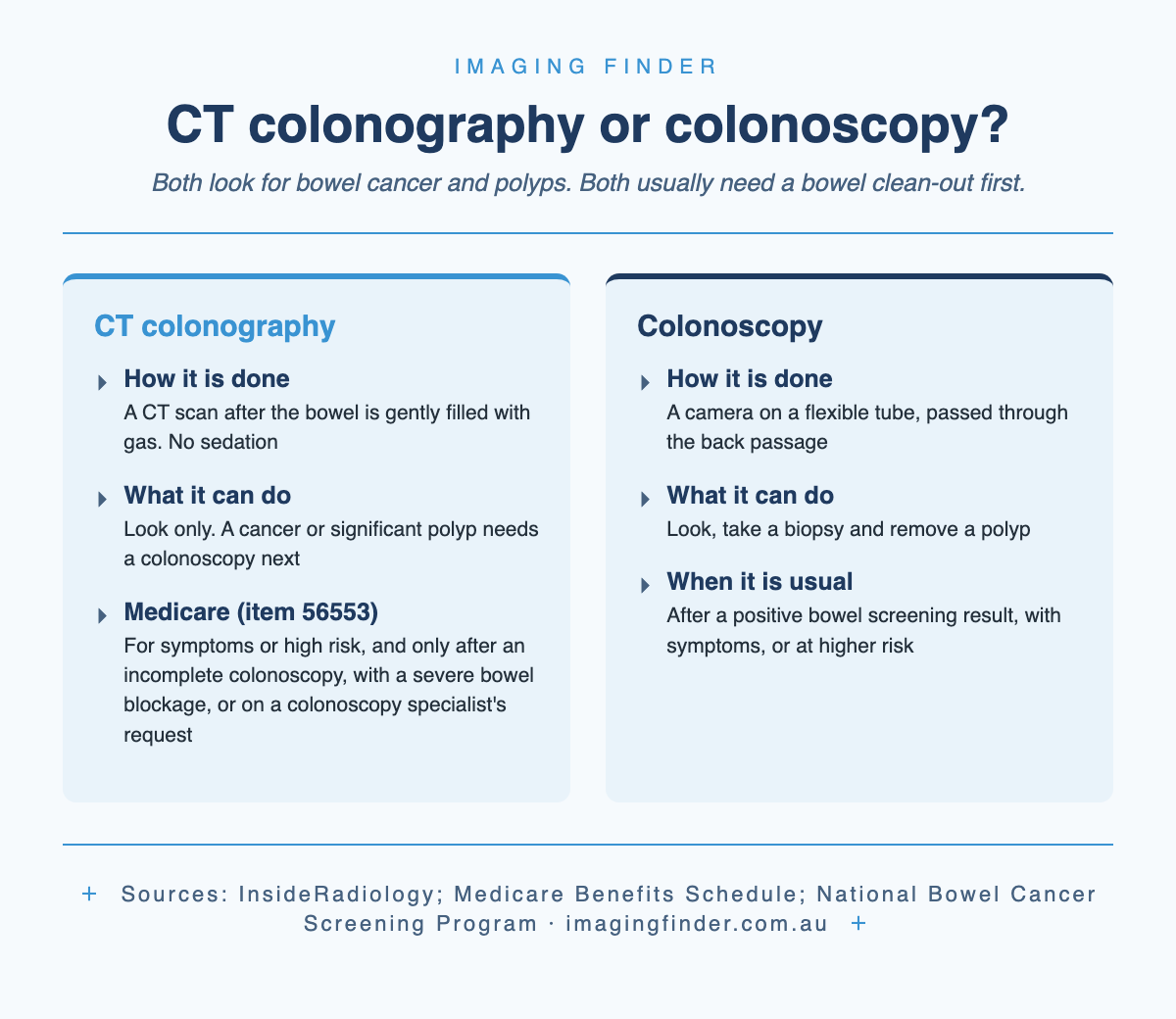
Here is the part people don’t expect. With the standard preparation, you still take the laxatives. The clean-out is similar to a colonoscopy’s, and if the scan finds a cancer or a significant polyp, the next step is a colonoscopy anyway. That means a second preparation. As a radiologist, I’d put it this way: the preparation, not the scan, is the hard part, and a CT colonography doesn’t spare you it.
If your free home bowel screening test comes back positive, the program’s advice is to see your doctor, who will probably refer you to a specialist for a colonoscopy. That specialist can request a CT colonography under the third route if they judge it the better test for you. Which test is right is their call, with you.
What happens on the day?
The clinic sends a preparation pack. It usually means a low-fibre diet for one to three days, laxatives the evening before and no breakfast. Some packs include a chalky drink that highlights, or “tags”, any leftover stool and fluid in the bowel. Packs differ: Perth Radiological Clinic’s starts two days out with no fruit, then clear fluids and two laxatives the day before, while Canberra Imaging Group gives you a letter to take to a pharmacy. If you have diabetes, kidney disease or a heart condition, tell your doctor and the radiologist, because the instructions may change.
On the table, a small soft tube in the rectum gently inflates the bowel with air or carbon dioxide. It feels tight and bloated. You hold your breath for two short scans, one on your back and one on your front, and you’re in the room for about 10 to 20 minutes. You might also get an injection to relax the bowel.
Cramping and bloating can last a few hours, and you can eat normally afterwards. A hole in the bowel wall is rare: InsideRadiology’s page (last updated 2017) puts it at up to 0.03% of patients. Worsening belly pain afterwards needs your doctor or an emergency department straight away.
The scan uses X-rays, so it isn’t done in pregnancy; our CT radiation guide puts the dose in context. A radiologist reports the scan to the doctor who requested it, who goes through the result with you.
Where can you have one, and what should you ask?
You can take your request to a different practice from the one printed on the form, as long as it offers the test. Not every CT clinic does colonography. Start with the CT clinics near you in Sydney, Melbourne, Brisbane, Perth, Adelaide or Canberra.
CT colonography isn’t a separate filter in our directory, and not every branch does it, so here are three examples whose groups describe it on their own websites (checked 10 November 2026). They are examples, not a ranking or a complete list:
- Perth Radiological Clinic, Wexford Medical Centre, Murdoch, Perth, one of the sites its virtual colonoscopy page names. Its price guide lists Medicare-rebatable diagnostic CT as bulk billed, without naming colonography.
- Canberra Imaging Group, ACT and nearby NSW (CT colonography page).
- Benson Radiology, Adelaide (referral guide).
Ask the clinic when you book
✓ “Do you do CT colonography at this branch?”
✓ “Does my request meet Medicare item 56553? If not, what is the full fee?”
✓ “If it does, do you bulk bill it, or what is my gap?”
✓ “When do I collect the preparation, and is it included?”
For other CT scans, our CT cost guide covers prices and rebates, and the bulk-billing guide explains why two clinics charge differently for the same item. The other CT test built around a cancer check, low-dose lung screening, has its own national program.
Common questions
Does private health insurance cover a CT colonography?
Not at a clinic as an outpatient. By law, private health insurance can’t cover out-of-hospital diagnostic imaging, so it can’t pay a self-funded scan either. Hospital cover only comes into play if you have the scan while admitted as a private patient; ask your fund about that before you assume anything.
Can I drive home after a CT colonography?
Plan a lift. If you’re given the injection that relaxes the bowel, your eyesight can be a little blurry for about half an hour, and I-MED says you won’t be able to drive home if you have it. You won’t know whether you need it until you’re on the table.
Why does my report mention something that isn’t in my bowel?
Because the scan covers the whole abdomen and pelvis, not just the bowel lining, the radiologist sees the other organs too and has to describe anything there. Your doctor decides whether anything needs following up.
Sources
- Medicare Benefits Schedule, item 56553
- Medicare Benefits Schedule, note IN.0.6 (requests)
- Medicare Benefits Schedule, note IN.0.15 (computed tomography)
- Medicare Benefits Schedule, note IN.0.19 (bulk billing incentive)
- Medical Costs Finder, item 56553
- Medical Services Advisory Committee, application 1789
- InsideRadiology, CT colonography (page last modified August 2017)
- National Bowel Cancer Screening Program, understanding your results
- Department of Health, what private health insurance covers
- Department of Health, public hospitals
- healthdirect, paying for diagnostic testing
- Perth Radiological Clinic, CT virtual colonoscopy
- Perth Radiological Clinic, price guidelines, September 2026
- Canberra Imaging Group, CT colonography
- Benson Radiology, CT colonography referral guide
- I-MED Radiology, CT colonography
This article is general information, not personal medical advice. Discuss your individual report and next steps with the healthcare professional responsible for your care.

Author: Dr. Mark Bekhit
Dr Mark Bekhit (MBChB, FRANZCR) is a musculoskeletal radiologist practising in Brisbane and an AHPRA-registered specialist in diagnostic radiology (MED0002920947). He spends as much time building software as reading scans: he founded Imaging Finder (Australia) and Radiology Clinics NZ to make imaging easier to find, and builds radiology dictation and pain-tracking tools with one aim — better patient outcomes and a smoother reporting workflow. Outside the reading room he's usually training, bringing the same performance mindset to imaging.
Leave a Reply