Someone has told you a cortisone injection might settle a stubborn shoulder, hip, knee or back, and that it will be done “under ultrasound” or “under CT”. You are probably weighing up three things: will it hurt, will it work, and what will it cost. Here is the honest version from a radiologist — the people who actually do these injections.
The quick answer
Short answer: An image-guided cortisone injection is a short, low-risk day-procedure. A radiologist uses ultrasound for a shoulder, hip, knee or bursa, and CT or live X-ray for a spinal facet joint, so the medication lands exactly where it should. Medicare helps when your doctor requests it, but the two are not priced alike. An ultrasound-guided injection is billed on a single item, Schedule fee $161.00. A CT-guided facet joint injection is billed on two, with a combined Schedule fee of $673.20. Ask which items will be billed before you book.
Keep your expectations realistic: an injection usually calms the pain rather than curing the cause. For many people the relief lasts months, not forever — so it works best as one part of a plan that includes the exercise or treatment your doctor recommends.
On this page
• What an image-guided cortisone injection is
• Who refers you, and why imaging is used
• Does Medicare cover it, and what does it cost?
What an image-guided cortisone injection is
It is an injection of a corticosteroid — usually with some local anaesthetic — placed directly into an inflamed joint or bursa. The steroid dampens inflammation, and the drop in pain can make physiotherapy and exercise more effective. It is used most often in the shoulder, knee or hip, but it can help in other joints and in the bursae around them.
“Image-guided” is the important part. Instead of injecting by feel, the radiologist watches a live ultrasound picture, or uses a CT scanner — or, in some units, live X-ray — for the small joints deep in the spine, and sees the needle tip reach the target before any medication goes in. That is the whole point of the guidance: the medicine ends up in the joint, not near it.
Who refers you, and why imaging is used
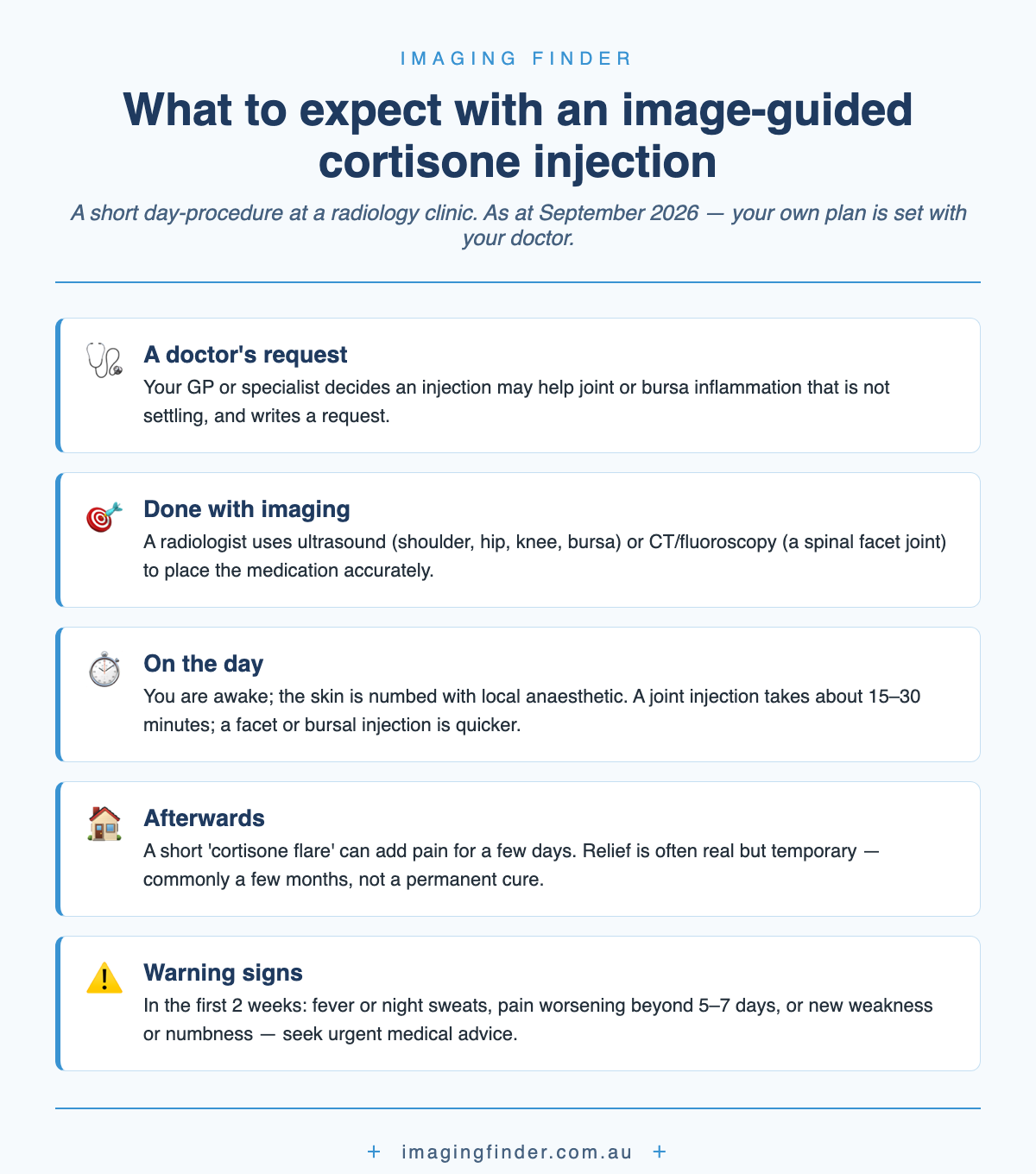
You need a request from a doctor — usually your GP, or a specialist such as a rheumatologist or orthopaedic surgeon. They will suggest an injection when there is inflammation in a joint that is not improving with other treatment. It is not a first move for every ache, and it is not a substitute for sorting out the underlying problem. Think of it as a way to quieten the pain enough to get moving and rehabilitate.
The reason a radiologist does it, rather than someone injecting in a consulting room, is accuracy. Ultrasound shows the needle sliding into a shoulder bursa in real time; CT shows a needle reaching a facet joint a few centimetres deep in your back. If the medication has to be in a precise, small space to work, seeing it get there matters. For general rules about who can request your scans, see our guide to referrals for an X-ray, ultrasound or CT.
What happens on the day
You are awake the whole time. The skin over the target is cleaned, then local anaesthetic is injected into the skin and deeper tissues — a sharp pin-prick and some stinging, which is usually the most uncomfortable part. Only that small area is numbed; you will not be put to sleep. Once it is numb, the radiologist places the needle under imaging and injects the steroid.
It is quick. An ultrasound-guided joint injection generally takes 15 to 30 minutes, most of which is positioning and scanning; a facet joint injection is around 15 minutes, and a bursal injection itself rarely takes more than five. There is no anaesthetic to sleep off, so most people get up and go home soon afterwards, though whether you should arrange a lift depends on which joint was injected.
How to prepare
There is not much to it, but two things matter. If your injection is a spinal facet joint, you will lie on your stomach, so keep food to a light meal only, up to about two hours beforehand, wear comfortable clothes that are easy to remove, and leave necklaces and other jewellery at home. The second thing is the one to phone ahead about: blood thinners.
Before you go, tell the clinic if you
✓ Take a blood thinner — warfarin, clopidogrel, dabigatran, prasugrel, dipyridamole or asasantin
✓ Have ever reacted to a local anaesthetic, contrast dye or cortisone
✓ Have diabetes — a steroid can raise your blood sugar for a few days
✓ Are, or might be, pregnant
Some blood thinners may need to be stopped before the procedure, and a blood test may be needed to check your clotting on the day. But do not stop any of them on your own — they are usually there to prevent a stroke or heart attack, so only stop if your doctor or the radiology practice tells you to. Aspirin is usually left alone. This is exactly the kind of thing the clinic sorts out when you book, which is why the phone call ahead is worth it. Our ultrasound preparation guide covers the general basics.
Does Medicare cover it, and what does it cost?
Yes, when a doctor has requested it. But two injections that sound alike can be priced very differently, and the reason is simple: the scanner that guides the needle sets the price. An ultrasound-guided injection into a shoulder, hip, knee or bursa is billed on one modest item. A CT-guided injection into a spinal facet joint is billed on two, and the CT guidance is the biggest single charge in the procedure. Medicare pays a set percentage of a fixed Schedule fee for each item; the clinic sets its own fee, and anything above the Medicare benefit is yours to pay.
Schedule fees as at September 2026, current to the 1 July 2026 indexation. A medial branch block, a close cousin of the facet injection, is item 39014 ($149.45), again with the CT guidance billed separately. An ultrasound-guided joint or bursa injection carries no second guidance item: item 55848 is the guidance on its own, and no other item in the ultrasound group may be claimed with it, while 55850 is the version that also includes the diagnostic musculoskeletal ultrasound. A facet injection can also be done under live X-ray, but the mobile-fluoroscopy items — 60506 ($75.10) and 60509 ($116.50) — are restricted to hospital treatment and pay only the 75% benefit, so they are not what a community radiology clinic bills. If your injection is booked under live X-ray rather than CT, ask which guidance item will be billed: the $673.20 above is the CT combination.
The difference is not a bigger dose of cortisone. A facet joint sits deep in the spine behind bone, so ultrasound cannot reach it and the needle is guided by X-ray or a CT scanner instead. Medicare prices CT guidance at $542.60, against $161.00 for the whole ultrasound-guided procedure. A shoulder or a bursa is close to the surface, so ultrasound sees it well, and the price follows.
What you will actually pay
Three outcomes, and your clinic decides which. Bulk billed: you pay nothing, and for the imaging items a bulk-billed service is paid at 95% of the Schedule fee rather than 85%. Bulk billing is each practice’s own decision. Privately billed: you pay the clinic’s fee and Medicare pays the benefit back, so your gap is the difference. Public patient in a public hospital: nothing to pay, but you wait by clinical priority.
Do the arithmetic before you book. On a privately billed ultrasound-guided shoulder, hip, knee or bursa injection the Medicare benefit is $136.85, so a clinic fee of $180 leaves you about $43 and a fee of $250 leaves about $113. On a privately billed CT-guided facet joint injection the combined benefit is $572.30, so a fee of $700 leaves about $128 and a fee of $850 leaves about $278. The Schedule fee is a benchmark, not a price cap: a practice can charge above it, and the whole of that excess is yours.
If the gap is large, check your safety net. Out-of-pocket costs for out-of-hospital services count towards the Extended Medicare Safety Net. In 2026 the threshold is $861.20 for concession card holders and families on Family Tax Benefit Part A, and $2,699.10 for everyone else. Above it, Medicare pays up to 80% of your out-of-pocket costs for the rest of the calendar year. Some items cap that extra benefit; none in the table above does. The Original Medicare Safety Net is separate, with a lower threshold of $594.00, but it counts only your gap amount — the difference between the Medicare benefit and the Schedule fee, not your whole out-of-pocket cost. Past it, Medicare pays 100% of the Schedule fee instead of 85% for the rest of the year. Register your family with Services Australia, or the amounts count one person at a time.
Ask for this exact figure: “Which item numbers will you bill, and what is my out-of-pocket cost on the day after the Medicare rebate?” The item numbers matter: 39013 plus 57341 is a very different bill from 55848 alone. For how imaging is billed more generally, see our guides to ultrasound costs, CT costs and bulk-billed radiology.
Will it work, and for how long?
Often it does, and sometimes quickly. For an acute facet joint, relief can be rapid, and about 80% of people get relief lasting three months or more; longer-standing facet pain tends to ease for weeks to months. A joint or bursa often responds too, though the relief may last a few months and then the pain returns, which is when people start asking about a repeat.
Here is the judgement I would offer as a radiologist: a cortisone injection buys you a window, not a cure. It lowers the inflammation so you can rehabilitate, lose load on the joint, or get through a bad patch. If nothing else changes in that window, the pain has a habit of coming back. So treat the injection as the start of a plan, not the whole of it, and talk to your doctor about what to do with the good weeks it gives you.
Risks and side effects
These injections are very safe. A facet joint injection is lower risk than an epidural or a nerve-root injection, and serious problems are rare. The common one is a cortisone flare: redness and flushing of the face and body, starting a few hours or the day after and lasting a few days. More soreness in the joint is common too, and it may last two to three days, with the steroid usually starting to work three to five days after the injection. A true allergy to the steroid is very rare — fewer than one in 250,000 people.
A few sensible caveats. If you have diabetes, the steroid can raise your blood sugar for a few days, so watch it more closely and have it checked after the procedure. There is a small infection risk any time a needle enters a joint, which is why the skin is cleaned with antiseptic and the procedure is done under sterile conditions — and why the warning signs below matter.
Get urgent medical advice if, in the first two weeks, you develop a fever or night sweats, pain that is getting worse beyond five to seven days, new or persistent weakness or numbness, or any loss of control of your bladder or bowel. These are uncommon, but they are the ones not to sit on.
Where to find a clinic
Image-guided injections are done at radiology clinics — the same places that do your ultrasound and CT scans. Once you have your request, you can take it to any clinic that offers the procedure, so it is worth choosing on location, cost and how soon they can fit you in. One catch: not every clinic offers every injection, so the single most useful thing you can do is phone and ask.
Imaging Finder helps with that step. Find an ultrasound clinic near you — Sydney, Melbourne, Brisbane, Perth — or a CT clinic — CT in Sydney, CT in Melbourne, CT in Brisbane, CT in Perth — if your injection is a spinal facet joint, and browse the full imaging directory. Because services change, call first and ask a couple of plain questions.
Ask the clinic when you book
✓ “Do you do image-guided cortisone injections for my joint, and under ultrasound or CT?”
✓ “I take a blood thinner — do you need me to do anything before I come in?”
✓ “Will you send the result and any advice to my referring doctor?”
That is the whole picture: a quick, accurate, low-risk procedure that can give you real relief for a few months — best used to buy time for the treatment that fixes the underlying problem. Sort the booking out with one phone call, and you have done the hard part. If you want to understand the words in the report that follows, see how to read your radiology report.
Common questions
Is a cortisone injection bulk billed?
Sometimes — it is each practice’s own decision, and it is worth asking, because the sum at stake is not small. If a clinic bulk bills you pay nothing, and the imaging items are then paid at 95% of the Schedule fee rather than 85%. If yours does not, the gap on a CT-guided facet joint injection is your clinic’s fee less a combined Medicare benefit of $572.30.
Does it hurt?
The most uncomfortable moment is the local anaesthetic going into the skin — a sharp sting for a few seconds. After that the area is numb, and most people find the injection itself very tolerable. A short ache for a day or two afterwards is normal.
How many cortisone injections can I have?
There is no single number that fits everyone, and it is a decision for your doctor. Because relief can wear off and the pain return, repeats are common — but as a rule of thumb a steroid injection is generally not given into the same area more than three or four times a year, to avoid damaging the joint. Ask your referring doctor how many make sense for you and how far apart.
Can I go back to work afterwards?
Usually yes, for desk-based work, though many people take it easy for a day. If your job is physical, or you had a spinal injection, ask the clinic and your doctor what to avoid and for how long — the answer depends on which joint was injected.
How we know: sources and method
What the injection is, why it is requested, that it eases inflammation and can make physiotherapy more effective, and that an ultrasound-guided joint injection takes 15 to 30 minutes come from InsideRadiology, the patient-information service of the Royal Australian and New Zealand College of Radiologists (RANZCR). The facet-joint details — the local anaesthetic being the most uncomfortable part, the roughly 15-minute procedure, the light-meal and blood-thinner preparation, the very-low risk compared with epidural and nerve-root injections, the cortisone flare, the rare allergy, the effectiveness figures and the two-week warning signs — are from the InsideRadiology facet joint page. The bursal timing and the “relief for a few months, then it returns” pattern are from its bursal injection page. The Medicare items, Schedule fees and benefits are from the Medicare Benefits Schedule, current as at 1 July 2026: item 39013 for the spinal facet joint injection ($130.60), item 39014 for a medial branch block ($149.45), item 57341 for computed tomography performed with an interventional procedure ($542.60), and items 55848 ($161.00) and 55850 ($212.45) for musculoskeletal ultrasound performed with an interventional procedure such as a joint injection. Note IN.0.19 sets the 95% benefit for bulk-billed diagnostic imaging. The 2026 Original and Extended Medicare Safety Net thresholds, and what Medicare pays above them, are from the Department of Health and Aged Care safety net factsheet. Clinic fees above the Schedule fee are set by each practice and are not published nationally, so the dollar examples in this article are arithmetic on the Medicare benefit, not a quote. Whether an injection is right for you, and how many, is a decision for you and your referring doctor.
- InsideRadiology (RANZCR): joint injection, image-guided facet joint corticosteroid injection and bursal injection — what the procedure is, preparation, timing, risks, aftercare and effectiveness
- Medicare Benefits Schedule: item 39013 (spinal facet joint injection under image guidance), item 39014 (medial branch block), item 57341 (CT with an interventional procedure), item 55848 and item 55850 (musculoskeletal ultrasound with an interventional procedure), item 60506 (fluoroscopy with a surgical procedure, hospital treatment only), and note IN.0.19 — descriptors, Schedule fees, benefits and the bulk-billing rule
- Department of Health and Aged Care: Medicare Safety Net arrangements from 1 January 2026 — the 2026 Original and Extended Medicare Safety Net thresholds, what counts towards each, and what Medicare pays above them
This article is general information, not personal medical advice. Discuss your individual report and next steps with the healthcare professional responsible for your care.
Last updated September 2026. Medicare Schedule fees current to 1 July 2026 and change over time.

Author: Dr. Mark Bekhit
Dr Mark Bekhit (MBChB, FRANZCR) is a musculoskeletal radiologist practising in Brisbane and an AHPRA-registered specialist in diagnostic radiology (MED0002920947). He spends as much time building software as reading scans: he founded Imaging Finder (Australia) and Radiology Clinics NZ to make imaging easier to find, and builds radiology dictation and pain-tracking tools with one aim — better patient outcomes and a smoother reporting workflow. Outside the reading room he's usually training, bringing the same performance mindset to imaging.
Leave a Reply