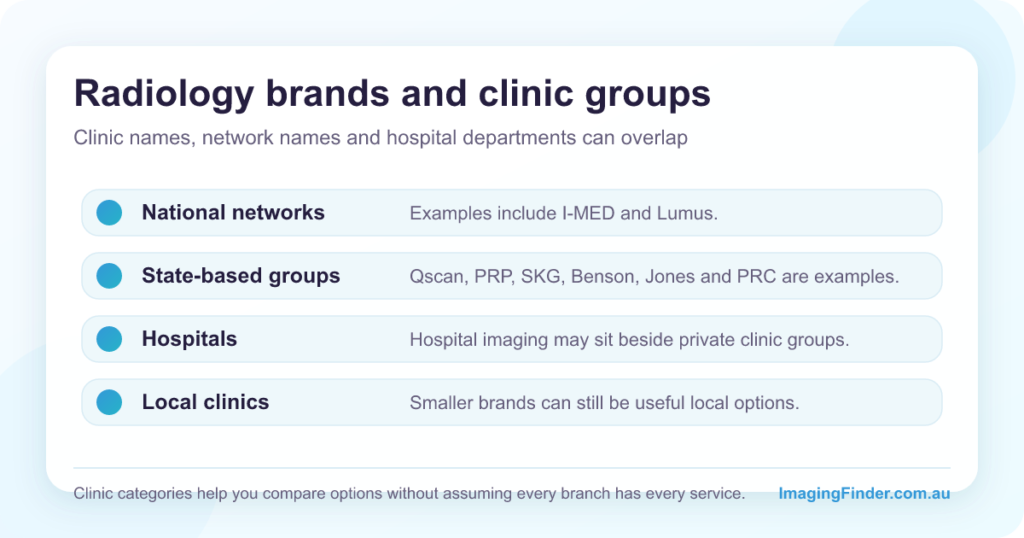
Short answer: Mostly private investors and listed companies. I-MED, Australia’s largest network, has been owned by private-equity firm Permira since 2018 — and in May 2026 Permira agreed to sell it to Jardine Matheson at a A$3.4 billion valuation. Healius sold Lumus Imaging to Affinity Equity Partners in May 2025. Sonic Healthcare owns Queensland X-Ray and SKG Radiology. Integral Diagnostics owns Capital Radiology. A handful of large practices — Perth Radiological Clinic, Jones Radiology and Benson Radiology — are still majority owned by their own radiologists.
- Who owns the major radiology networks in Australia?
- Which radiology networks are still doctor-owned?
- Which brands you’ll see in each city
- Does it matter who owns your radiology clinic?
- What to check before you book
- Common questions about radiology clinic ownership
- How we know: sources and methodology
Find a branch by clinic group
Compare branch addresses, listed scans and contact details. These directories include scan filters and links to clinic websites.
Who owns the major radiology networks in Australia?
Several of the biggest radiology brands changed hands, or started to, between late 2024 and mid-2026. Capitol Health — the company behind Capital Radiology — merged into ASX-listed Integral Diagnostics in December 2024. Healius completed the sale of Lumus Imaging to private-equity firm Affinity Equity Partners in May 2025, at a A$965 million enterprise value. Infratil — the listed infrastructure investor that led the Qscan buy-in of December 2020, taking 56.25% for A$289.6 million — put that majority stake under strategic review in September 2025. And in May 2026, Permira agreed to sell I-MED to Hong Kong-based conglomerate Jardine Matheson at a A$3.4 billion enterprise value, with completion expected later in 2026 subject to regulatory approval.
Here is the current picture, network by network. Each brand links to its clinic locations.
| Network | Sites listed | Owner | Since | Source |
|---|---|---|---|---|
| I-MED Radiology Network | about 120 | Permira funds (private equity); sale to Jardine Matheson agreed May 2026, not yet completed | 2018 | Permira announcement |
| Lumus Imaging | about 112 | Affinity Equity Partners (private equity); bought from Healius | 2025 | Deal completion, May 2025 |
| Qscan Group | about 47 | Infratil (57%), with a Morrison & Co fund, doctors and management; stake under strategic review | 2020 | Infratil completion notice |
| Capital Radiology | about 43 | Integral Diagnostics (ASX: IDX), via the Capitol Health merger | 2024 | Merger completion |
| Queensland X-Ray | about 40 | Sonic Healthcare (ASX: SHL) | 2001 | QXR: who we are |
| PRP Diagnostic Imaging | about 36 | IFM Investors and UniSuper (controlling interest); doctors and management retain a significant stake | 2022 | Buyout announcement |
| SKG Radiology | about 23 | Sonic Healthcare (ASX: SHL) | 2001 | ASX announcement, 2001 |
| Benson Radiology | about 20 | Radiologist partners; Crescent Capital investment agreed April 2026, not yet completed | 1958 | Benson announcement |
| Perth Radiological Clinic | 15 | Radiologist partnership (majority), Allegro Funds (minority) | 2019 | PRC announcement |
| Jones Radiology | 15 | South Australian radiologist partners (100%) | 2025 | Jones announcement |
| Hospital imaging departments | about 197 | Public hospitals (state health services) or private hospital operators | — | — |
Sites listed are the clinic listings published on Imaging Finder as at July 2026. The networks and hospital departments in this table account for about 670 of the roughly 940 listings nationally; the remainder belongs to smaller named groups (about 210 listings) and an independent-clinics grouping (62). A network’s own clinic tally is usually higher — I-MED reports 215 clinics across Australia, New Zealand and the US — because some sites operate inside hospitals or under sub-brands.
Which radiology networks are still doctor-owned?
More than you might expect, and they are not boutiques. Perth Radiological Clinic is a partnership founded in 1948 that bought back full ownership from I-MED in December 2014; since 2019 it has had a minority private-equity investor, Allegro Funds, but remains majority owned and controlled by its doctors — more than 80 of them.
Jones Radiology in South Australia went the whole way back. Its partner doctors held 51%, and in August 2025 bought I-MED’s 49% — ending 25 years inside the I-MED network and making the practice 100% doctor-owned in its hundredth year.
Benson Radiology, Adelaide’s other big group, has been owned by its radiologist partners since it formed in 1958. In April 2026 the partners agreed to bring in Crescent Capital Partners as an investor alongside them; the deal had not completed as of July 2026, and the partners say they will keep leading the practice’s clinical direction.
The pattern runs the other way too. Queensland X-Ray and SKG Radiology both began as doctor-run practices and both joined Sonic Healthcare in 2001; they have kept their names and local radiologist leadership for a quarter-century since. PRP Diagnostic Imaging in NSW sold to Crescent Capital in 2020 at a reported A$440 million valuation, and control passed to IFM Investors and UniSuper in 2022 — with PRP’s doctors retaining a significant stake.
Doctor ownership means the radiologists own the business and carry its decisions; it does not automatically mean lower fees. Billing is set practice by practice under every ownership model.
Which brands you’ll see in each city
Ownership is national; the brands on the street are local. Lumus lists sites in all five of the biggest capitals. I-MED lists sites in four — it has none in Adelaide, where its long-time affiliate Jones Radiology returned to full doctor ownership in 2025. Each city has one or two names that lead it — we compare the four biggest metros in detail in our city-by-city clinic guide.
| City | Clinics listed | Brands you’ll see most |
|---|---|---|
| Melbourne | about 177 | Capital Radiology, I-MED, Lumus, hospital departments |
| Sydney | about 148 | I-MED, Lumus, hospital departments, PRP Diagnostic Imaging |
| Brisbane | about 132 | Lumus, I-MED, Queensland X-Ray, Qscan |
| Perth | about 65 | SKG Radiology, Perth Radiological Clinic, hospital departments, I-MED |
| Adelaide | about 55 | Benson Radiology, Jones Radiology, Lumus, hospital departments |
Counts and brand rankings are from the clinic listings published on Imaging Finder as at July 2026; SKG and Qscan sites mostly list under suburb names (all 23 SKG sites are in WA, and Qscan’s 47 cluster in south-east Queensland suburbs such as Toowong and Redcliffe, with others in Canberra and Hobart). The ownership behind those local names is what the first table shows: Perth’s two biggest brands split between Sonic Healthcare (SKG) and a doctor-owned partnership (PRC), while Adelaide’s two biggest groups, Benson and Jones, are both doctor-owned.
Does it matter who owns your radiology clinic?
Choosing an appointment? You can compare radiology clinic brands, booking options and billing policies before making a local shortlist.
Day to day, usually not. When a network is sold, the clinic keeps its name, its radiographers and its radiologists — Capital Radiology is still Capital Radiology under Integral Diagnostics, and Queensland X-Ray has traded under its own name for 25 years inside Sonic. Your scan is performed and reported the same way the week after a sale as the week before.
Your referral is more portable than most people realise. Under Medicare’s diagnostic imaging rules, a request does not have to be taken to the clinic whose name is printed on the form — branded request forms must carry a statement that the request “may be taken to a diagnostic imaging clinic of the patient’s choice”. If your GP hands you an I-MED form and a doctor-owned clinic next door suits you better, you can take it there.
What genuinely differs between networks — and between branches of one network — is billing. Medicare pays its benefit against the item on your referral, not the brand on the door. A clinic that bulk bills accepts that benefit as full payment and you pay nothing; a clinic that doesn’t sets its own fee and you pay the gap. Not every clinic bulk bills every scan; the number that matters is what you will pay on the day for your specific item — our bulk-billed radiology guide covers how to find out before you book. For MRI in particular, whether Medicare contributes at all depends on your referral and the scanner, not the network — see our MRI and Medicare guide.
One practical reason to stay inside a network: prior images. If your last scan was done at the same group, the radiologist can usually pull it up and compare directly, which matters when the question is whether something has grown or changed. You can request images be sent between clinics, but same-network comparison is the path of least friction.
Consolidation is also why the regulator watches this market. When Integral Diagnostics bought Capitol Health, the ACCC cleared the deal on 10 December 2024 only after Integral undertook to sell a clinic in Melton, Victoria — without that, two of the area’s three imaging clinics would have merged, a risk the ACCC said could mean “increased prices, reduced bulk-billing rates or reduced quality for patients”. In a capital city with many competing clinics, ownership concentration rarely touches you; in a smaller market with two clinics, it can.
What to check before you book
Branch services matter more than brand or owner. One branch of a network may offer only X-ray and ultrasound while another runs MRI, PET-CT and nuclear medicine, so check the individual clinic’s page — or our Medicare-by-modality guide for how funding works scan by scan.
| If you need… | Do not assume… | Better approach |
|---|---|---|
| X-ray or ultrasound | That every branch has identical hours or walk-in access. | Look up the specific branch; call ahead if timing is tight. |
| CT | That contrast CT is available at every CT site. | Mention contrast when booking so kidney-function checks and preparation are arranged. |
| MRI | That a listed MRI service means your scan is Medicare-rebatable. | Have the clinic check your referral against the item and scanner before you attend. |
| PET-CT | That “nuclear medicine” automatically includes PET-CT. | Book a site that names PET-CT specifically, with your tracer and indication. |
| Mammography | That screening and diagnostic breast imaging are the same pathway. | Diagnostic breast imaging needs a referral and runs separately from routine screening programs. |
Common questions about radiology clinic ownership
Who owns I-MED Radiology?
Funds advised by private-equity firm Permira, which has owned I-MED since 2018. In May 2026 Permira agreed to sell I-MED to Jardine Matheson, a Hong Kong-based conglomerate, at a A$3.4 billion enterprise value. The sale is expected to complete later in 2026, subject to regulatory approval — until then, Permira remains the owner.
Is Lumus Imaging part of Healius?
Not anymore. Healius, the ASX-listed pathology company, sold Lumus Imaging to Affinity Equity Partners at a A$965 million enterprise value; the sale completed on 1 May 2025. Lumus kept its name and clinics. If you last checked in 2024, the ownership has changed but little else visibly has.
What is the biggest radiology company in Australia?
I-MED, with 215 clinics across Australia, New Zealand and the US and more than seven million patient procedures a year — about 120 of its Australian sites are listed here. Integral Diagnostics, which describes itself as the second largest, merged with Capitol Health in December 2024 and runs 155 clinics across brands including Capital Radiology and Lake Imaging.
Are any radiology networks doctor-owned?
Yes. Perth Radiological Clinic (founded 1948) is majority owned by its 80-plus doctors, Jones Radiology has been 100% doctor-owned since buying back I-MED’s stake in August 2025, and Benson Radiology’s radiologist partners still own the practice, with a Crescent Capital investment agreed in April 2026 but not yet completed. PRP’s doctors also retain a significant stake.
Does it matter which network I choose?
Clinically, rarely — whoever the owner is, a practice must be accredited under the Diagnostic Imaging Accreditation Scheme for Medicare benefits to be payable on its imaging. Practically, three things differ: whether the branch offers your scan, whether it bulk bills your item, and whether your prior images are already in that network. Your referral can be used at any clinic you choose, whatever name is printed on the form.
How we know: sources and methodology
Ownership facts come from company and investor announcements read in July 2026 — Permira, Healius’s advisers, Infratil, Integral Diagnostics, the ACCC and the practices’ own newsrooms — each linked where the fact appears above. Where a deal was still pending in July 2026 (I-MED, Benson, the Qscan review), we say so rather than assuming the outcome. Clinic counts are the listings published on Imaging Finder as at July 2026; they understate networks whose sites sit inside hospitals. Medicare rules are taken from MBS notes IN.0.4 and IN.0.6 and Services Australia, all accessed 7 July 2026.
- Permira: sale of I-MED to Jardine Matheson (accessed 7 July 2026)
- Capital Brief: Healius completes Lumus Imaging sale (accessed 7 July 2026)
- Infratil: completion of Qscan acquisition and interim results, November 2025 (accessed 7 July 2026)
- Integral Diagnostics: Capitol Health merger completion (accessed 7 July 2026)
- ACCC: Integral Diagnostics–Capitol Health decision (accessed 7 July 2026)
- Allens: IFM Investors buyout of PRP Diagnostic Imaging (accessed 7 July 2026)
- Benson Radiology: Crescent Capital announcement (accessed 7 July 2026)
- Jones Radiology: return to 100% doctor ownership (accessed 7 July 2026)
- MBS note IN.0.6: diagnostic imaging requests and MBS note IN.0.4: accreditation (accessed 7 July 2026)
- Services Australia: bulk billing (accessed 7 July 2026)
This article is general information, not personal medical advice. Availability, Medicare eligibility, billing and preparation can change — confirm the specifics with your referrer and the clinic.

Author: Dr. Mark Bekhit
Dr Mark Bekhit (MBChB, FRANZCR) is a musculoskeletal radiologist practising in Brisbane and an AHPRA-registered specialist in diagnostic radiology (MED0002920947). He spends as much time building software as reading scans: he founded Imaging Finder (Australia) and Radiology Clinics NZ to make imaging easier to find, and builds radiology dictation and pain-tracking tools with one aim — better patient outcomes and a smoother reporting workflow. Outside the reading room he's usually training, bringing the same performance mindset to imaging.
Leave a Reply