
By Dr. Mark Bekhit, Radiologist · Last updated August 2026
The quick answer
Short answer: For most people, the MRI dye — called gadolinium — is generally very safe, and with normal kidneys over 90% leaves your body within a day. It is a different substance from the iodine dye used for CT. Serious allergic reactions are extremely rare — about 1 in 10,000. The one group that needs care is people with severe kidney disease, which the clinic’s screening questions check for. When you book, mention any kidney problem, any past reaction to contrast, or a chance of pregnancy. Breastfeeding is fine.
On this page
- What is the MRI dye, and is it the same as the CT dye?
- How safe is gadolinium contrast?
- Gadolinium and your kidneys
- Does gadolinium stay in the body or brain?
- Gadolinium in pregnancy and breastfeeding
- What to tell the clinic when you book
- Common questions about the MRI dye
- How we know: sources and method
What is the MRI dye, and is it the same as the CT dye?
The dye used in an MRI is called gadolinium contrast medium. It is injected into a vein during the scan, and it makes certain things — inflammation, tumours, blood vessels and the blood supply to some organs — show up much more clearly. Only about 1 in 3 MRI scans need it; the radiologist decides from your referral whether it will help answer the clinical question. Like the body’s own waste, the dye then leaves in your urine, cleared by your kidneys.
One clarification first, because the two dyes are constantly mixed up. This article is about the MRI dye, gadolinium. It is a completely different substance from the iodine-based dye used for CT scans, with its own risks and its own rules. If your scan is a CT, this is the wrong page — see our guide to whether CT contrast dye is safe instead. Gadolinium also has nothing to do with radiation: an MRI uses a strong magnet and radio waves, not X-rays.
A quick word on how the chemical is built, because it explains why it is safe. Gadolinium on its own would be toxic, so it is locked to a carrier molecule — a chelating agent — that holds it stable while keeping its usefulness on the scan. Different brands use different carriers, and that difference matters later when we get to kidneys and retention. Sometimes the radiologist decides during the scan that gadolinium would sharpen the images; if that happens, it does not mean something serious has been found — it usually just means the pictures will be clearer for your doctor.
How safe is gadolinium contrast?
The honest, reassuring answer is that gadolinium is generally very safe, and side effects or reactions are uncommon. In people with normal kidney function, over 90% of the dye is passed out in the urine within 24 hours. Most patients feel nothing at all from the injection; a few notice a brief cold feeling in the arm, which means nothing.
Reactions do happen, so it helps to see the real numbers rather than the worst-case stories online. A small number of people (about 1 to 4 in 100) get mild nausea or a headache for a short time, and vomiting is rare — fewer than 1 in 100. A little less often, about 1 in 1,000 people get an itchy skin rash a few minutes after the injection, which usually settles within an hour. A truly severe, whole-body allergic reaction is extremely rare, at about 1 in 10,000, and responds very well to the emergency treatment every MRI unit keeps on hand.
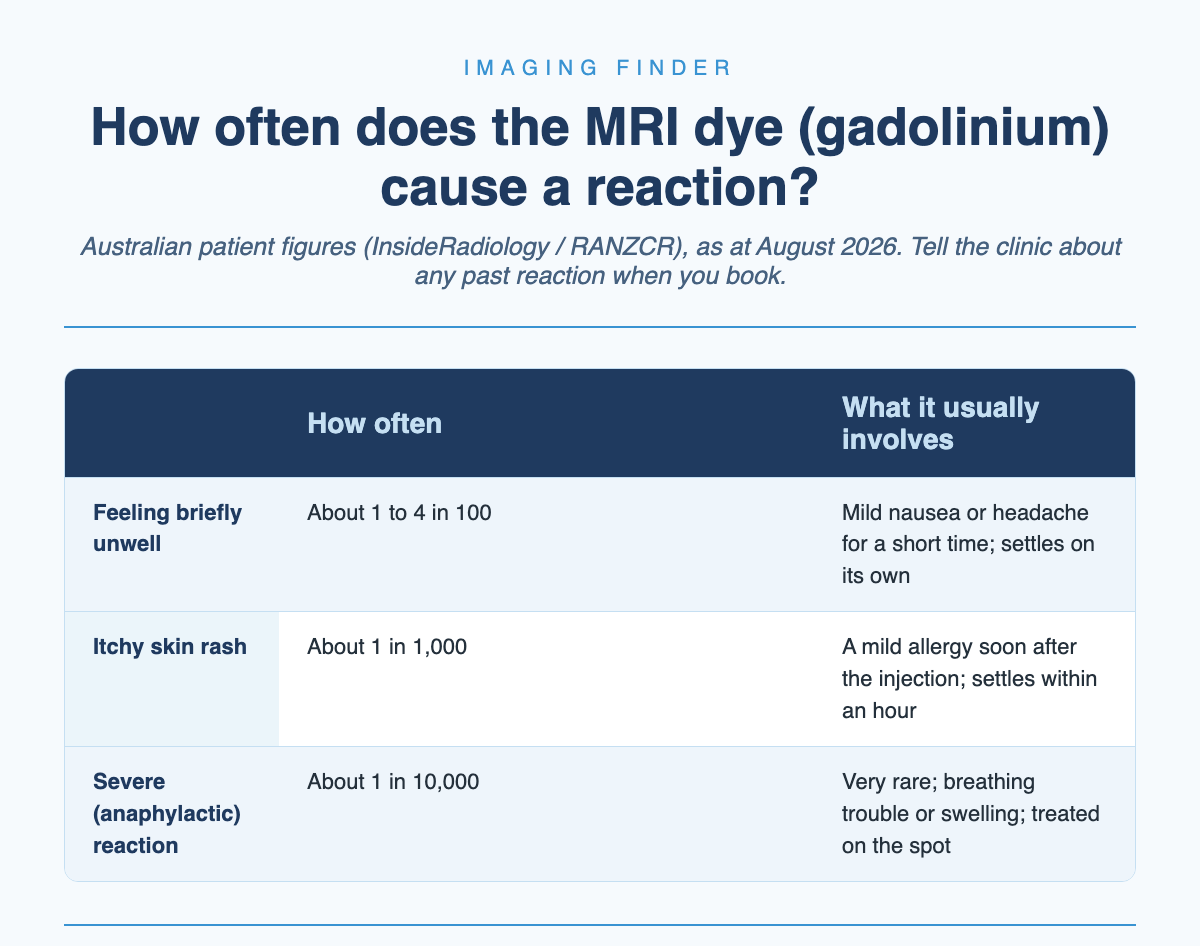
Figures are the InsideRadiology (RANZCR) patient-information rates for gadolinium, current as at August 2026. They describe reactions across everyone who has the dye — not a prediction for any one person.
Two things follow from this. First, reactions almost always show up within a few minutes of the injection, while you are still in the scanner or the department — the safest possible place for one to happen. Second, your history is the useful signal. If you have had a previous reaction to a gadolinium injection, or a severe allergic reaction to something else, tell your doctor and the MRI facility, because it affects whether gadolinium is recommended and whether any preventive medicine is worth considering. If a severe reaction ever did occur after you left — trouble breathing, throat tightness or feeling faint — treat it as an emergency and call triple zero (000) for an ambulance.
Gadolinium and your kidneys
This is where nearly all the genuine caution sits, and it comes down to one distinction: normal kidneys versus severe kidney disease. For almost everyone, gadolinium passes through the kidneys and out in the urine without trouble. The concern is a rare condition called nephrogenic systemic fibrosis (NSF), a debilitating disease that thickens and tightens the skin and can damage internal organs. It has only occurred with some forms of gadolinium, and in a minority of patients who already had severe kidney problems.
The numbers are genuinely reassuring, even at the extreme. Some forms of gadolinium carry a lower NSF risk than others, and these are the ones used when kidney function is reduced. Even in people with end-stage kidney disease, the risk of NSF after a single dose of a lower-risk agent is believed to be well under 1 in 100. And because radiology units now routinely screen for kidney disease and withhold gadolinium from those with severe disease, NSF has become extremely uncommon — when it does appear, it almost always shows within six months of the dose.
You will notice I have not quoted a single kidney-function number to act on, and that is deliberate. The exact threshold is a clinical decision that depends on your agent, your dose and your history, and it belongs to the radiologist — not to a figure you apply yourself, and certainly not to an overseas cut-off from a US website. What you can do is practical: if you have kidney disease or diabetes, you will usually need a recent kidney function result before contrast, so tell your referring doctor before the scan. That result is a simple blood test reporting your eGFR, a measure of how well your kidneys filter waste, which your GP can organise.
Good to know: if your kidneys work normally, gadolinium is one of the safest injections in medicine, and NSF is simply not a risk for you. The screening questions and the occasional blood test exist to find the small group with severe kidney disease — not to warn everyone else off. If you are unsure whether your kidneys are healthy, ask your GP or the clinic when you book.
Does gadolinium stay in the body or brain?
You may have read that gadolinium “stays in the body”, sometimes alongside alarming lawsuit pages. Here is the measured, Australian version. It is now recognised that very small amounts of some forms of gadolinium — about 1% of the dose — are retained in the tissues, mostly in the bones, with tiny amounts in the brain. This is more likely with the same forms that carry the higher NSF risk.
The key point is what this retention does, and the current position from Australia’s medicines regulator is clear: no harmful effects of gadolinium retention in the brain have been identified. InsideRadiology puts it the same way — at this stage there are no known adverse effects from these very small retained amounts. So the honest summary is: yes, a trace can linger; no, it has not been shown to cause harm.
What has changed is caution, not alarm. The two chemical families behave differently — the older “linear” agents retain more in the brain than the newer “macrocyclic” ones — and the TGA now recommends using these agents judiciously, at the lowest effective dose, and avoiding repeat scans with them unless they are clinically needed. That is exactly why radiologists have become more careful to recommend gadolinium only where it genuinely helps the diagnosis — the same judgement that protects you from an unnecessary injection.
Gadolinium in pregnancy and breastfeeding
Breastfeeding is the simple one. It is safe to keep breastfeeding normally after gadolinium — there is no need to express and throw milk away. The reason is the tiny quantities involved: less than one part in a thousand of the dose reaches the milk, and an even smaller amount is absorbed by the baby — so small it is not thought to pose any danger. Feed as usual.
Pregnancy calls for more care, and the position is cautious rather than frightening. For the wider picture across every scan type, see our guide to medical imaging safety in pregnancy. An MRI itself is generally considered safe in pregnancy, though usually avoided in the very early weeks, and it uses no radiation. The dye is treated more conservatively: if you are or might be pregnant, gadolinium is unlikely to be given unless it is absolutely essential, and any decision is discussed with you and your doctor first. So the action is simply to tell your doctor or the radiologist before the scan if there is any chance you are pregnant, and let that conversation guide what happens.
What to tell the clinic when you book
Almost every precaution above works best when the MRI clinic knows in advance. Before your scan you will be asked screening questions about your medical history, any implants, kidney disease, past reactions and pregnancy — and you always keep the right to ask more or to decline the injection. A two-minute phone call when you book means none of it is a surprise on the day. Have your request form in front of you and raise these points.
Tell the clinic when you book
✓ “I have a kidney problem” or “I’m not sure — do you need a recent kidney blood test?”
✓ “I have diabetes” — a common reason your kidney function is already being watched.
✓ “I have had a reaction to contrast dye before” — if so, describe what happened.
✓ “I am, or might be, pregnant” — if there is any chance, let them know. Breastfeeding is fine and needs no mention.
✓ “I have an implant or metal in my body” — this is about the magnet, and the clinic will ask regardless.
When you are ready to book, start with the national radiology clinic directory, or go straight to MRI clinics in Brisbane, Sydney, Melbourne or Perth, and use the questions above with each clinic. If you are still deciding between scans, our guide to MRI versus CT explains which answers which question; for what Medicare covers, see MRI scans and Medicare and Medicare-eligible scans by modality; for the money side, our guide to what an MRI costs in Australia. And if it is the enclosed scanner rather than the dye that worries you, see MRI, claustrophobia and open or wide-bore machines.
Common questions about the MRI dye
Is the MRI contrast dye (gadolinium) safe?
For most people, yes. Gadolinium is generally very safe, and in people with normal kidneys over 90% is cleared in the urine within a day. Mild, brief effects like nausea or a headache happen in about 1 to 4 in 100 people, and a severe allergic reaction is extremely rare at about 1 in 10,000. The main precaution is for people with severe kidney disease, which the clinic’s screening questions are designed to pick up.
Is gadolinium the same as the CT contrast dye?
No. Gadolinium is the dye for MRI; CT uses a separate iodine-based dye. The two are different substances with different risks, so advice about one does not apply to the other. If your scan is a CT, see our separate guide to CT contrast dye safety.
Can I have gadolinium if I have kidney problems?
Often yes, but it depends on how reduced your kidney function is, and the radiologist decides. The concern is a rare condition, NSF, which has occurred mainly in people with severe kidney disease; lower-risk forms of gadolinium are used when function is reduced, and even in end-stage disease the risk after a single lower-risk dose is well under 1 in 100. Tell your doctor about any kidney disease before the scan, and expect to provide a recent kidney blood test.
Does gadolinium stay in your body or brain?
A trace can. About 1% of the dose can be retained, mostly in the bones with tiny amounts in the brain, more so with the older “linear” agents. Importantly, no harmful effects of gadolinium retention in the brain have been identified. As a precaution the TGA recommends using these agents only when needed and at the lowest effective dose.
Can I have gadolinium contrast if I’m pregnant or breastfeeding?
Breastfeeding is not a barrier: less than one part in a thousand reaches breast milk, so you can keep feeding normally. In pregnancy, gadolinium is usually avoided unless it is absolutely essential, and any decision is made with your doctor. Tell the clinic if you are or might be pregnant.
What should I tell the clinic before an MRI with contrast?
Mention any kidney disease or diabetes (so they can check whether a recent kidney result is needed), any past reaction to contrast, and whether you are or might be pregnant. The clinic will separately ask about implants and metal, because that is about the MRI magnet rather than the dye. Breastfeeding does not need a mention for safety.
How we know: sources and method
The figures in this guide come from Australian sources, not overseas rules of thumb. The reaction frequencies, kidney and NSF guidance, retention figures, and pregnancy and breastfeeding advice are from InsideRadiology, the patient-information service of the Royal Australian and New Zealand College of Radiologists (RANZCR). The position on gadolinium retention in the brain, and the difference between linear and macrocyclic agents, is from the Australian Government’s Therapeutic Goods Administration (TGA). The kidney-test explanation, the general MRI-safety and pregnancy points, and the emergency advice are from the Government’s healthdirect service. Kidney guidance is kept general on purpose: the exact threshold for using or avoiding gadolinium is an individual clinical decision, so this guide states the rule and defers the number to your radiologist rather than importing an overseas cut-off.
- InsideRadiology (RANZCR): gadolinium contrast medium (MRI contrast agents) — reactions, kidneys and NSF, retention, pregnancy and breastfeeding
- InsideRadiology (RANZCR): contrast medium in patients with kidney problems — when a recent kidney result is needed
- TGA: gadolinium-based contrast agents for MRI scans — brain retention, linear versus macrocyclic agents, judicious use
- healthdirect: magnetic resonance imaging (MRI), kidney function tests (eGFR) and anaphylaxis
This article is general information, not personal medical advice. Discuss your individual report and next steps with the healthcare professional responsible for your care.

Author: Dr. Mark Bekhit
Dr Mark Bekhit (MBChB, FRANZCR) is a musculoskeletal radiologist practising in Brisbane and an AHPRA-registered specialist in diagnostic radiology (MED0002920947). He spends as much time building software as reading scans: he founded Imaging Finder (Australia) and Radiology Clinics NZ to make imaging easier to find, and builds radiology dictation and pain-tracking tools with one aim — better patient outcomes and a smoother reporting workflow. Outside the reading room he's usually training, bringing the same performance mindset to imaging.
Leave a Reply