If you have had a screening mammogram in Australia recently, your result letter may now tell you something it never used to: that you have dense breasts. It reads like a warning with the instructions missing. Here is what it means, and whether you should add an ultrasound.
The quick answer
Short answer: Dense breasts are common and are not a diagnosis. A dense result is a reason to have one conversation with your GP about your overall risk — not an automatic reason to book an extra scan. Experts have not agreed on a best supplemental test, BreastScreen does not provide one routinely, and a screening-only breast scan may not be covered by Medicare. A mammogram is still worthwhile at every breast density.
The one exception: if you have a new or changing breast symptom — a lump, breast pain, a nipple change or discharge, or puckered skin — do not wait for a screen. See your GP now.
On this page
• What a dense-breast result actually means
• Does a mammogram still work on dense breasts?
• So do I need an ultrasound as well?
What a dense-breast result actually means
Breast density is not about how your breasts feel or look. It is what your breasts are made of on the mammogram. Glandular and connective tissue show up white; fatty tissue shows up dark. If a lot of your breast is the white, dense kind, radiologists call it dense.
Radiologists grade it in four categories, using a system called BI-RADS. The top two are grouped together as “dense breasts”.
Two things follow from a dense result, and it helps to hold both at once. Dense tissue is linked to a somewhat higher chance of breast cancer, though in absolute terms that increase may be small. And dense tissue makes the mammogram itself a little harder to read.
Does a mammogram still work on dense breasts?
Yes. This is the part the letter does not say loudly enough. Mammography screening has a demonstrated benefit for women of every breast density, including fewer deaths from breast cancer. Dense breasts do not make your mammogram pointless.
What density does is lower the sensitivity — the mammogram’s ability to catch everything. Here is the honest reason, from someone who reads these films: dense tissue is white, and an early cancer is also white. A small tumour can hide against a white background the way a snowball hides in snow. It does not vanish; it is just harder to pick out. That is why a dense result prompts a sensible question about whether to look a second way.
Good to know: Keep going to your regular screening mammograms. A dense result is a reason to talk to your GP, not a reason to skip the scan that still finds most breast cancers early.
So do I need an ultrasound as well?
This is the question everyone actually types into Google, and the pages that answer it most directly are often breast clinics that also sell the scan. So here is the neutral version.
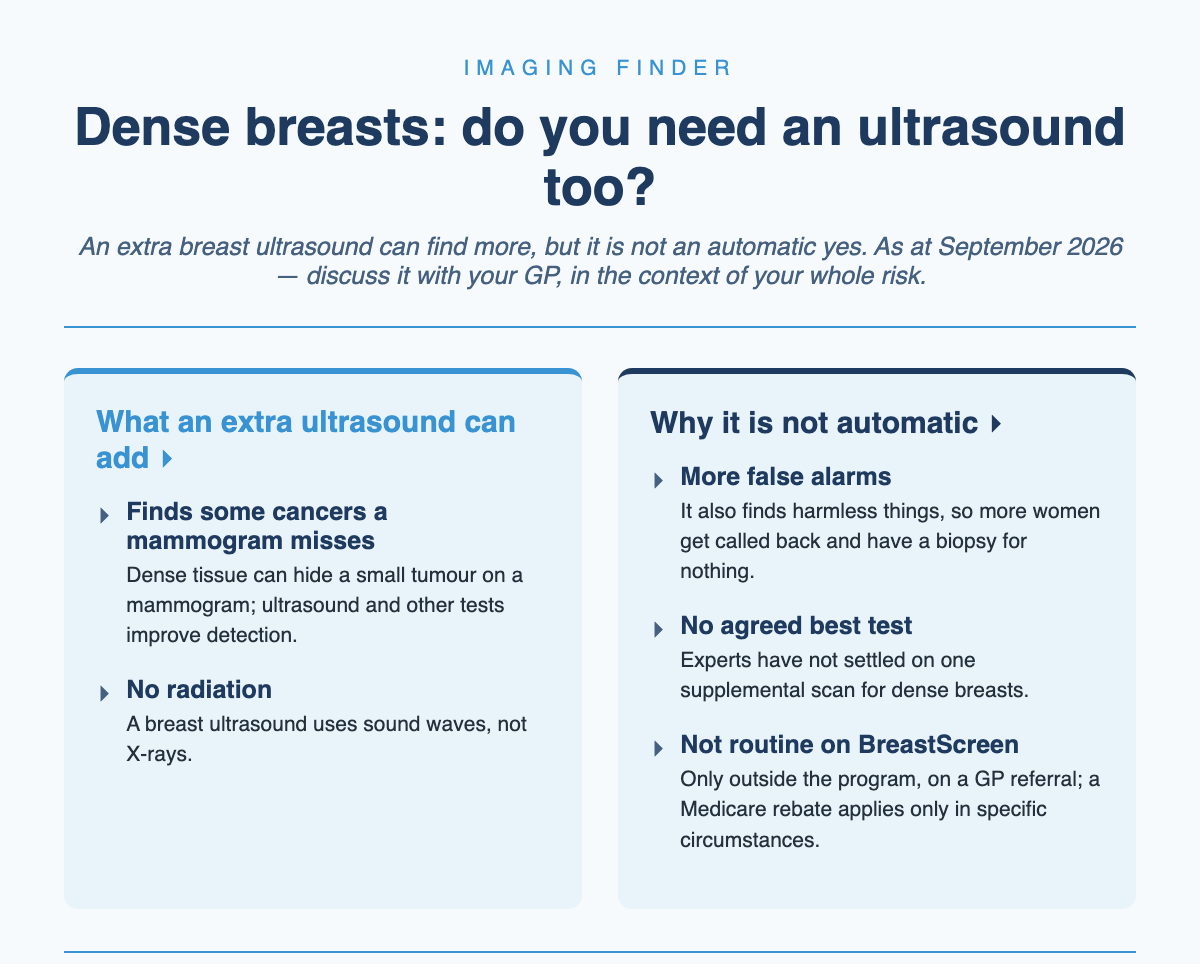
An extra test — breast ultrasound, MRI, tomosynthesis or contrast mammography — does find some cancers a mammogram misses in dense tissue. That is real. But there is a genuine trade-off, and it is the reason “everyone with dense breasts should get an ultrasound” is not the settled answer:
- Extra scans also flag more harmless things. That means more women are called back, worried, and sent for a biopsy that turns out to be nothing.
- There is currently no consensus on which supplemental test is best for dense breasts.
- For women with no symptoms and no other risk factors, the trials have not shown that adding a supplemental scan saves more lives.
None of that means an ultrasound is wrong for you. It means the decision depends on your whole picture — family history, previous findings, your own preferences — not on the density number alone. That is a conversation with your GP, who can weigh it all up. My honest view as a radiologist: density is a prompt to have that conversation, not a prescription for another scan.
What BreastScreen does — and what it would cost
BreastScreen Australia now tells women their breast density and encourages them to discuss it with their GP or a breast specialist. What it does not do is arrange a supplemental scan for you. A screening mammogram through BreastScreen is free for women over 40 with no symptoms, and the program is aimed squarely at ages 50–74.
If you and your GP decide an extra scan makes sense, that happens outside the BreastScreen program: your GP refers you to a public or private radiology service. And this is the cost detail the booking pages skip — a Medicare rebate for a private service is only available in specific circumstances. A purely precautionary, screening-only scan because your breasts are dense may not attract a rebate at all, which means you could pay the full fee.
Medicare’s reference fee for that item is $128.60, but that is the figure Medicare uses for its sums — not a clinic’s price, and not what you would pay. For how bulk billing, gaps and real patient payments actually work, see our guide to ultrasound costs in Australia, and for breast scans specifically, our breast ultrasound cost and gap fees guide. If you are weighing up a screening mammogram versus a referred diagnostic one, that decision is covered in BreastScreen versus a diagnostic mammogram.
When to see your GP now
Everything above is about screening — checking when nothing feels wrong. It does not apply if something has changed. Screening is for women with no symptoms; a new or changing symptom is a different, GP-referred pathway.
See your GP promptly if you notice
✓ A new lump, or a lump that is changing
✓ New breast pain that does not settle
✓ A change in a nipple, or any nipple discharge
✓ Skin puckering, or one breast becoming uneven
With a symptom, your GP arranges a diagnostic assessment — often a mammogram and an ultrasound together — rather than a routine screen. That is the right and faster path, and because there is a clinical reason for the scan a Medicare rebate is more likely to apply, though the exact rebate still depends on your circumstances. Do not sit on a change and wait for your next screening letter.
The one thing to do next
Book a short chat with your GP and bring the density line from your letter. Ask how your density sits alongside the rest of your risk, and whether an extra scan is worth it for you. If you decide together to go ahead, you can choose where to have it.
Imaging Finder helps with that last step: find a breast-imaging clinic near you — Sydney, Melbourne, Brisbane, Perth — or browse the full imaging directory. Because services change, phone first and ask a couple of plain questions.
Ask the clinic when you book
✓ “Do you do breast ultrasound, and can I have it with a radiologist on site?”
✓ “With my referral, will there be a Medicare rebate — and what would I pay on the day?”
✓ “Can you send the result to my GP?”
A density result is not a verdict. It is your cue to ask one good question. Answer it with your GP, and act quickly on anything new — that is the whole of it. For help making sense of the words on any imaging result, see how to read your radiology report, and if you are unsure who can refer you, who can request your scan. You can also see which scans Medicare helps pay for.
Common questions
Does breast density change over time?
Generally, yes — breast density tends to reduce with age. It is one reason your density category can shift between screening rounds, so it is worth checking each new result rather than assuming it stays the same.
Does a breast ultrasound use radiation?
No. A breast ultrasound uses high-frequency sound waves to make its images, not X-rays. That is one reason it is sometimes added after a mammogram, and why it is often the first test in younger women, whose breast tissue is naturally denser.
Will Medicare pay for a breast ultrasound because I have dense breasts?
Not automatically. A Medicare rebate for a private breast ultrasound applies only in specific circumstances, and a screening-only scan requested purely because your breasts are dense may not qualify. Ask the clinic for a written estimate before you book so you know what you would pay.
How we know: sources and method
The density notification, the four BI-RADS categories, the “no consensus” on a best supplemental test, the benefit-and-harm of extra scans, and the rules that supplemental screening sits outside BreastScreen on a GP referral with a Medicare rebate only in specific circumstances are taken directly from the BreastScreen Australia Position Statement on breast density and screening (National Policy, published 30 May 2025). That a mammogram helps at every density, and that density generally reduces with age, are from the same statement. What a screening versus a diagnostic mammogram is for, the symptom rule, and that a breast ultrasound uses sound waves rather than radiation are from InsideRadiology, the patient-information service of the Royal Australian and New Zealand College of Radiologists (RANZCR). The $128.60 Schedule fee and $109.35 benefit for item 55076 are from the Medicare Benefits Schedule, current as at 1 July 2026. Whether any extra scan is right for you is a decision for you and your GP.
- Australian Government, Department of Health, Disability and Ageing: BreastScreen Australia position statement on breast density and screening — density notification, BI-RADS categories, no-consensus and supplemental-screening rules, Medicare-rebate context
- InsideRadiology (RANZCR): breast ultrasound, screening mammography and diagnostic mammography — what each test is for, the symptom rule and preparation
- Medicare Benefits Schedule: item 55076 — descriptor, Schedule fee and benefits for a both-breast scan
This article is general information, not personal medical advice. Discuss your individual report and next steps with the healthcare professional responsible for your care.
Last updated September 2026. Medicare Schedule fees current to 1 July 2026 and change over time.

Author: Dr. Mark Bekhit
Dr Mark Bekhit (MBChB, FRANZCR) is a musculoskeletal radiologist practising in Brisbane and an AHPRA-registered specialist in diagnostic radiology (MED0002920947). He spends as much time building software as reading scans: he founded Imaging Finder (Australia) and Radiology Clinics NZ to make imaging easier to find, and builds radiology dictation and pain-tracking tools with one aim — better patient outcomes and a smoother reporting workflow. Outside the reading room he's usually training, bringing the same performance mindset to imaging.
Leave a Reply