
By Dr. Mark Bekhit, Radiologist · Last updated September 2026
Short answer: A plain X-ray is the cheapest scan in Australian medicine, and most people pay nothing for it. Medicare Schedule fees for the common X-rays run from $46.80 for a hand or wrist to $90.65 for the lower back, and in 2023–24 most patients paid nothing at all: 91% for a chest X-ray, 93% for a knee, 94% for the lower back. Among the minority who did pay, the typical gap was between $46 and $75. Your job is one phone call: ask the clinic whether it bulk bills the X-ray on your request.
Bulk billed means Medicare pays the clinic directly and you pay nothing.
On this page
• How much does an X-ray cost in Australia?
• Will your X-ray be bulk billed?
• Where to book, and what to ask
• What decides the price: the request, the views, the spine and your postcode
How much does an X-ray cost in Australia?
Every X-ray has a Medicare item with a Schedule fee set by the government. If the clinic bulk bills, Medicare pays the clinic 95% of that fee and you pay nothing: about $53 for a chest X-ray, about $49 for a knee. If the clinic charges its own fee instead, Medicare gives you back 85% of the Schedule fee and the rest of the clinic’s price is yours. Our bulk-billed radiology guide covers that mechanism for every scan type; the table below is the X-ray version, with what people actually paid.
Fees and benefits are the requested-service items on the Medicare Benefits Schedule, updated 1 July 2026 and read as at September 2026. The two right-hand columns are the Department of Health’s Medical Costs Finder for each item at radiology practices outside hospital, nationally, in 2023–24: the share of patients with no out-of-pocket cost, and the median payment among the rest. They are historical and national, not a quote.
Read the gap column against the fee column and something stands out. A chest X-ray’s Schedule fee is $55.50, yet the people who were charged typically paid $75 on top of their rebate. A clinic that bills privately for an X-ray is not adding a small top-up to the government fee; it is charging well above it. That is why the body part barely matters to your bill and the clinic’s billing policy decides almost everything.
Will your X-ray be bulk billed?
Probably, but the honest answer needs two numbers, because the government publishes two. The percentages in the table above count patients who had that X-ray at a radiology practice outside hospital, and they sit between 91% and 95%. The Department’s Medicare quarterly statistics, published on 10 August 2026, count services across the whole X-ray group, which also includes mammograms, contrast studies and angiography. On that wider count, 82.4% of the 2,980,521 services between April and June 2026 were bulk billed, and when a fee was charged outside hospital the average patient contribution was $82.86.
Both are true. The first describes your knee X-ray; the second describes the industry. The group rate has been steady at about 82% for three years, so nothing in the recent data suggests bulk billing of X-rays is disappearing. About one service in six still carries a fee, and where you live changes the odds.
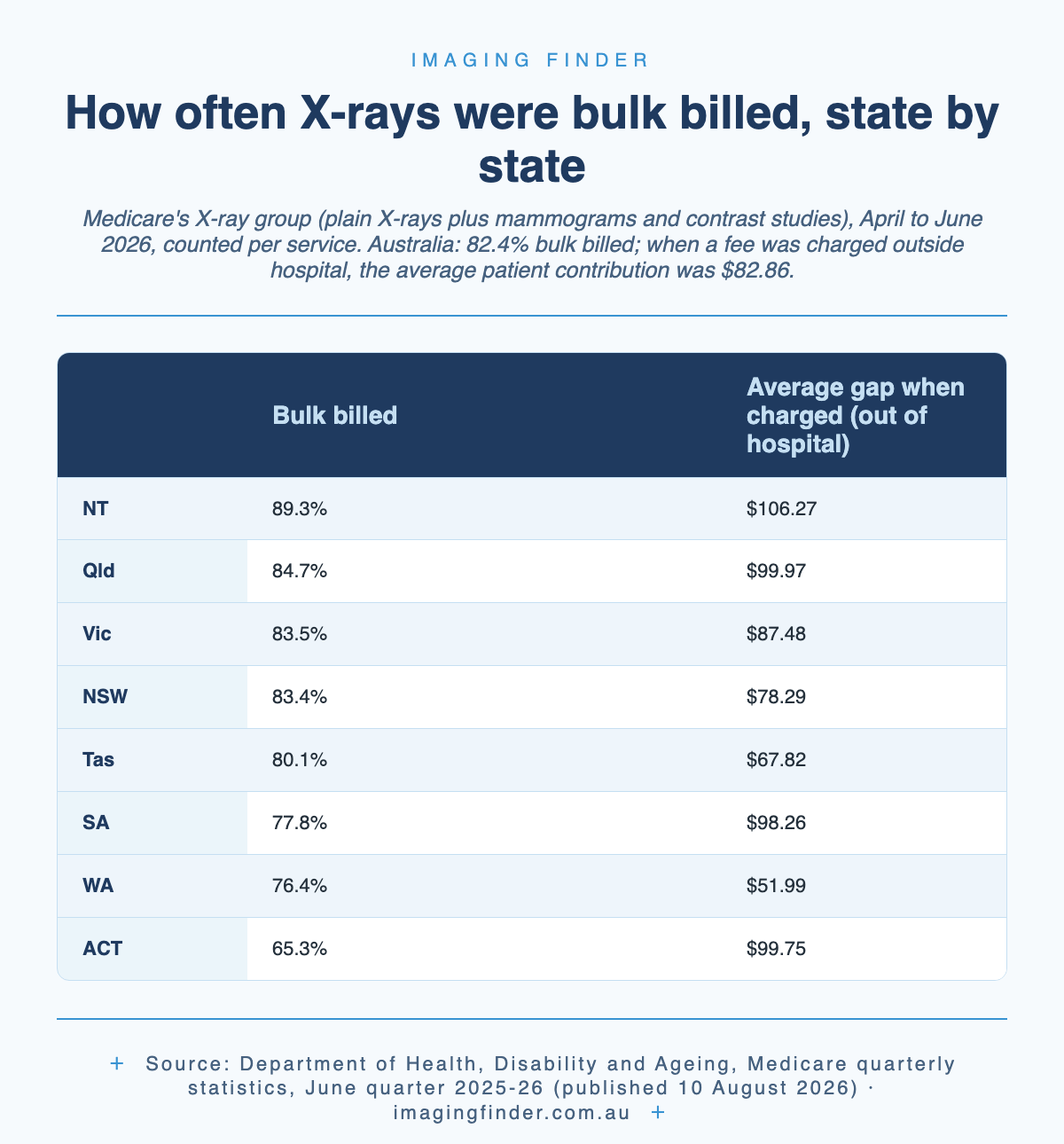
Source: Department of Health, Disability and Ageing, Medicare quarterly statistics, Diagnostic Imaging Summary, June quarter 2025–26, Group I3 Diagnostic Radiology, all Medicare-claimed services; the average gap is for out-of-hospital services where a fee was charged. Canberra is the outlier: a third of X-ray group services there carried a fee. Rural and remote areas were within a few points of the cities, from 79.5% in large rural towns to 87.2% in very remote communities.
Against the other scans, X-ray sits in the middle for how often it is bulk billed and at the bottom for what a gap costs. In the same quarter, ultrasound was bulk billed 66.3% of the time, MRI 80.8%, X-ray 82.4%, CT 85.1% and nuclear medicine 87.8%. The average gap when charged was $82.86 for X-ray, against $144.94 for ultrasound and $200.43 for MRI.
Where to book, and what to ask
A request does not have to be taken to the practice printed on the form; you can take it to any practice you choose. Shortlist X-ray clinics near you in Sydney, Melbourne, Brisbane, Perth or Adelaide, then phone the nearest two. Practices set their own fees, and a listing cannot tell you a billing policy, so the call is the step that matters.
Ask the clinic when you book
✓ “Do you bulk bill the X-ray on my request? If not, what is your fee, and how much will Medicare pay back?”
✓ Bring the request, your Medicare card, and any previous X-rays of the same part if this is a follow-up, so the radiologist can compare.
✓ If you are pregnant or think you might be, say so when you book and again on the day.
If the first practice charges a fee, the second may not. The fee is the practice’s decision, not Medicare’s, and the difference between two practices in the same suburb can be the whole bill.
What decides the price: the request, the views, the spine and your postcode
Four things move the number.
The request. The items in the table are “requested” items: Medicare pays them only if the practice has a written request from a practitioner before the X-ray is taken. A request from any doctor works for any X-ray. Dentists, chiropractors, physiotherapists, osteopaths, podiatrists and participating nurse practitioners can request specific X-rays for a Medicare benefit: physiotherapists, for example, can request hip, pelvis and spine films, and podiatrists can request the foot, ankle and knee. The request never expires, and it can be sent by email. Our guide to imaging requests has the full list of who can send you for what.
Good to know: you are not billed per picture. One item covers every view of the part examined, however many the radiographer takes, and if a film of your other knee is needed for comparison, that is part of the same service, not a second one.
The spine. The one exception to that rule is the back, where the item follows how many regions are examined in the same visit: one region such as the lower back is $90.65, two regions are $114.55, and three or four regions are $129.55. A physiotherapist or osteopath who wants your whole spine uses a separate item Medicare pays once per calendar year.
Your postcode. The state table above shows the spread, and nothing on the request form changes it.
What happens on the day
An X-ray needs no preparation. You will usually change into a gown and take off watches, necklaces and anything with a metal zip. The radiographer positions you standing, sitting or lying, asks you to keep still, and sometimes to hold a breath. The whole visit is usually under 15 minutes; a chest X-ray on someone who can stand and hold their breath takes less than a minute. Extra pictures are common and almost always mean a better angle was needed, not that something is wrong.
A plain X-ray uses a small amount of radiation, far less than a CT; if the dose question is on your mind, our radiation guide puts the numbers side by side, and our pregnancy guide covers what changes if you are expecting. A radiologist reads the images and sends a written report to whoever requested the X-ray; you rarely get a verdict in the room. If the report arrives before your follow-up appointment, this is how to read it.
Common questions
Can I get an X-ray without a referral?
Medicare has non-requested versions of most X-ray items at a lower fee: a chest X-ray with no request is item 58500, Schedule fee $41.65 with a $35.45 benefit, against $55.50 and $47.20 with one. But the practice’s own doctor must decide the X-ray is clinically needed, so do not assume a walk-in will be accepted. A GP request is the simpler route, and the requested item pays the higher benefit, so a request never leaves you worse off.
Does private health insurance cover an X-ray?
Not at a radiology practice. By law, private health insurance cannot cover out-of-hospital diagnostic imaging; Medicare covers it, and the practice’s fee above the benefit is yours. Hospital cover helps only with imaging done while you are an admitted private patient.
Is a bone density scan or a CT billed as an X-ray?
No. Both use X-rays, but each has its own Medicare items and rules. Bone density scans are claimed under items 12306 to 12322, explained in our bone density guide; CT has its own group, covered in our CT cost guide.
How we know: sources and method
Item numbers, Schedule fees and benefits come from the Medicare Benefits Schedule, read on 19 September 2026; every item quoted carries a Schedule fee updated on 1 July 2026, and the request, view and spine rules come from explanatory notes IN.0.6 and IN.0.16. What patients paid per item comes from the Department of Health’s Medical Costs Finder, filtered to diagnostic radiology, out of hospital, 2023–24, the same filter as our ultrasound cost guide and the other cost guides on this site. The state and modality bulk-billing rates are the Department’s Medicare quarterly statistics for the June quarter of 2025–26, published 10 August 2026 and counted per service across the whole Diagnostic Radiology group. What happens during the X-ray is drawn from InsideRadiology, the Royal Australian and New Zealand College of Radiologists’ patient site, and healthdirect.
This article is general information, not personal medical advice. Discuss your individual report and next steps with the healthcare professional responsible for your care.

Author: Dr. Mark Bekhit
Dr Mark Bekhit (MBChB, FRANZCR) is a musculoskeletal radiologist practising in Brisbane and an AHPRA-registered specialist in diagnostic radiology (MED0002920947). He spends as much time building software as reading scans: he founded Imaging Finder (Australia) and Radiology Clinics NZ to make imaging easier to find, and builds radiology dictation and pain-tracking tools with one aim — better patient outcomes and a smoother reporting workflow. Outside the reading room he's usually training, bringing the same performance mindset to imaging.
Leave a Reply