By Dr. Mark Bekhit, Radiologist · Last updated October 2026
Short answer: Yes, some clinics will scan you without a referral, but then you pay the whole fee. For Medicare to pay, someone must write the request before the scan. For most adult body parts, only a specialist can. A GP can request one only from a short list: the head for unexplained seizures or a chronic headache where the GP suspects a problem inside the skull, the neck for a pinched nerve or neck injury, the knee after an acute injury at ages 16 to 49, and some children’s scans. Physios and chiropractors cannot request one.
On this page
• Can you book an MRI without a referral?
• Who can request an MRI that Medicare pays for
• What is the quickest way to a Medicare-funded MRI?
Can you book an MRI without a referral, and what does it cost?
The Medicare rule is blunt. For a requested scan, Medicare pays no benefit unless the clinic had a request before the scan started. The request must come from someone who decided you needed the scan. healthdirect puts it more simply: you need a referral from your doctor to get an MRI. You cannot add the paperwork afterwards and claim the rebate.
Some clinics will still book you. Full-body screening companies are the obvious group. OneMRI, for example, says you don’t need a GP referral and listed its full-body MRI at $2,990 when we checked on 3 October 2026. Our full-body MRI cost guide compares several of these companies and what each price includes.
Other “no referral needed” offers are not quite what they sound like. One Melbourne clinic that advertises no referrals required first books you a consultation with its own practitioner, and a fee applies. That practitioner then arranges the MRI if they think you need it. That is a referral, made in-house.
So what does a self-paid scan of one body part cost? There is no national price list for self-paid MRI. For scale, take a GP-requested head MRI. In 2023–24, the patients who were charged more than the rebate typically paid a fee of $513, and Medicare paid back $363. Most patients (87%) were bulk billed and paid nothing. Without a request Medicare can accept, the full fee is yours.
Good to know: Private health insurance will not fill the gap. By law, it does not cover out-of-hospital diagnostic imaging. And imaging clinics set their own fees, so get the total price in writing before you book.
Who can request an MRI that Medicare pays for?
Medicare controls MRI far more tightly than X-ray, ultrasound or CT. The rules sit in the Medicare Benefits Schedule (MBS), the government’s list of what Medicare pays for. The default rule is that only a specialist or consultant physician can request one, and the request must state the clinical reason. Everyone else works from a short list of exceptions, or has none.
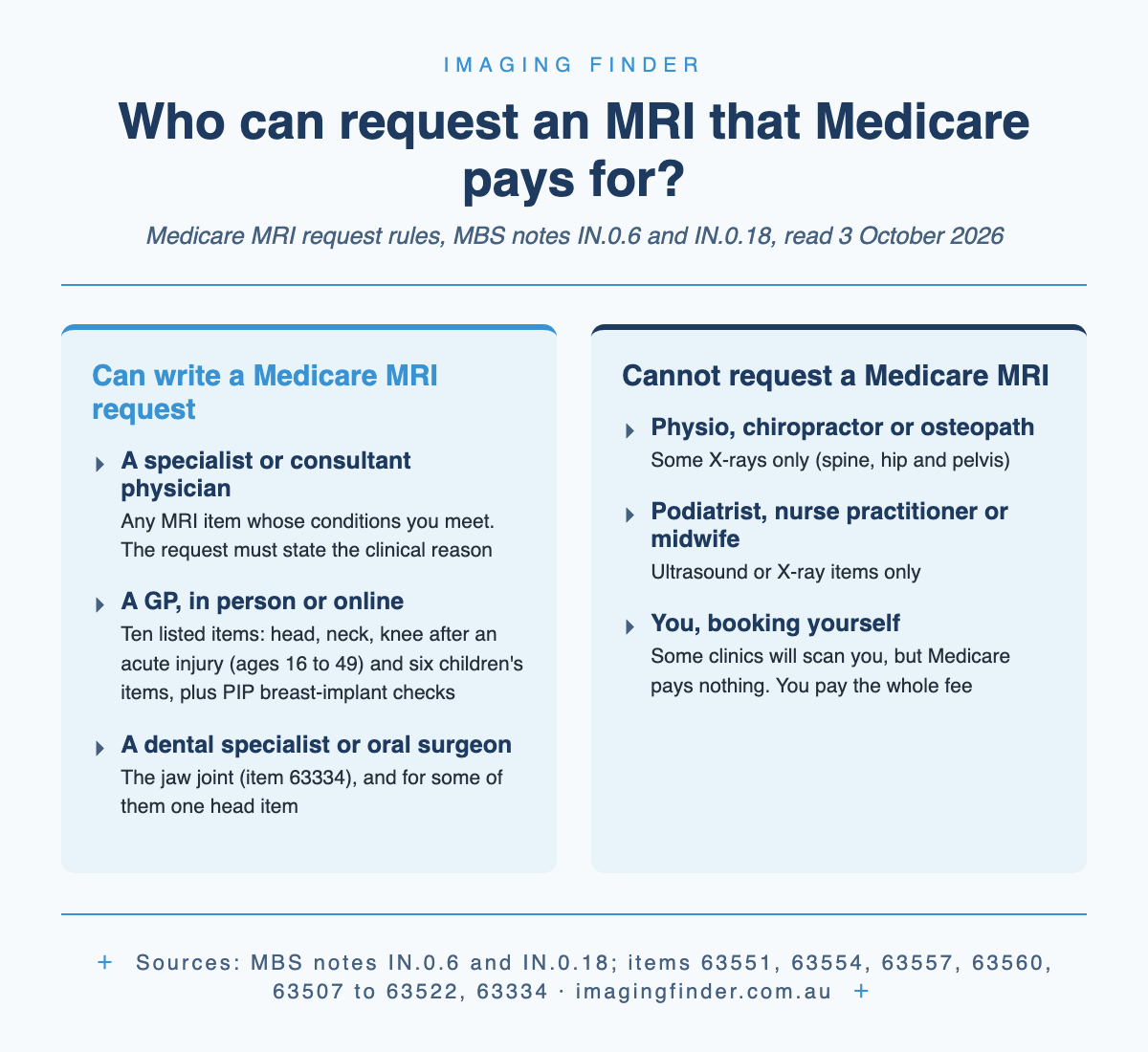
So when a GP tells you “I can’t order that for you”, it is usually because Medicare does not let them. It is not reluctance. For who can request X-rays, ultrasound and CT, see our guides to Medicare scans by type and referrals for X-ray, ultrasound and CT.
What MRI can a GP order?
A GP can request ten MRI items: four for people aged 16 or older and six for children. The fees below were updated on 1 July 2026. “Paid nothing” and the typical gap come from the government’s Medical Costs Finder for 2023–24. It counts patients scanned at radiology practices outside hospital.
Notice what is missing. There is no GP item for an adult’s lower back, shoulder, hip, ankle or abdomen. Our spine scan guide explains why a GP’s lower-back request is usually a CT instead. The brain MRI and knee MRI guides cover those items in detail. Any doctor can also request a breast MRI to check a PIP silicone breast implant, a rare exception.
There is also a limit. Medicare pays for at most three GP-requested MRIs in any rolling 12 months, counted across all of these items together. When a clinic bulk bills, Medicare pays the clinic 95% of the fee and you pay nothing.
What is the quickest way to a Medicare-funded MRI?
If your problem fits a GP item, see your GP. The request can be written at that visit, and you can take it to any clinic you like.
If it does not fit, the Medicare route goes through a specialist. Your GP refers you, and the specialist requests the scan. You need the GP referral for the specialist visit too: Medicare will not cover any costs if you see a specialist without a referral. Yes, that is an extra appointment. But it is the route where Medicare pays for the scan. The specialist is also the person who will act on the result.
Through a public hospital, care is free for anyone with a Medicare card as a public patient, in the emergency department, as an inpatient or in the hospital’s clinics. You cannot book a public hospital MRI yourself, though. The hospital doctors looking after you decide on it, based on clinical need, so there may be a wait.
If it feels like an emergency, an MRI booking is the wrong queue. Call triple zero (000) or go to the nearest emergency department. The hospital team will decide which scan you need.
Paying yourself is still a legitimate choice, especially when time matters to you more than money. Just make it with the price in front of you, and compare it with what the Medicare route would cost.
Why the request matters to the radiologist
I report MRI scans for a living, so here is the part the rules leave out. An MRI is not one picture. It is a set of sequences, and the radiologist chooses them for the question being asked. The MBS expects this too. It asks the request to carry enough clinical detail for the clinic to choose the right examination and answer the referrer’s question in the fewest steps. A scan with no question still produces images. In my view, it is just more likely to produce findings without an answer.
One thing a clinic cannot do: turn your X-ray or CT request into an MRI on the day, or add an MRI because the first scan raised a question. Medicare excludes MRI from the add-on and swap rules that apply to other scans. If the first scan points to an MRI, the request has to come from your doctor.
Before you book
Start with our scan cost calculator. It asks who requested your scan, with options that include “No referral yet” and “Physio or allied health clinician”. Your answers change the Medicare estimate, the chance of no gap and the fee range. Then shortlist MRI clinics near you in Sydney, Melbourne, Brisbane, Perth or Adelaide. For the full cost picture across body parts, see the MRI cost guide and which MRI scans Medicare covers.
Ask the clinic when you book
✓ “For this request, what is the total fee, the Medicare rebate and my final gap?”
✓ “Is the MRI machine I will be scanned on Medicare-eligible?” Medicare pays only for scans on eligible machines.
✓ If you are booking without a referral: “Does the price include a consultation, the radiologist’s report and someone to explain the result?”
Common questions
Can my physio or chiropractor refer me for an MRI?
They can write one, and some clinics will scan you on it, but Medicare pays nothing because no physio, chiropractor or osteopath item list includes an MRI. If they think you need one, ask them to write to your GP with their findings. If your problem fits a GP item, your GP can request it; if not, your GP can refer you to a specialist.
Can an online doctor give me an MRI referral?
An online GP is still a GP. Requests can be sent electronically, so the request is valid, but it carries exactly the same GP item limits. An online GP cannot get Medicare to pay for an adult lower-back or shoulder MRI any more than your own GP can.
Does an MRI referral expire?
No. Imaging requests do not expire; they stay valid until the scan is done, and you can take them to any clinic. The specialist referral that gets you to the specialist is different: most GP referrals to specialists last 12 months.
How we know: sources and method
The request rules come from MBS notes IN.0.6 and IN.0.18, and item wording and fees from the Medicare Benefits Schedule. All were read on 3 October 2026, and every fee quoted was updated on 1 July 2026. What patients paid comes from the Department of Health, Disability and Ageing’s Medical Costs Finder, filtered to diagnostic radiology, out of hospital, 2023–24. It is counted per patient, the same filter as our other cost guides. Clinic prices and offers are as published on the date shown. The view on why a clinical question matters is my judgement as a radiologist. Your own doctor’s advice comes first.
This article is general information, not personal medical advice. Discuss your individual report and next steps with the healthcare professional responsible for your care.

Author: Dr. Mark Bekhit
Dr Mark Bekhit (MBChB, FRANZCR) is a musculoskeletal radiologist practising in Brisbane and an AHPRA-registered specialist in diagnostic radiology (MED0002920947). He spends as much time building software as reading scans: he founded Imaging Finder (Australia) and Radiology Clinics NZ to make imaging easier to find, and builds radiology dictation and pain-tracking tools with one aim — better patient outcomes and a smoother reporting workflow. Outside the reading room he's usually training, bringing the same performance mindset to imaging.
Leave a Reply