By Dr. Mark Bekhit, Radiologist · Last updated September 2026
Short answer: A lumbar (lower-back) CT has a Medicare Schedule fee of $277.10; outside hospital, Medicare pays $235.55. In 2023–24, 96% of patients scanned at radiology practices outside hospital paid nothing for it. MRI is different. From age 16, Medicare pays for a lower-back MRI only on a specialist’s request for a named problem, such as sciatica or a narrowed spinal canal: fee $412.25, Medicare $350.45. A GP’s request can get Medicare to pay for a neck MRI, but only for suspected pressure on a nerve root in the neck or a suspected neck injury.
On this page
• How much does a spine CT or MRI cost?
• Why a GP’s request for your lower back is a CT
• CT or MRI: what each one shows
• Will your spine scan be bulk billed?
How much does a spine CT or MRI cost?
Every Medicare spine scan has a Schedule fee, and Medicare pays 85% of it when you are charged outside hospital. If the practice bulk bills, you pay $0 and Medicare pays the practice 95% instead, which is $263.25 for a lower-back CT. If the practice charges more, you pay the difference. Practices set their own fees, so the question is always which of those three happens to you. For every body part, see the CT cost guide and the MRI cost guide.
In this table, “CAT scan” means a CT and “plain film” means an ordinary X-ray.
Fees are from MBS Online, updated 1 July 2026; “Medicare pays” is the 85% out-of-hospital benefit. The last two columns are the Department of Health’s Medical Costs Finder for 2023–24. They count patients scanned at radiology practices outside hospital, and the gap is the median among those who were charged. It is history, not a quote.
Three details change the bill. A CT with contrast dye injected into a vein costs more: $405.60, with $344.80 from Medicare. A CT of two spine regions without contrast has the same $277.10 fee as one. And an MRI covering three joined regions, or two apart, carries a $515.30 fee, with $438.05 from Medicare.
Charged exactly at the Schedule fee, you would pay $41.55 for the lower-back CT and $61.80 for the sciatica MRI. The typical gaps above are bigger because practices that charge usually charge more than the Schedule fee.
Why a GP’s request for your lower back is a CT
Many people leave the GP with a CT request and a nagging feeling they have been given the cheaper test. The reason is a Medicare rule, not your GP’s judgement of your back. Most Medicare MRI items can be requested only by a specialist or consultant physician, in writing, naming the clinical reason. GPs have a short list of exceptions, set out in which MRI scans Medicare covers; the knee and brain MRI guides cover those body parts. For anyone 16 or older, the spine exceptions cover the neck only: suspected cervical radiculopathy (pressure on a nerve root in the neck) and suspected cervical spinal trauma.
No GP item covers an adult’s lower back. A CT, by contrast, can be requested by any doctor. So when your GP wants a Medicare-rebated picture of your lumbar spine, the choices are a CT or an X-ray.
Children are the exception. For a child under 16, a GP can request a spine MRI after an X-ray for significant trauma, unexplained neck or back pain with nerve signs, or unexplained back pain when something serious is suspected.
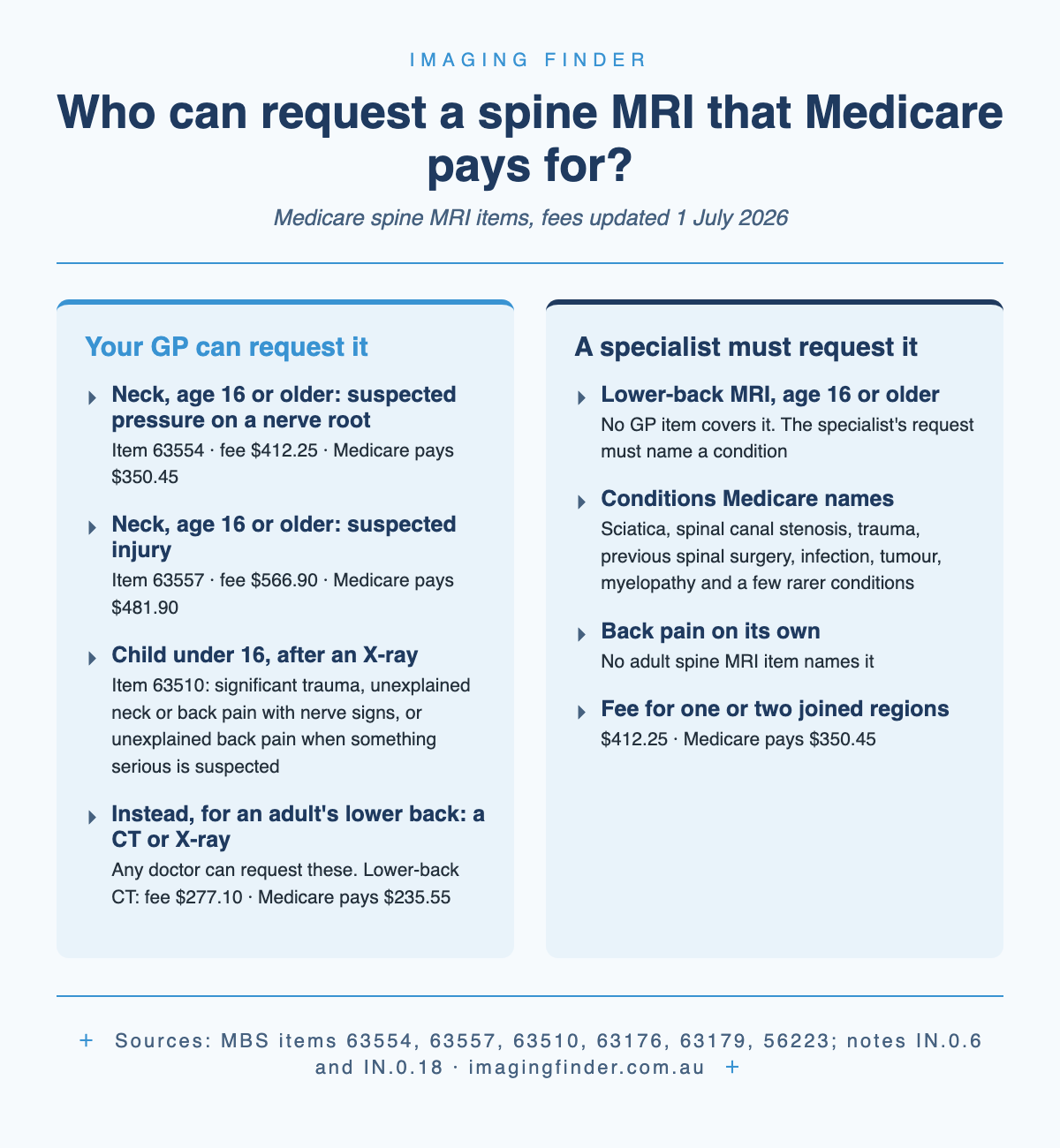
For adults, the specialist items name the problem. The list covers sciatica, spinal canal stenosis, trauma, previous spinal surgery, infection, tumour, myelopathy (pressure on the spinal cord) and a few rarer conditions. None names back pain on its own. Most of these items allow three scans in any 12 months. The doctor who writes the request decides the clinical reason. It is not the practice’s call, and an MRI can never be substituted for the scan your doctor asked for.
CT or MRI: what each one shows
A CT builds very thin cross-sectional pictures from X-rays, and a spine CT needs no preparation. The cost is radiation: CT uses a higher dose than a plain X-ray, so it should be used only when needed. Our guide to CT radiation puts the dose in context.
MRI uses no X-ray radiation and may be the best way of showing certain spine problems. Some people with a pacemaker or certain metal implants cannot have one. If the tunnel is the worry, read about wide-bore and open MRI.
My view as a radiologist: CT shows bone very well, and MRI shows discs, nerves and the spinal cord better. So for leg pain from a nerve in the lower back that is not settling, MRI usually answers the question better than CT. That is the job the specialist sciatica item exists for. A CT is still a useful first scan, and many questions end there.
Do you need a scan at all?
Often, no. More than 9 out of 10 cases of back pain are not caused by a serious medical problem, and most are diagnosed without an X-ray, CT or MRI. The same is true of most neck pain. If you do have a scan, expect it to show some changes that come with age. They don’t necessarily mean your spine is damaged. See your GP if back pain isn’t improving after about 6 weeks, or sooner if it is affecting your sleep or daily activities.
Don’t wait for a booking: call triple zero (000) or go to an emergency department if back pain came on very quickly and is severe, follows a significant injury or accident, comes with fever or feeling unwell, stops you walking, or comes with leg weakness or numbness or changes in bladder or bowel control, or with numbness around the genitals or anus. The same goes for neck pain after an accident. Get urgent medical care for sudden lower back pain if you have had cancer, have lost weight without trying, or the pain is severe at night or when lying down.
Will your spine scan be bulk billed?
Nationally, CT is bulk billed more often than MRI, though not in every state. In the June quarter of 2026, 85.1% of all Medicare CT services were bulk billed, against 80.8% for MRI. When a practice did charge outside hospital, the average patient contribution was $179.09 per CT service and $200.43 per MRI service.
This is a different measure from the first table: services rather than patients, every CT or MRI item, and a later period. Use it to compare states, not to predict your own bill. In the ACT, fewer than half of MRI services were bulk billed, so ask before you book.
Where to book, and what to ask
Your request can go to any practice you choose, even if it is printed on one group’s form. For a CT, start with the clinics offering CT in Sydney, CT in Melbourne, CT in Brisbane, CT in Perth or CT in Adelaide. For an MRI, see the clinics offering MRI in Sydney, MRI in Melbourne, MRI in Brisbane, MRI in Perth or MRI in Adelaide.
Two examples from our directory, checked on 29 September 2026, not a ranking: Queensland X-Ray at the Mater Hospital, South Brisbane, whose group lists spine imaging by X-ray, CT and MRI, and Melbourne Radiology Clinic, East Melbourne, which offers MRI. Neither listing shows today’s billing. For an MRI there is one more check: Medicare pays only when the scan is done on a Medicare-eligible machine, and not every MRI machine is.
Ask the clinic when you book
✓ “Do you bulk bill this scan on my request, and if not, what is the fee and the Medicare benefit?”
✓ For an MRI: “Is the machine I’ll be scanned on Medicare-eligible?”
✓ “Will it be done with dye?” It changes the CT fee.
✓ Bring any earlier spine X-rays or scans. The radiologist reads new images better with the old ones beside them.
If your doctor suggests an injection for back or neck pain next, our guide to image-guided cortisone injections covers the cost and what to expect.
Common questions
Can my physio or chiropractor refer me for a spine scan?
For an X-ray, yes. Physiotherapists, chiropractors and osteopaths can request Medicare spine X-rays, but not a CT or MRI. If they think you need more, ask them to send their findings to your GP, who can request the CT.
Does private health insurance pay for a spine MRI?
Not at a radiology practice. By law, private health insurance cannot cover out-of-hospital scans. Hospital cover helps only with treatment as a private patient in hospital.
Can I just pay for a lower-back MRI myself?
You can, but Medicare will pay nothing if your request fits no Medicare item, and the practice sets its own fee. Ask for the price in writing first. As one dated example, one practice’s January 2026 price list shows non-Medicare MRI from $250; that is its general starting price, not a spine quote. Or ask your GP about a specialist referral. A public hospital is free for Medicare card holders, based on clinical need, though there may be a wait.
How we know: sources and method
Item wording, Schedule fees and benefits come from the Medicare Benefits Schedule, read on 29 September 2026; every fee quoted was updated on 1 July 2026. The requester and frequency rules are from notes IN.0.18, IN.0.6 and IN.0.2. What patients paid is the Department of Health’s Medical Costs Finder, filtered to diagnostic radiology, out of hospital, 2023–24, counted per patient, the same filter as our other cost guides. The state rates are the Department’s June-quarter 2025–26 Medicare statistics, counted per service. The view on CT versus MRI for sciatica is my judgement as a radiologist; your own doctor’s advice comes first. For how bulk billing works across all scans, see our bulk-billing guide.
This article is general information, not personal medical advice. Discuss your individual report and next steps with the healthcare professional responsible for your care.

Author: Dr. Mark Bekhit
Dr Mark Bekhit (MBChB, FRANZCR) is a musculoskeletal radiologist practising in Brisbane and an AHPRA-registered specialist in diagnostic radiology (MED0002920947). He spends as much time building software as reading scans: he founded Imaging Finder (Australia) and Radiology Clinics NZ to make imaging easier to find, and builds radiology dictation and pain-tracking tools with one aim — better patient outcomes and a smoother reporting workflow. Outside the reading room he's usually training, bringing the same performance mindset to imaging.
Leave a Reply