By Dr. Mark Bekhit, Radiologist · Last updated November 2026
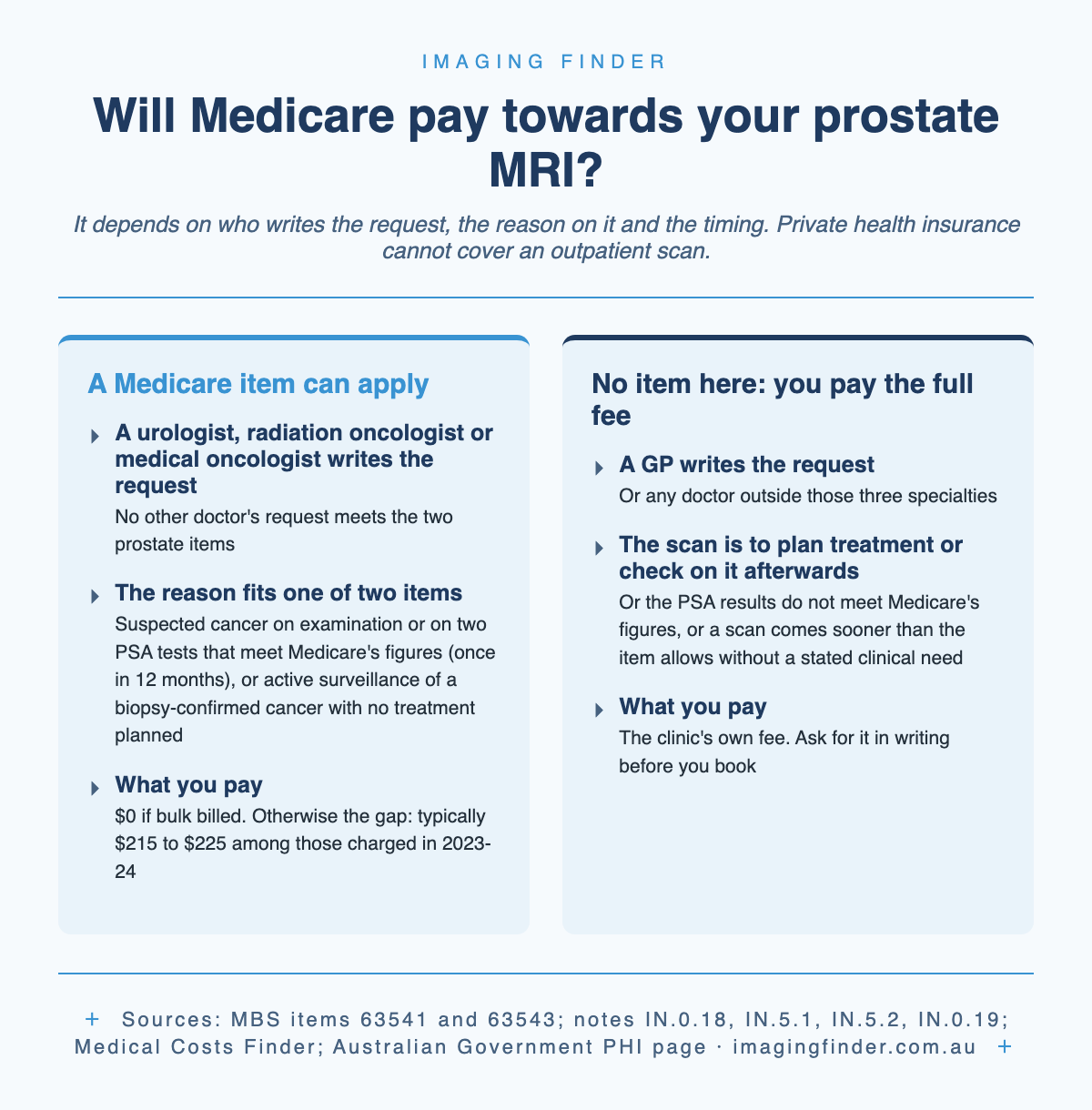
Short answer: Medicare pays towards a prostate MRI only when a urologist, radiation oncologist or medical oncologist requests it, either because cancer is suspected on examination or on PSA tests that meet Medicare’s figures, or for active surveillance of a diagnosed cancer. Medicare then pays $439.95 (2026 rate) if the clinic charges a gap. In 2023–24 nearly two in three men whose scan Medicare covered paid nothing, and those charged typically paid $215 to $225. A GP’s request, or a scan to plan treatment or check on it afterwards, gets nothing back: the whole fee is yours.
On this page
• How much does a prostate MRI cost?
• When does Medicare pay towards it?
• When does Medicare pay nothing?
How much does a prostate MRI cost?
Two things decide it, in this order. Does the request fit one of the two Medicare prostate items? Then, does the clinic bulk bill it?
The Schedule fee is the amount Medicare sets for the scan: $517.55 for both prostate items from 1 July 2026. A clinic charging exactly that would leave you $77.60 out of pocket. Clinics set their own fees, though, and men charged a gap in 2023–24 typically paid $215 to $225.
When does Medicare pay towards a prostate MRI?
First, a raised PSA is not a diagnosis: PSA can rise for several reasons, which is exactly what the MRI helps sort out. As for the bill, Medicare pays only when one of three kinds of specialist writes the request: a urologist, a radiation oncologist or a medical oncologist. This is narrower than most MRI items, which any specialist or consultant physician can request. It also rules out your GP, even if your GP ordered the PSA test.
The request then has to fit one of two items, which have been on the Medicare schedule since July 2018:
For the first item, the request must say why cancer is suspected. One route is a suspicious digital rectal examination, where the doctor feels the prostate with a gloved finger. The other is a pair of PSA blood tests that meet the figures in Medicare’s explanatory note (PSA in µg/L):
“Above” means above: a result of exactly 3.0 does not count. The free/total ratio is a second figure some PSA tests report, and Medicare’s PSA route needs it in every row except the “repeat above 5.5” option for men under 70. The 2026 guidelines go the other way: they no longer recommend free/total testing now that MRI is used to sort out a raised PSA, so your results may not include it. That doesn’t close the door. A suspicious rectal examination noted on the request, or a repeat PSA above 5.5 under 70, meets the item without it.
Good to know: new national PSA testing guidelines were approved on 18 May 2026. They suggest your GP refer you to a specialist after a confirmed PSA of 3.0 or above at 50 to 69 (2.0 for men at higher risk, and 1.0 at 45 to 49), with no free/total ratio condition, and they recommend an MRI before any biopsy. They also define “higher risk” differently from Medicare. The Medicare item’s wording was last changed in November 2021. So a 55-year-old with a confirmed PSA of 3.5, no free/total result and a normal examination can be properly referred under the guidelines and still not meet the Medicare item. If that might be you, ask the specialist’s rooms whether your request fits item 63541 before you book.
When does Medicare pay nothing?
The scan can still go ahead in each of these situations. Medicare just pays nothing towards it, so the clinic’s fee is yours.
- A GP wrote the request, or any doctor outside the three specialties above. Our guide to who can request an MRI covers the general rules.
- The request doesn’t state a qualifying reason: a suspicious examination, PSA results that meet the figures above, or active surveillance.
- The scan is to stage a diagnosed cancer, plan surgery or radiotherapy, or check on things after treatment. Medicare’s note says the surveillance item is not payable for treatment planning or monitoring after treatment, and no other MRI item on the schedule covers the prostate.
- It is too soon. A second suspected-cancer scan inside 12 months, or a surveillance scan inside the 12-month and three-year intervals unless the request states the clinical need for an earlier one.
- The MRI machine isn’t Medicare-eligible. Benefits are only paid for scans on eligible machines at practices that also provide X-ray, ultrasound and CT.
What did men actually pay?
The government’s Medical Costs Finder publishes what patients paid for each Medicare item. These are the figures for scans done in clinics (not as a hospital inpatient) in the 2023–24 financial year, the latest in the tool as at November 2026. “Paid nothing” is the share of patients with no out-of-pocket cost; “typical gap” is the middle amount among those who paid.
Western Australia, Tasmania, the ACT and the Northern Territory aren’t published, and scans billed privately with no Medicare item aren’t counted. Prostate MRI carried a gap more often than a GP-requested head MRI, where 87% paid nothing. And in New South Wales more than half of men paid something, against about one in seven in Queensland. Where you live made a real difference to the bill.
Where can you have one, and what should you ask?
Your request is yours to take to the imaging practice of your choice, and it doesn’t expire. Start with the MRI clinics near you, and check they do prostate MRI when you call: Sydney, Melbourne, Brisbane, Perth, Adelaide, Canberra, Hobart or Darwin.
Prostate MRI isn’t a filter in our directory yet, so here are four examples in our directory whose clinic groups list prostate MRI at that branch on their own websites (checked 3 November 2026). They are examples, not a ranking or a complete list:
- North Shore Radiology, North Shore Private Hospital, St Leonards, Sydney (prostate MRI page)
- Radiology Victoria at Epworth Richmond, Melbourne (prostate MRI page)
- Queensland X-Ray, Mater Private Hospital, South Brisbane (branch services)
- Perth Radiological Clinic, Subiaco, Perth (prostate MRI page)
None of them publishes a prostate MRI price. Preparation differs too: three of the four groups use a small enema on the day, and one asks you to fast for six hours, which is worth knowing before the morning of the scan.
Ask the clinic when you book
✓ “My urologist has asked for a prostate MRI because of my PSA. Do you bulk bill item 63541?” (On active surveillance, the item is 63543.)
✓ “If not, what is your fee, and what will I get back from Medicare?” Ask for it in writing.
✓ “Is the scan done on a Medicare-eligible MRI?”
✓ “Do I need to fast, and will I have an enema or a bowel-relaxing injection?” Practices differ, and it helps to know before the day.
One radiologist’s view: for this scan, the request form decides the bill more than the clinic does. Before you book, read what it says. Does it come from one of the three specialties, and does it name a suspicious examination, PSA results that meet Medicare’s figures, or active surveillance? If a reason that does apply to you has been left off, a call to the rooms can add it. Disputing a full fee afterwards takes a lot longer. Whether you need the scan at all is a decision for you and your specialist; the costs above shouldn’t make it for you.
Common questions
Does private health insurance cover a prostate MRI?
Not for a scan at a clinic as an outpatient. By law, private health insurance does not cover out-of-hospital diagnostic imaging; Medicare covers it. The general MRI cost rules are in our MRI cost guide and MRI and Medicare guide.
Can I have it free in a public hospital?
Anyone with a Medicare card can choose to be treated free as a public patient in a public hospital, with access based on clinical need. If you are already being seen in a public hospital clinic, ask whether the MRI can be done there.
What happens during a prostate MRI?
You lie as still as you can on the scanner table for 30 to 45 minutes while the machine knocks loudly; you get earplugs or headphones. A small needle in your arm is used for Buscopan, which slows the bowel so the pictures are sharp, and for gadolinium contrast, which both Medicare items include unless there is a reason not to give it. Buscopan can briefly blur your vision; if it does, don’t drive until it clears, which takes no more than an hour. If enclosed spaces worry you, our claustrophobia guide has practical options.
Sources
- Medicare Benefits Schedule, item 63541
- Medicare Benefits Schedule, item 63543
- Medicare Benefits Schedule, note IN.0.18 (MRI)
- Medicare Benefits Schedule, note IN.5.1
- Medicare Benefits Schedule, note IN.5.2
- Medicare Benefits Schedule, note IN.0.19 (bulk billing incentive)
- Medicare Benefits Schedule, note IN.0.6 (requests)
- Medical Costs Finder, item 63541
- Medical Costs Finder, item 63543
- Medical Costs Finder, item 63551
- 2026 Guidelines for the Early Detection of Prostate Cancer in Australia (full guideline)
- Prostate Cancer Foundation of Australia, new national guidelines for PSA testing (2026)
- InsideRadiology, MRI of the prostate
- Department of Health, Medicare funding for new MRI prostate scans
- Services Australia, bulk billing
- Department of Health, what private health insurance covers
- Department of Health, public hospitals
- North Shore Radiology, MRI prostate
- Radiology Victoria, prostate MRI
- Queensland X-Ray, Mater Private Hospital South Brisbane
- Perth Radiological Clinic, MRI of the prostate
This article is general information, not personal medical advice. Discuss your individual report and next steps with the healthcare professional responsible for your care.

Author: Dr. Mark Bekhit
Dr Mark Bekhit (MBChB, FRANZCR) is a musculoskeletal radiologist practising in Brisbane and an AHPRA-registered specialist in diagnostic radiology (MED0002920947). He spends as much time building software as reading scans: he founded Imaging Finder (Australia) and Radiology Clinics NZ to make imaging easier to find, and builds radiology dictation and pain-tracking tools with one aim — better patient outcomes and a smoother reporting workflow. Outside the reading room he's usually training, bringing the same performance mindset to imaging.
Leave a Reply