The short answer
Your doctor picks the scan that answers your clinical question, not the one you ask for. CT uses X-rays and is fast, so it leads for acute injury, chest and abdominal problems and suspected bleeding. MRI uses a strong magnet and radio waves, gives no radiation dose, and shows soft tissue in far more detail — the brain, spinal cord, joints and ligaments. Both need a referral in Australia, and MRI’s Medicare rebate rules are stricter than CT’s. What you pay on the day comes down to whether your clinic bulk bills, not the type of scan.
On this page
- Which do you need — MRI or CT?
- How MRI and CT actually differ
- Do you need a referral for a CT or an MRI?
- Which costs more — and will Medicare cover it?
- Safety, metal and contrast: what to tell the clinic
- Booking the right scan near you
- Common questions about MRI and CT
- How we know: sources and method
Which do you need — MRI or CT?
In almost every case this is not your decision to make, and that is a good thing. Your referring doctor matches the scan to the question they need answered, because the two machines are good at different things. As the RANZCR patient resource InsideRadiology puts it, different procedures give different specialised information, and MRI “might be the best way of showing certain problems, such as for a knee injury, the brain or spine”, and is often used to add detail after an X-ray or ultrasound.
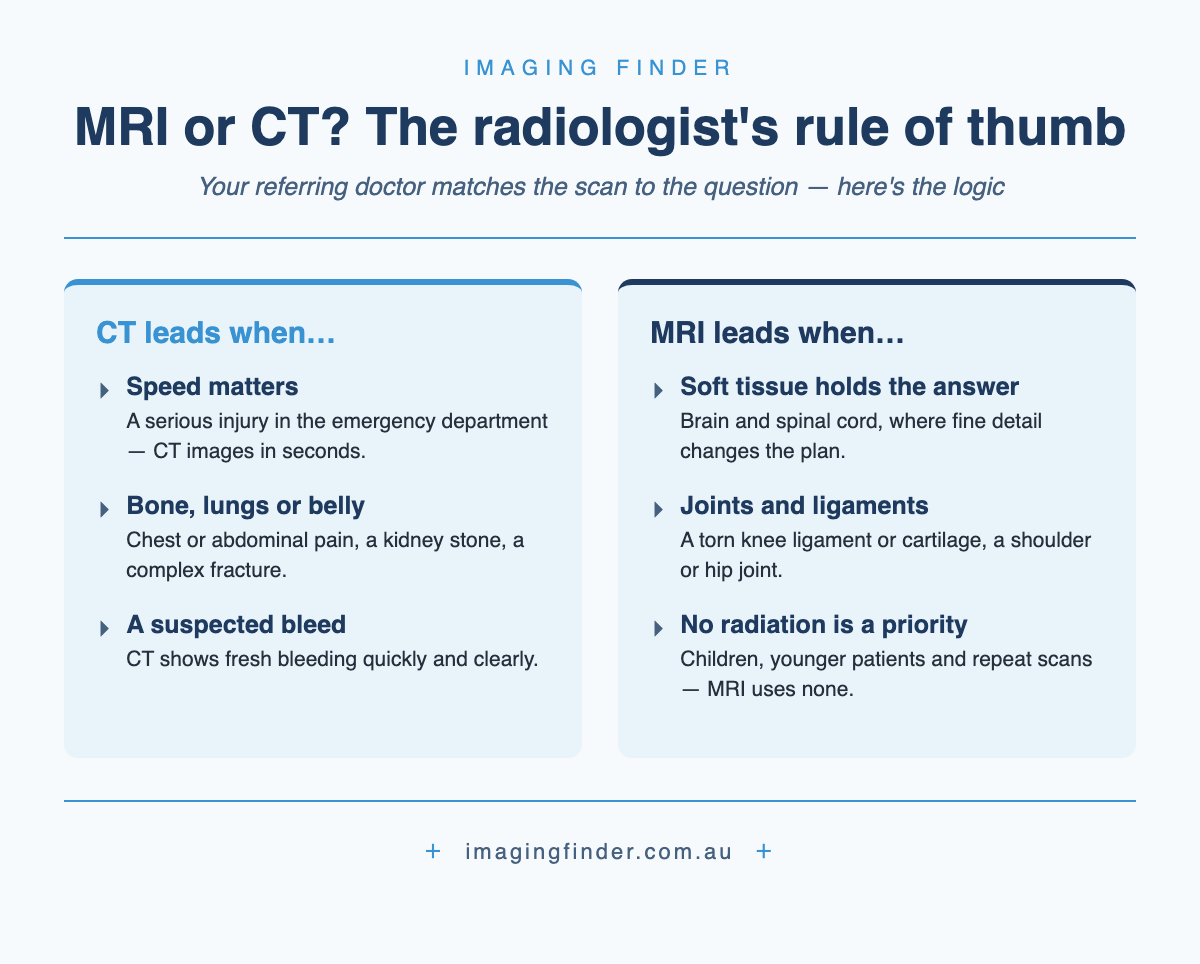
The practical rule of thumb a radiologist uses looks like this. Reach for CT when speed and a clear view of bone, the lungs and the abdomen matter most: a serious injury in the emergency department, a suspected bleed, chest or abdominal pain, a kidney stone, or a complex fracture. Reach for MRI when the answer lives in soft tissue that CT sees only faintly: the brain and spinal cord, a torn knee ligament or cartilage, a shoulder or hip joint, and many cancer questions where fine soft-tissue contrast changes the plan.
Some problems can be worked up by either scan, and the referrer weighs speed, radiation, availability and the exact question before choosing. Persistent low-back pain with leg symptoms is a common example: a plain X-ray or CT often comes first to look at the bones, but if nerve pain continues the referrer usually moves to MRI, which shows the disc and nerve roots that CT cannot see clearly. If you are curious why one was chosen over the other, that is a fair thing to ask the doctor writing the request — the reason is usually specific to your symptom. For a wider view of what each modality is for, see our guide to which scans Medicare covers, modality by modality.
How MRI and CT actually differ
A CT scan is a type of X-ray that builds detailed cross-sectional images — think of slices through a loaf of bread. InsideRadiology describes it as “a way of using X-rays to take pictures or images in very fine slices”. Because it uses X-rays, CT delivers a dose of ionising radiation — the same kind of exposure we all get from natural background sources every day, measured in millisieverts. healthdirect is blunt about the trade-off: CT scans use a high level of radiation and should only be used when necessary. The dose is justified when the information changes your care, which is exactly the judgement your referrer is making.
MRI works on a completely different principle. It uses strong magnets and radiofrequency pulses to generate signals from the body, which a computer turns into images. For safety this matters: MRI uses no ionising radiation at all (our guide to whether a CT scan is safe puts the CT dose in context) — InsideRadiology notes it “has no known long-term harmful effects, provided the safety precautions are followed” and can be used safely in pregnancy if required. That radiation-free advantage matters most for children and younger patients, and for anyone who needs repeated imaging over time.
Speed is the other everyday difference. The CT scan itself is quick — usually under 10 minutes in the machine, with a whole appointment running about 10 to 30 minutes once preparation is counted. An MRI takes longer and is noisier: the scan can run from about 10 minutes to over an hour depending on the body part, and the scanner knocks loudly while it works. Here is the head-to-head:
Neither is simply “better.” A CT can show a fresh fracture in seconds that an MRI would take half an hour to picture; an MRI can reveal a ligament tear or an early brain change that barely registers on CT. That is why the clinical question, not the technology, decides.
Do you need a referral for a CT or an MRI?
Yes — for both. Under the Medicare rules, a benefit is not payable for a requested imaging service unless the clinic first receives a written request from a referring practitioner. No referral, no rebate, whichever scan it is.
Good to know: both scans need a written referral. A GP can request most CT scans, but many adult MRI items only attract a Medicare rebate when a specialist requests them.
Where CT and MRI part ways is who can refer you. Common CT scans can be requested by a GP. Most MRI items are stricter: the Medicare Benefits Schedule limits the bulk of adult MRI items to a request from a recognised specialist or consultant physician, with only a defined set that a GP can request for a rebate — certain adult head and cervical spine scans, acute knee scans within set age limits, and several children’s scans. So a GP can often send you straight for a CT, while an MRI may first need a referral to a specialist. The exact GP-referable MRI items, and the ages they apply to, are set out in our guide to MRI scans and Medicare in Australia.
Which costs more — and will Medicare cover it?
There is no fixed national price on either scan. Services Australia states plainly that diagnostic imaging clinics set their own fees, that you should ask what you will pay before the test, and that if the clinic bulk bills you there is nothing to pay on the day. So the honest answer to “which costs more” is often “whichever one your clinic does not bulk bill” — a bulk-billed CT and a bulk-billed MRI both cost you nothing on the day, whichever machine is used. Cost, in other words, is set by the clinic’s billing choice for your item, not by the modality. For current Australian Government gap examples and a checklist that separates the upfront fee from the final gap, see our MRI cost breakdown. For what a CT scan costs in detail, see our CT scan cost guide.
The same Services Australia guidance confirms you are free to choose your own clinic as long as they offer the scan you need, even if the referral names a particular brand. So it is worth ringing a couple of clinics to ask whether they bulk bill your item and what any gap would be before you book. Use our bulk-billed radiology guide to keep the Medicare eligibility question separate from the clinic’s fee. PET-CT, a specialised third option some patients ask about, sits outside this CT-versus-MRI choice and has its own referral and rebate pathway, covered in our guide to PET-CT scans in Australia.
Ask the clinic when you book
✓ “Do you bulk bill this item?”
✓ “If not, what will the gap be on the day?”
✓ “How soon can you fit me in?”
Safety, metal and contrast: what to tell the clinic
MRI’s strong magnet is why it is radiation-free and also why it needs careful screening. Before your scan you will complete a safety questionnaire, and so will anyone who comes into the room with you. As InsideRadiology stresses, if you have a pacemaker or other implants it is important to tell the facility — some devices and retained metal make an MRI unsafe or need special handling. Mention claustrophobia when you book, too. Our guide to open MRI, wide-bore scanners and planned sedation gives the questions to ask before scan day.
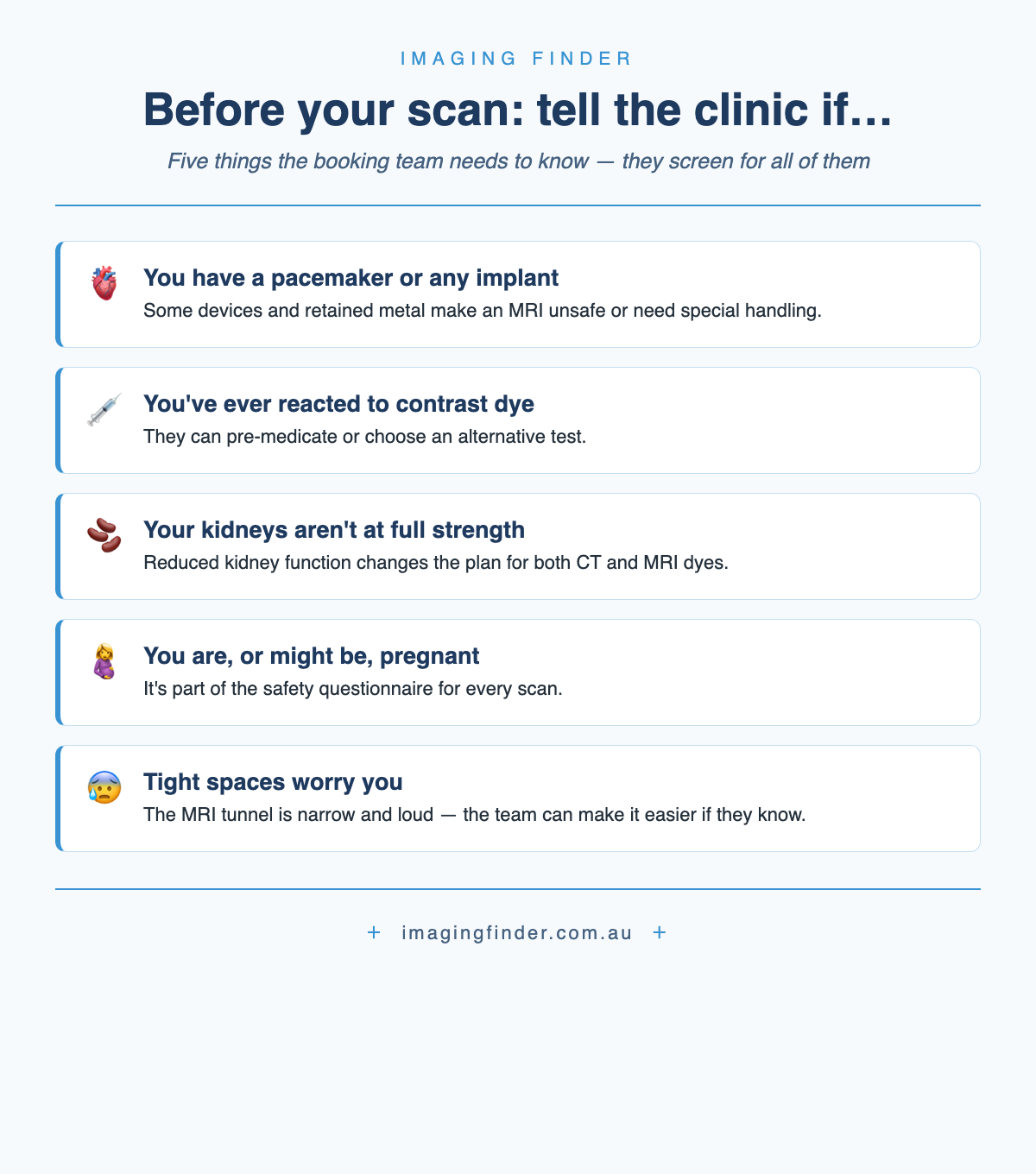
Contrast dye is a separate question for each scan. Some CT scans use an iodine-based dye; people with allergies are more likely to react to it, and our guide to whether CT contrast dye is safe explains the kidney, metformin and allergy checks; if you have ever had a reaction to iodinated contrast you must tell the radiology facility when you book, and they can use pre-medication or an alternative test. MRI uses a different, gadolinium-based dye that InsideRadiology describes as generally very safe, with uncommon reactions and, in people with normal kidney function, more than 90% cleared in the urine within a day. Reduced kidney function changes the calculation for both dyes, which is one reason the request form and a recent blood test matter. None of this is something to sort out alone — it is exactly what the clinic screens for.
Booking the right scan near you
Once your referrer has chosen the scan and written the request, the next step is finding a clinic that performs it, ideally nearby and, where possible, one that bulk bills your item. Use the Imaging Finder directory to compare radiology clinics by modality and suburb rather than ringing around blind. You can start from a capital city — Brisbane, Sydney or Melbourne — or browse every location across Australia and filter to the clinics that offer CT or MRI.
To go straight to the right modality: browse MRI clinics in Sydney, Melbourne, Brisbane or Perth — or CT clinics in Sydney, Melbourne, Brisbane or Perth.
When you call, have the request form in front of you and read out the exact scan and item number if it is written there. Ask whether they bulk bill that item, what any out-of-pocket gap would be, and how soon they can fit you in. When your results come back, our plain-language guide to reading your radiology report explains the terms your radiologist uses.
Common questions about MRI and CT
Is an MRI safer than a CT because it has no radiation?
MRI does avoid ionising radiation, which is a genuine advantage, especially for children, younger patients and repeated scans. But “safer” depends on the question being asked: a CT that answers an urgent problem in minutes is the safer choice in an emergency, and its radiation dose is justified when it changes your care. The right scan is the one that answers your clinical question with the least risk overall.
Can I ask for an MRI instead of a CT?
You can raise it, but the referrer decides based on the clinical question and the Medicare rules. Many adult MRI items also need a specialist’s request to attract a rebate, so a GP may not be able to send you straight for the MRI even if you would prefer it. Ask your doctor why they chose one over the other; the answer is usually specific to your symptoms.
How long does each scan take?
A CT is quick — usually under 10 minutes in the scanner, and about 10 to 30 minutes for the whole appointment once preparation is included. An MRI runs longer, from roughly 10 minutes to over an hour depending on the body part and the type of scan, and the machine is noisy while it works.
Do CT and MRI both use a dye?
Only when the scan needs it. Some CT scans use an iodine-based contrast dye; some MRI scans use a gadolinium-based one. Many scans use no dye at all. If contrast is planned, tell the clinic about any previous contrast reaction, allergies or kidney problems so they can screen you properly.
Will Medicare cover my scan?
Medicare pays a rebate on a CT or MRI when the scan matches a Medicare item and the request comes from the right kind of practitioner — a GP for most CTs, and often a specialist for MRI. Whether you pay anything on the day is a separate question that depends on whether the clinic bulk bills your item for that scan.
Related reading
- MRI scans and Medicare in Australia
- Which scans does Medicare cover, modality by modality
- How to prepare for an ultrasound appointment
How we know: sources and method
The clinical descriptions on this page — how CT and MRI work, their radiation, timing, safety screening and contrast agents — are drawn from the RANZCR patient resource InsideRadiology and from healthdirect, and were read directly on 22 July 2026. The referral and rebate rules come from the Medicare Benefits Schedule explanatory notes and Services Australia, also read on 22 July 2026. This article explains how a referring doctor chooses between the two scans; it does not set fees or decide your eligibility, which the clinic checks against the current schedule when they see your referral.
- InsideRadiology (RANZCR): Computed Tomography (CT) — accessed 22 July 2026
- InsideRadiology (RANZCR): Magnetic Resonance Imaging (MRI) — accessed 22 July 2026
- healthdirect: CT scan — accessed 22 July 2026
- InsideRadiology (RANZCR): Radiation Risk of Medical Imaging for Adults and Children — accessed 22 July 2026
- InsideRadiology (RANZCR): Iodine-containing contrast medium — accessed 22 July 2026
- InsideRadiology (RANZCR): Gadolinium contrast medium — accessed 22 July 2026
- MBS Online: requests for R-type diagnostic imaging services (note IN.0.6) — accessed 22 July 2026
- MBS Online: MRI request rules (note IN.0.18) — accessed 22 July 2026
- Services Australia: screening tests and scans covered by Medicare — accessed 22 July 2026
This article is general information, not personal medical advice. Availability, Medicare eligibility, billing and preparation can change — confirm the specifics with your referrer and the clinic.

Author: Dr. Mark Bekhit
Dr Mark Bekhit (MBChB, FRANZCR) is a musculoskeletal radiologist practising in Brisbane and an AHPRA-registered specialist in diagnostic radiology (MED0002920947). He spends as much time building software as reading scans: he founded Imaging Finder (Australia) and Radiology Clinics NZ to make imaging easier to find, and builds radiology dictation and pain-tracking tools with one aim — better patient outcomes and a smoother reporting workflow. Outside the reading room he's usually training, bringing the same performance mindset to imaging.
Leave a Reply