By Dr. Mark Bekhit, Radiologist · Last updated September 2026
The quick answer
Short answer: An MRI can cost $0 when it meets a Medicare item and the clinic bulk bills. For a privately billed eligible outpatient scan, the final gap is the clinic fee minus the Medicare benefit; with no benefit, one January 2026 clinic guide starts full private fees at $250. In Australian Government 2023–24 examples, gap-paying private-setting patients typically paid $185 for a knee MRI item and $160 for a brain MRI item.
About 81 of every 100 Medicare-billed MRI services were bulk billed nationally in the June quarter of 2025–26. This excludes MRI services without a Medicare benefit. It does not predict one clinic’s billing decision.
Choose the right path: for GP versus specialist request rules, use the MRI Medicare guide. Use this page for clinic fees, Medicare benefits and final gaps.
On this page
How much does an MRI cost in Australia?
There is no single Australian MRI price. Diagnostic imaging clinics set their own fees, so the amount on your quote depends on the Medicare pathway and the clinic’s billing policy.
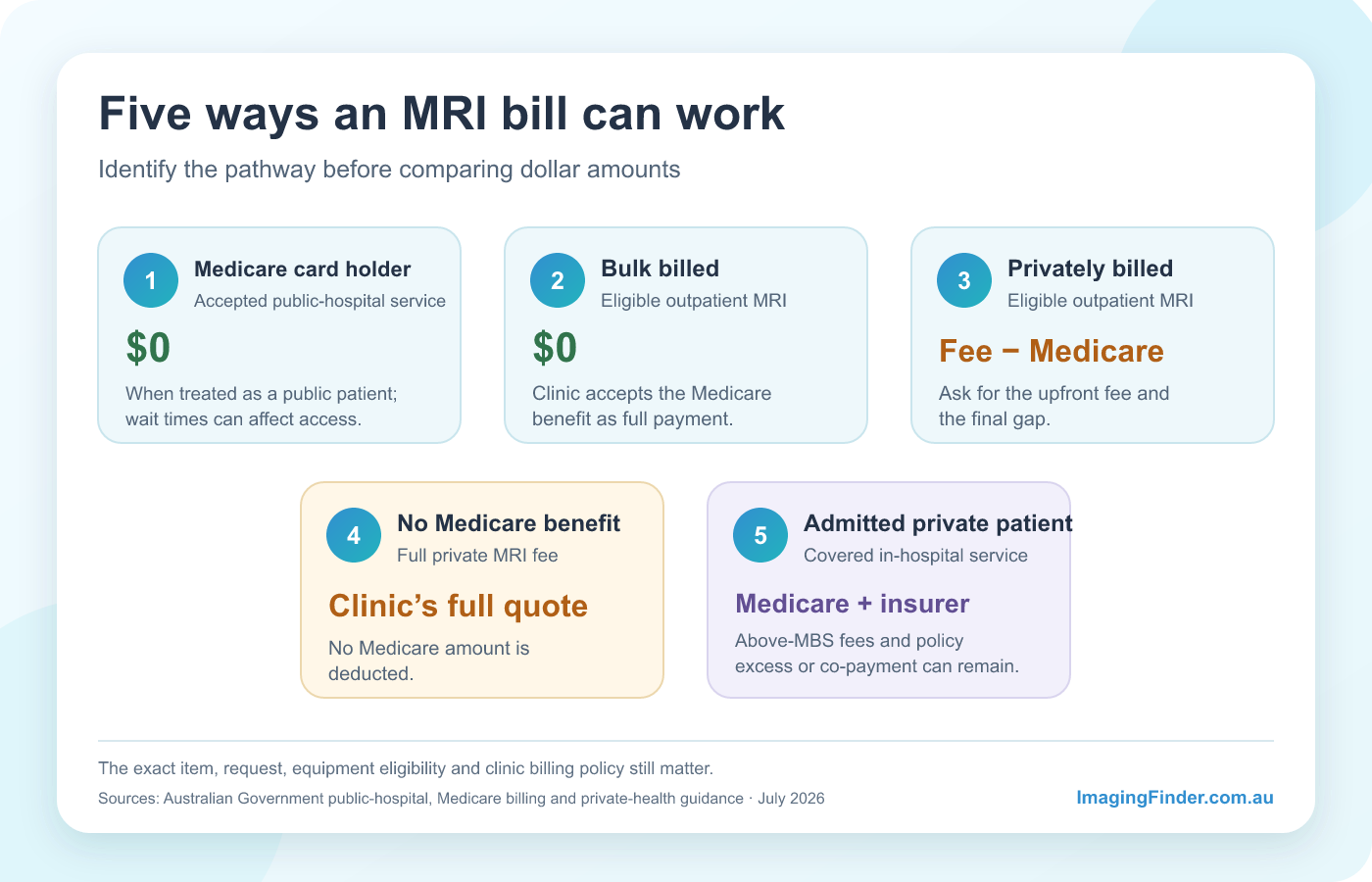
| Your pathway | What the MRI can cost you |
|---|---|
| Medicare card holder receiving an accepted public hospital service as a public patient | $0; the hospital prioritises clinical need, and public patients can wait and cannot choose their doctor |
| Medicare item, bulk billed | $0 because the clinic accepts the Medicare benefit as full payment |
| Medicare item, privately billed | The final gap is the clinic fee minus the Medicare benefit; you usually pay the full fee upfront and then claim the benefit |
| No Medicare benefit expected | A clinic-specific private price; one January 2026 clinic guide advertises non-eligible MRI from $250 |
| Covered service during a private admission | Medicare pays 75% of the MBS fee and the insurer at least the remaining 25%; fees above the MBS amount and any policy excess can remain out of pocket |
The latest item-level Australian Government Medical Costs Finder data is from 2023–24. The examples below span neurological, spinal, musculoskeletal, cancer and cardiac MRI items. Match any comparison to the same body part and MBS item.
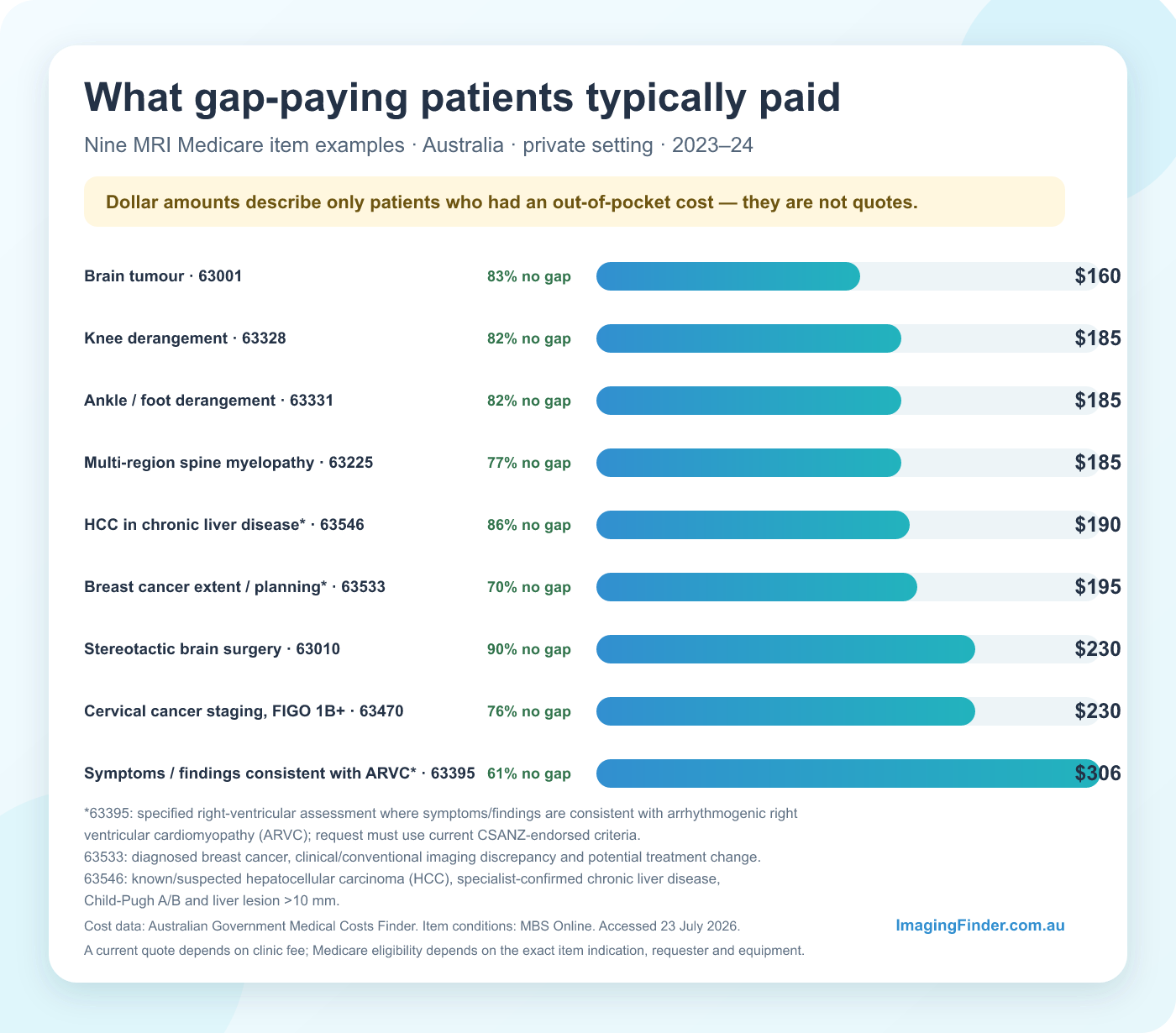
See all nine MRI cost examples
On a phone, swipe the table sideways to see all columns.
*The fee and payment figures describe patients who had a gap. The no-gap percentage uses all private-setting patients. Figures are national 2023–24 data.
For the head items specifically, the two reasons a GP can request one, the child item and the state-by-state figures are in our brain MRI cost guide.
For the spine, including why Medicare does not pay for a lower-back MRI requested by a GP, see our spine CT and MRI cost guide.
For the foot and ankle, where no GP MRI item exists at any age, see our foot and ankle MRI cost guide.
For the shoulder, where Medicare pays only on a specialist’s request and the ultrasound a GP can request is usually the first scan, see our shoulder MRI cost guide.
Read the denominator carefully. For the knee MRI item, 18% of patients had an out-of-pocket cost; the $185 figure describes the typical payment within that group. For the cardiac MRI item, 39% paid a gap and the typical payment within that group was $306. Our heart MRI cost guide covers all six Medicare heart MRI items. None of these figures predicts what a non-rebatable scan or a clinic quote today will cost.
When Medicare does not contribute, published clinic fees provide a more practical example than a national average. Exact Radiology’s January 2026 price guide advertises Medicare-eligible MRI as bulk billed and Medicare-non-eligible MRI from $250. Treat that as one clinic’s dated starting price, not a fee every Australian clinic follows.
What changes the price you are quoted?
Start with the exact MRI written on the request. “MRI” is a family of MBS items, not one product with one price. The body part and clinical indication identify the possible item; the requester affects whether that item is rebatable. The clinic independently sets its fee and decides whether to bulk bill.
The requested body region and clinical question identify a different service. The Medical Costs Finder treats the nine examples above as separate MBS items, each with its own clinic-fee and patient-payment data. A written estimate should identify the likely item and any additional service charged separately from the main MRI.
The requester is especially important for MRI. Under MBS note IN.0.18, most MRI item groups require a written request from a recognised specialist or consultant physician. A defined set allows a request from a non-specialist medical practitioner. A non-specialist request is therefore not automatically private, and a specialist request is not automatically rebatable; the requested scan still has to match an item.
The machine’s location remains part of the answer in 2026. The Department of Health says not all MRI machines are Medicare-eligible before 1 July 2027. Since 1 July 2025, every MRI machine at a listed eligible location can provide the MRI services on the MBS. That equipment rule opens the door to a benefit; it does not override the item description or request rules.
Finally, bulk billing is a clinic choice. Two clinics can assess the same Medicare-rebatable request and give different out-of-pocket quotes because one accepts the Medicare benefit as full payment and the other sets a higher fee. For a non-bulk-billed out-of-hospital service, you usually pay the full clinic fee upfront and then claim the Medicare benefit. Compare both the amount payable on the day and the final gap after Medicare.
Does Medicare cover your MRI?
Medicare contributes only when the scan, clinical indication, requester, professional-supervision requirements and equipment satisfy the relevant MBS item. Ask the clinic to match the request to the expected item before it gives you a quote.
- Look at who wrote the request. Most adult MRI items need a specialist or consultant physician; a smaller group is available on a GP request.
- Use the exact wording on the request. A knee MRI is not one universal item, and the indication can decide whether a benefit is payable. Our knee MRI cost guide sets out the three knee items and the age-50 rule.
- Equipment eligibility. This remains relevant until the national equipment change scheduled for 1 July 2027.
- Separate eligibility from billing. A Medicare benefit can exist even when the clinic charges a gap. Bulk billing reduces that gap to $0 because the clinic accepts the benefit as full payment.
For the item-by-item GP and specialist request rules, see our MRI and Medicare guide. Our bulk-billed radiology guide explains the billing model across imaging services.
Will private health insurance pay?
For an outpatient MRI, Australian private health insurance is not a second rebate. The Department of Health states that private health insurance does not cover out-of-hospital diagnostic imaging and tests. If your outpatient MRI has an MBS benefit, Medicare can contribute; if the clinic charges more, the remaining gap is yours.
The position changes when you are admitted as a private patient in a public or private hospital. For a covered in-hospital medical service, Medicare pays 75% of the MBS fee and the insurer covers at least the remaining 25%. The official guidance identifies two additional cost categories: a clinic fee above the MBS amount, and an excess or co-payment required by the patient’s policy.
The public-hospital and private-clinic checklist compares access, timing and costs.
No Medicare card? Visitors, international students and other temporary visa holders pay the clinic’s whole fee rather than a gap. Our guide to scan costs without Medicare shows what an MRI costs then, what Overseas Student Health Cover pays back, and which visitors are covered after all.
How do you compare two MRI quotes?
A quote that says only “the MRI is $550” leaves the most important number hidden. It might be the full clinic fee before Medicare, the amount after Medicare, or a private fee with no benefit. A comparable quote separates the parts.
| Line on the quote | What it means |
|---|---|
| Likely MBS item | The item number the clinic expects to claim for the requested scan |
| Clinic fee | The clinic’s total charge for the MRI service before any Medicare payment |
| Medicare benefit | The amount Medicare is expected to pay for the eligible item |
| Amount payable on the day | The upfront payment; for a non-bulk-billed outpatient service this is usually the full clinic fee |
| Outpatient final gap | The clinic fee minus the expected Medicare benefit for an eligible out-of-hospital service |
| Bulk billed / patient payment $0 | The clinic accepts the Medicare benefit as full payment, leaving no MRI-service gap |
| Full private fee — no Medicare benefit expected | The clinic’s entire quoted fee, with no Medicare amount deducted |
| Admitted-patient out-of-pocket cost | The clinic and hospital charges remaining after Medicare and insurer benefits, including any policy excess or co-payment |
| Hospital excess | The amount your policy requires you to contribute to this admission; ask your insurer whether one applies and how much it is |
Have the request in front of you when you call. Ask for a written estimate listing the likely MBS item, total clinic fee, expected Medicare benefit, amount payable on the day and final out-of-pocket cost. Add: “Will contrast, another imaging service or a hospital excess be charged separately, and how much?”
Then compare the final patient payment, appointment time and travel. You can choose another clinic even when the request names a particular imaging brand, provided the new clinic offers the scan.
How do you find an MRI clinic near you?
As at 23 July 2026, about 606 Imaging Finder directory listings record MRI as a service. This does not show billing policy or confirm that a request attracts a Medicare benefit.
Start with the national radiology clinic directory, or narrow the map to MRI clinics in Brisbane, MRI clinics in Sydney or MRI clinics in Melbourne. The individual clinic listing provides the contact details for using the quote script above. For a general comparison of the tests, see the MRI-versus-CT guide.
Shortlist two clinics you can reasonably reach and use the same request when asking each for a price. Compare the final patient payment alongside appointment timing and travel, rather than comparing an upfront clinic fee with another clinic’s after-Medicare gap.
Sources and methodology
Sources and methodology
The dollar examples come from Australian Government Medicare claims data, not clinic surveys. The latest item-level Medical Costs Finder examples use 2023–24 data. We read the current MBS request note, MRI equipment register, private-health rules and Services Australia billing guidance on 23 July 2026. The Exact Radiology figure is included only as a dated example of a published non-rebatable starting price.
The clinic total comes from services publicly listed by clinics in Imaging Finder as at July 2026. It identifies places that can provide a quote; it does not show billing policy, appointment availability or individual Medicare eligibility.
- Services Australia: screening, tests and scans covered by Medicare
- Medical Costs Finder: knee MRI item 63328
- Medical Costs Finder: brain MRI item 63001
- Medical Costs Finder: brain surgery planning MRI item 63010
- Medical Costs Finder: multi-region spine MRI item 63225
- Medical Costs Finder: ankle and foot MRI item 63331
- Medical Costs Finder: cardiac MRI item 63395
- Medical Costs Finder: cervical cancer pelvis MRI item 63470
- Medical Costs Finder: breast cancer treatment planning MRI item 63533
- Medical Costs Finder: liver MRI item 63546
- MBS Online: current item descriptions for 63001, 63010, 63225, 63328, 63331, 63395, 63470, 63533 and 63546
- MBS Online: MRI request and eligibility note IN.0.18
- Department of Health: Medicare-eligible MRI locations
- Department of Health: what private health insurance covers
- Department of Health: hospital cover and product tiers
- Department of Health: public hospitals
- Exact Radiology: January 2026 price guide
This article is general information, not personal medical advice. Discuss your individual report and next steps with the healthcare professional responsible for your care.

Author: Dr. Mark Bekhit
Dr Mark Bekhit (MBChB, FRANZCR) is a musculoskeletal radiologist practising in Brisbane and an AHPRA-registered specialist in diagnostic radiology (MED0002920947). He spends as much time building software as reading scans: he founded Imaging Finder (Australia) and Radiology Clinics NZ to make imaging easier to find, and builds radiology dictation and pain-tracking tools with one aim — better patient outcomes and a smoother reporting workflow. Outside the reading room he's usually training, bringing the same performance mindset to imaging.
Leave a Reply