By Dr. Mark Bekhit, Radiologist · Last updated October 2026
Short answer: What you pay for a foot or ankle MRI depends on who requests it. With a specialist’s request, Medicare pays $394.25 of the $463.80 Schedule fee, and in 2023–24, 82% of those patients paid nothing. No Medicare item lets a GP request one, and podiatrists and physiotherapists cannot request any Medicare MRI. On their request you pay the practice’s own fee; published starting prices in October 2026 were $250 at one practice group and $290 per region at another. A GP, podiatrist or nurse practitioner can request a foot X-ray or ultrasound, which Medicare covers.
On this page
• How much does a foot or ankle MRI cost?
• Who can request one that Medicare pays for?
• Is an X-ray or ultrasound enough?
• What does it cost without Medicare?
• Will a specialist-requested MRI be bulk billed?
How much does a foot or ankle MRI cost?
Find your row first. The person who signed your request decides whether Medicare can pay at all; the clinic then decides whether to bulk bill.
Schedule fees are the amounts Medicare sets for each scan, from 1 July 2026; the 2023–24 figures are from the Department of Health’s Medical Costs Finder.
On the specialist route there are still two outcomes. If the practice bulk bills, you pay $0 and Medicare pays the practice 95% of the Schedule fee. If it charges its own fee, Medicare still pays $394.25 and you pay the gap. At exactly the Schedule fee that gap would be $69.55; real gaps run higher because practices set their own fees.
Item 63331 covers what the Schedule calls “derangement”: a problem with the joints of the ankle or foot, or their supporting structures. If a specialist suspects infection, a tumour or osteonecrosis, bone that has died from a lack of blood supply, other specialist items apply (63304, 63301, 63307), each with a $438.05 Schedule fee and a $372.35 benefit.
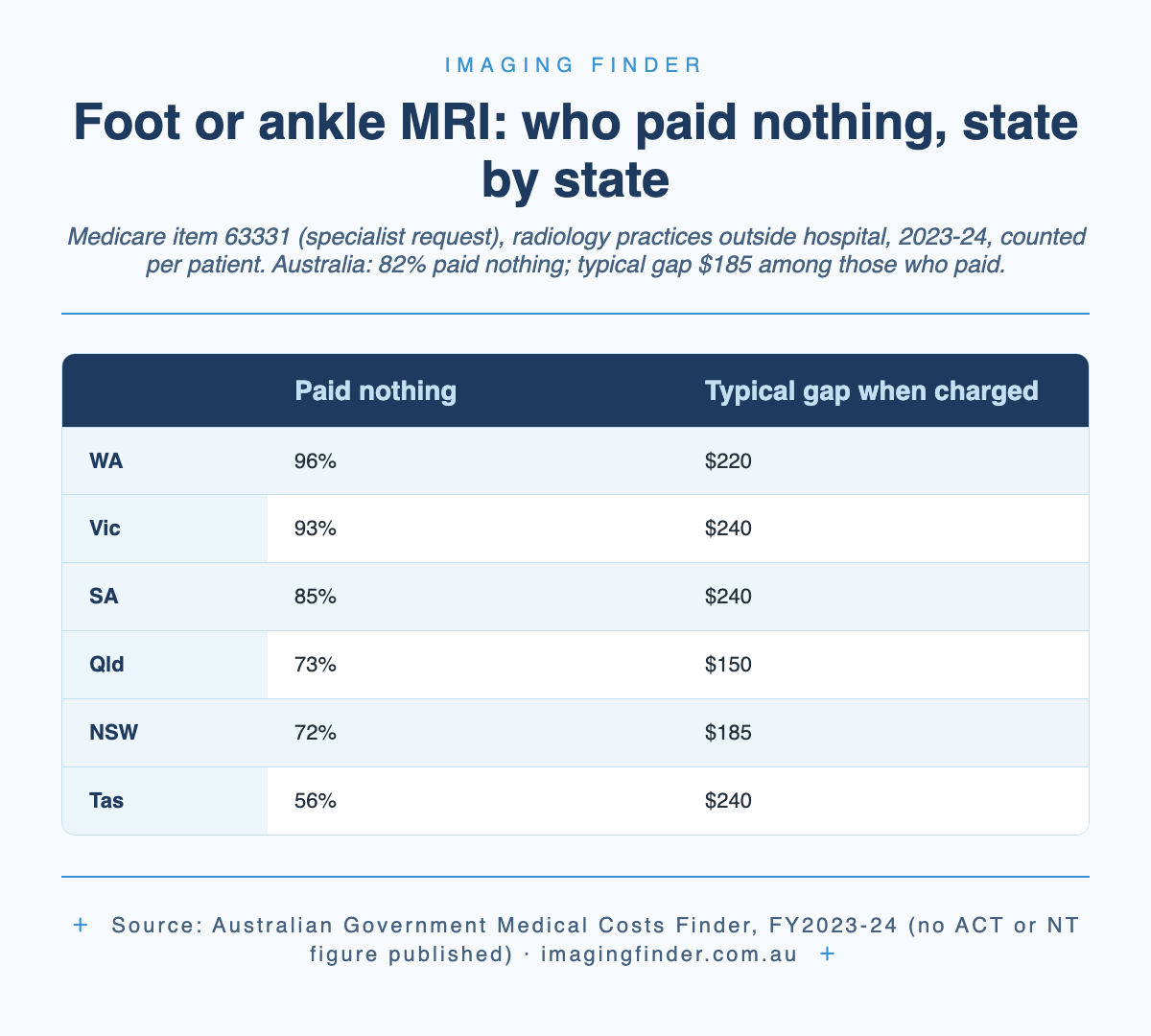
On the specialist route, where you live mattered. Under item 63331, 96% of patients in Western Australia paid nothing in 2023–24, against 56% in Tasmania. No ACT or Northern Territory figure is published for this item.
Who can request one that Medicare pays for?
As a rule, only a recognised specialist or consultant physician can request a Medicare MRI, in writing, naming the clinical reason. For a foot or ankle, that is often an orthopaedic surgeon (bone doctor), to whom your GP may refer you to discuss treatment. Medicare pays for up to three 63331 scans of each side in any 12 months.
So the Medicare route runs GP, then specialist, then MRI. You need a GP referral for Medicare to help with the specialist visit, and that visit has its own fee and gap.
GPs have a short list of MRI exceptions. From age 16 they cover the head and the neck, and an injured knee up to age 49; for children under 16, the head, spine, knee, hip, elbow and wrist.
No GP item for the foot or ankle, at any age: a GP can still write the request and the scan can go ahead, but Medicare pays nothing towards it. That is not your GP doing anything wrong. The Schedule simply has no GP item for this part of the body.
The same goes for podiatrists, physiotherapists, chiropractors, osteopaths and nurse practitioners, none of whom can request any Medicare MRI. So when someone tells you “Medicare won’t cover a foot MRI”, they are right about their own request and wrong about a specialist’s.
One trap for foot problems: for Medicare, a specialist is a medical practitioner recognised as one, such as an orthopaedic surgeon. A surgical podiatrist, the new title for a podiatric surgeon, works within podiatry and is not a medical specialist, so their MRI request earns no rebate either.

Is an X-ray or ultrasound enough?
Often, yes, at least to start. For ankle pain, the tests a doctor may recommend are an X-ray, an ultrasound and blood tests. After a sprain, an X-ray may rule out broken bones. For heel pain from plantar fasciitis, an X-ray or ultrasound can rule out other causes, though often no scan is needed at all. These are the tests Medicare covers well, and a GP, podiatrist or nurse practitioner can request them.
Medicare Schedule fees from 1 July 2026; 2023–24 Medical Costs Finder figures. Each figure covers everyone billed that item, so the two X-ray rows also include lower leg, knee and thigh X-rays. A physiotherapist cannot request any of these four for a Medicare benefit: their list covers X-rays of the spine, hip and pelvis. Our guide to who can request an X-ray or ultrasound has the full lists, and the scan cost calculator compares clinic prices for an X-ray or an ultrasound.
My own view, as a radiologist: an X-ray answers the bone question, and an ultrasound shows tendons, the plantar fascia and some ligament injuries, and can watch them while you move the foot. MRI earns its place when a specialist is planning treatment, when a stress fracture or cartilage injury is suspected but the X-ray looks normal, or when symptoms have not settled. The cheaper test is often what a specialist will want to see first anyway.
If your ankle is very painful, you think it is broken or dislocated, or it is hot, red and swollen with a fever, see a doctor or go to an emergency department rather than booking a scan.
What does it cost without Medicare?
On a GP, podiatrist or physio request, the practice charges its own fee. The two starting prices in the table come from a Queensland group around Ipswich, in its January 2026 price guide, and a Sydney group whose MRI scans are all private. Neither is a foot quote, and a starting price is the floor, not the bill. If you have no request at all, our guide to getting an MRI without a referral covers that route.
If a public hospital is treating you, its services are free to you as a public patient, based on clinical need.
Will a specialist-requested MRI be bulk billed?
That is the practice’s choice, and it varies by state. Across all MRI items from April to June 2026, 80.8% of Medicare MRI services were bulk billed.
This table counts every Medicare MRI scan of any body part in one recent quarter. The state graphic above counts patients having a foot or ankle MRI in 2023–24. That is why Western Australia shows 96% there and 90.8% here: different scans, different years. Medicare also pays only for a scan on a Medicare-eligible MRI machine.
Where to book, and what to ask
The scan cost calculator shows the MRI prices that a small number of clinic groups publish. On a GP, podiatrist or physio request, read its self-funded price, because Medicare pays nothing on that request. Then shortlist MRI clinics in Sydney, Melbourne, Brisbane, Perth or Adelaide. For the cheaper first test, use the city pages, for example X-ray clinics in Brisbane or ultrasound clinics in Melbourne.
Two examples from our directory, checked on 6 October 2026. Harbour Radiology North Sydney bills all its MRI privately, so even a specialist’s request earns no Medicare rebate there; its ankle MRI page lists North Sydney. Queensland X-Ray at the Mater Hospital Brisbane lists foot and ankle MRI on its MRI page. They are examples, not a ranking.
Ask the clinic when you book
✓ “My request is from [a specialist / my GP / my podiatrist]. Which Medicare item applies, and do you bulk bill it?”
✓ “If not, what is the full fee and what will I get back?” Medical Costs Finder calls this a written estimate.
✓ “Is the MRI machine I will be booked on Medicare-eligible?”
✓ Bring previous foot or ankle X-rays, and check the request names the side and the part: ankle, heel, midfoot or toes.
For other body parts, see the MRI cost guide, the knee MRI cost guide, the brain MRI cost guide and the spine CT and MRI cost guide. If you are nervous in the scanner, read our guide to MRI claustrophobia and wide-bore machines.
Common questions
Does private health insurance cover a foot MRI?
Not for an outpatient scan. By law, private health insurance cannot cover out-of-hospital diagnostic imaging. Medicare can help, but for a foot or ankle MRI only on a specialist’s request. Hospital cover helps only with treatment as a private patient in hospital, so a fund comes into it only if the scan happens during a private hospital admission.
How long does an ankle MRI take?
One Sydney practice books 20 minutes for an ankle MRI, and times vary with the request. MRI is painless and uses no X-ray radiation. Tell the team beforehand if you have claustrophobia, a pacemaker or a metal implant.
How we know: sources and method
Item wording, Schedule fees and benefits come from the Medicare Benefits Schedule, read on 6 October 2026 (every fee quoted was updated on 1 July 2026). The requester and frequency rules are from notes IN.0.18 and IN.0.6, and the surgical podiatrist title from the Department of Health. What patients paid per item is the Department of Health’s Medical Costs Finder, filtered to diagnostic radiology, out of hospital, 2023–24, counted per patient; “paid nothing” is the share of all patients for that item, and the typical gap is the median among those who were charged. That is the same filter as our X-ray cost guide and ultrasound cost guide. State bulk-billing rates are the Department’s June-quarter 2025–26 Medicare statistics, counted per service across all MRI. Self-funded prices are the clinic groups’ own published starting prices, read on 6 October 2026. Symptom guidance is from healthdirect. Where I give a view on X-ray and ultrasound before MRI, that is my judgement as a radiologist; your own doctor’s advice comes first. For the full list of GP MRI items, see which MRI scans Medicare covers.
This article is general information, not personal medical advice. Discuss your individual report and next steps with the healthcare professional responsible for your care.

Author: Dr. Mark Bekhit
Dr Mark Bekhit (MBChB, FRANZCR) is a musculoskeletal radiologist practising in Brisbane and an AHPRA-registered specialist in diagnostic radiology (MED0002920947). He spends as much time building software as reading scans: he founded Imaging Finder (Australia) and Radiology Clinics NZ to make imaging easier to find, and builds radiology dictation and pain-tracking tools with one aim — better patient outcomes and a smoother reporting workflow. Outside the reading room he's usually training, bringing the same performance mindset to imaging.
Leave a Reply