By Dr. Mark Bekhit, Radiologist · Last updated October 2026
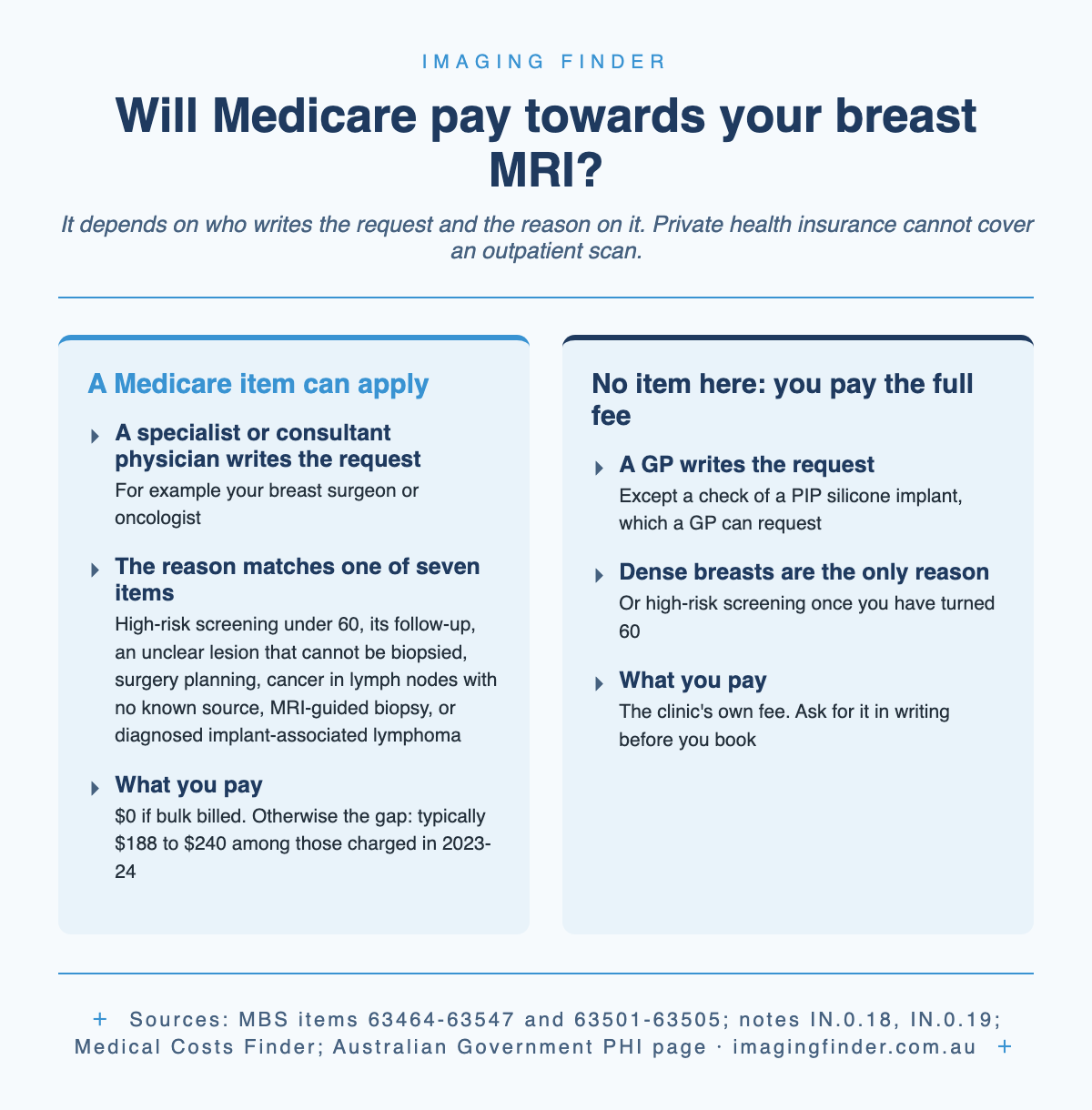
Short answer: Apart from a check of a PIP silicone implant, Medicare pays towards a breast MRI only when a specialist’s request fits one of seven situations, such as high-risk screening before 60 or planning cancer surgery. For most of them Medicare pays $689.25 if the clinic charges a gap (more if it bulk bills or uses contrast), and in 2023–24 between six and eight in ten patients paid nothing; those charged typically paid $190 to $240. A GP’s request, dense breasts alone, or high-risk screening from 60 gets no Medicare benefit, so the whole fee is yours.
On this page
• How much does a breast MRI cost?
• Which breast MRIs does Medicare pay for?
• When does Medicare pay nothing?
• What did people actually pay?
How much does a breast MRI cost?
Two questions decide it, in this order. Does the reason on your request fit a Medicare item? Then, does the clinic bulk bill it?
The Schedule fee is the amount Medicare sets for each scan; the figures here apply from 1 July 2026 and are current as at October 2026. For most breast MRI items it is $793.75, and when contrast is injected for items 63464, 63531, 63533 or 63547 the clinic can add a contrast item worth $51.55 (Medicare pays $43.85 of it). A clinic that charges exactly the Schedule fees leaves you about $105 to $112 out of pocket, but clinics set their own fees, and the typical gap was roughly double that.
Which breast MRIs does Medicare pay for?
Seven, plus a check of a PIP silicone implant (covered below). All seven need a written request from a recognised specialist or consultant physician that names the clinical reason. In practice that is usually your breast surgeon or oncologist. If your GP writes the request instead, these items do not apply.
The screening item, 63464, is the one most people searching this are asking about. The request must say you have no symptoms, are younger than 60, and are at high risk for at least one of five listed reasons:
- genetic testing has found a high-risk breast cancer gene change, such as BRCA1 or BRCA2, in you or a first-degree relative;
- a first- or second-degree relative had breast cancer at 45 or younger, and another on the same side of the family had a bone or soft tissue sarcoma at 45 or younger;
- you had breast cancer yourself before 50;
- you have had mantle radiation therapy, a type of chest radiotherapy used for Hodgkin’s disease;
- a recognised risk calculator puts your lifetime risk above 30%, or your 10-year risk above 5%. Medicare names the Tyrer-Cuzick (IBIS) calculator, version 8 or later.
Good to know: the age limit used to be 50. It was raised to 60 after the Medical Services Advisory Committee supported the change, because cancers in BRCA2 carriers peak between 51 and 60. Some older clinic guides still say “less than 50”. If you are in your 50s and were told you are too old, ask your specialist to check the current wording.
When does Medicare pay nothing?
The scan can still go ahead in each of these situations. Medicare just pays nothing towards it, so you pay the clinic’s fee.
A GP wrote the request. Breast MRI sits in the group of MRI items that only a specialist or consultant physician can request (our guides to who can request an MRI and MRI and Medicare set out the general rules). The exception is a check of a silicone implant made by Poly Implant Prosthèse (PIP), or one suspected to be. Any doctor, including your GP, can request that scan, and Medicare pays $488.95 towards a $575.20 Schedule fee. Other implant checks have no item here unless a rare implant-associated lymphoma has already been diagnosed (item 63547 above), although MRI is the best test for showing whether an implant has ruptured.
Dense breasts are the only reason. Density alone does not meet the high-risk criteria. Extra screening for dense breasts happens outside BreastScreen, after a GP referral, with Medicare rebates only in specific circumstances. It finds more cancers but also more false alarms. Our guide to dense breasts and ultrasound covers that choice, and BreastScreen versus a diagnostic mammogram explains which route fits symptoms.
You have turned 60. High-risk screening by MRI from 60 has no item in this group, even with a gene change. A scan for an unclear lesion or a diagnosed cancer can still fit one of the other items.
You have had one screening MRI in the last 12 months. Item 63464 can be claimed once in any rolling 12 months, not once per calendar year.
What did people actually pay?
The screening, lesion and surgery-planning items carried a gap more often than a GP-requested head MRI. The Department of Health, Disability and Ageing’s Medical Costs Finder shows, for 2023–24 scans outside hospital:
“Paid nothing” counts patients, and the typical gap is the middle amount among those who paid one. These figures cover the scan item only, not the contrast item, so a bill with contrast can be a little higher. The other three items have no published figures.
Where you live matters too. For the screening item, 80% paid nothing in Queensland, 74% in New South Wales and 59% in Victoria; the tool shows no figure for other states. When these items did carry a gap, the middle total fee charged was about $820 to $870, with Medicare paying most of it. That is a guide to Medicare scans, not a quote for a scan with no item.
Where can you have one, and what should you ask?
Not every MRI clinic does breast MRI. Every Medicare item needs a dedicated breast coil, and not every site with an MRI machine offers it. Your request is not tied to the clinic printed on the form: you can take it to the practice of your choice, and it does not expire.
Start with our MRI clinic pages for Sydney, Melbourne, Brisbane, Perth, Adelaide, Canberra and Hobart. They list MRI clinics, not breast MRI specifically. These clinics in our directory say on their own websites that they do breast MRI at that location (checked 27 October 2026). They are examples, not a complete list or a recommendation:
- Sydney: North Shore Radiology, North Shore Private Hospital, St Leonards (breast MRI page).
- Brisbane: Queensland X-Ray, Mater Private Hospital, South Brisbane (location page).
- Perth: Perth Radiological Clinic, Hollywood Consulting Centre, Nedlands (breast MRI page).
- Adelaide: Jones Radiology, Seaford Meadows (location page).
We could not confirm a specific Melbourne, Canberra or Hobart location on a clinic’s own page that day, so ring the clinics on those city pages and ask directly.
One piece of radiologist advice. Breast MRI is very sensitive, and many of the small things it shows are not cancer. Some are visible only on MRI. If you are called back, the next step may be an ultrasound or a biopsy, sometimes guided by MRI itself. I would ask at booking whether the clinic can do that follow-up, so a call-back does not mean starting again somewhere else.
Ask the clinic when you book
✓ “Do you do breast MRI at this location, on a Medicare-eligible machine?”
✓ “Which Medicare item will my request be billed under, and what will I pay on the day?”
✓ “If you see something, can you do the follow-up ultrasound or biopsy here?”
✓ Have your cycle dates ready. The scan is usually booked 6 to 16 days after your period starts, the best time for the scan to show any abnormality. If you take HRT, your doctor may ask you to stop it 4 to 6 weeks before. Bring previous mammograms, ultrasounds and biopsy reports.
Common questions
Does private health insurance cover a breast MRI?
Not as an outpatient. By law, private health insurance cannot cover out-of-hospital diagnostic imaging.
Can I have it free in a public hospital?
Possibly, as a public patient. Anyone with a Medicare card can choose public hospital services free of charge, provided on the basis of clinical need and within a clinically appropriate period. If you are already being treated at a public hospital, ask your specialist whether the scan can be done there and how long that is likely to take.
How long does it take, and does it hurt?
It is painless, and the light pressure that holds the breasts still is far less than a mammogram’s. You lie face down with your arms above your head, and the breasts rest in a padded coil. Expect 30 to 60 minutes on the table and up to an hour and a half in total. Contrast (gadolinium) is often injected into a vein in your hand or arm; our gadolinium safety guide explains it, and you do not need to stop breastfeeding. If enclosed spaces worry you, read our guide to MRI claustrophobia and tell the clinic when you book.
How we know: sources and method
Item wording, Schedule fees and benefits come from the Medicare Benefits Schedule, read on 27 October 2026 (every fee quoted was updated on 1 July 2026). The requester, age and frequency rules are from note IN.0.18, and the age change from the Medical Services Advisory Committee’s application 1682. What patients paid is the Department of Health, Disability and Ageing’s Medical Costs Finder, filtered to diagnostic radiology, out of hospital, 2023–24, counted per patient, the same filter as our MRI cost guide and breast ultrasound cost guide. Preparation and the description of the scan are from InsideRadiology, the patient site of the Royal Australian and New Zealand College of Radiologists. Clinic details are from each clinic’s own pages, read on 27 October 2026. The advice about choosing a clinic that can do the follow-up is my judgement as a radiologist; your specialist’s advice about which test you need comes first.
This article is general information, not personal medical advice. Discuss your individual report and next steps with the healthcare professional responsible for your care.

Author: Dr. Mark Bekhit
Dr Mark Bekhit (MBChB, FRANZCR) is a musculoskeletal radiologist practising in Brisbane and an AHPRA-registered specialist in diagnostic radiology (MED0002920947). He spends as much time building software as reading scans: he founded Imaging Finder (Australia) and Radiology Clinics NZ to make imaging easier to find, and builds radiology dictation and pain-tracking tools with one aim — better patient outcomes and a smoother reporting workflow. Outside the reading room he's usually training, bringing the same performance mindset to imaging.
Leave a Reply