By Dr. Mark Bekhit, Radiologist · Last updated November 2026
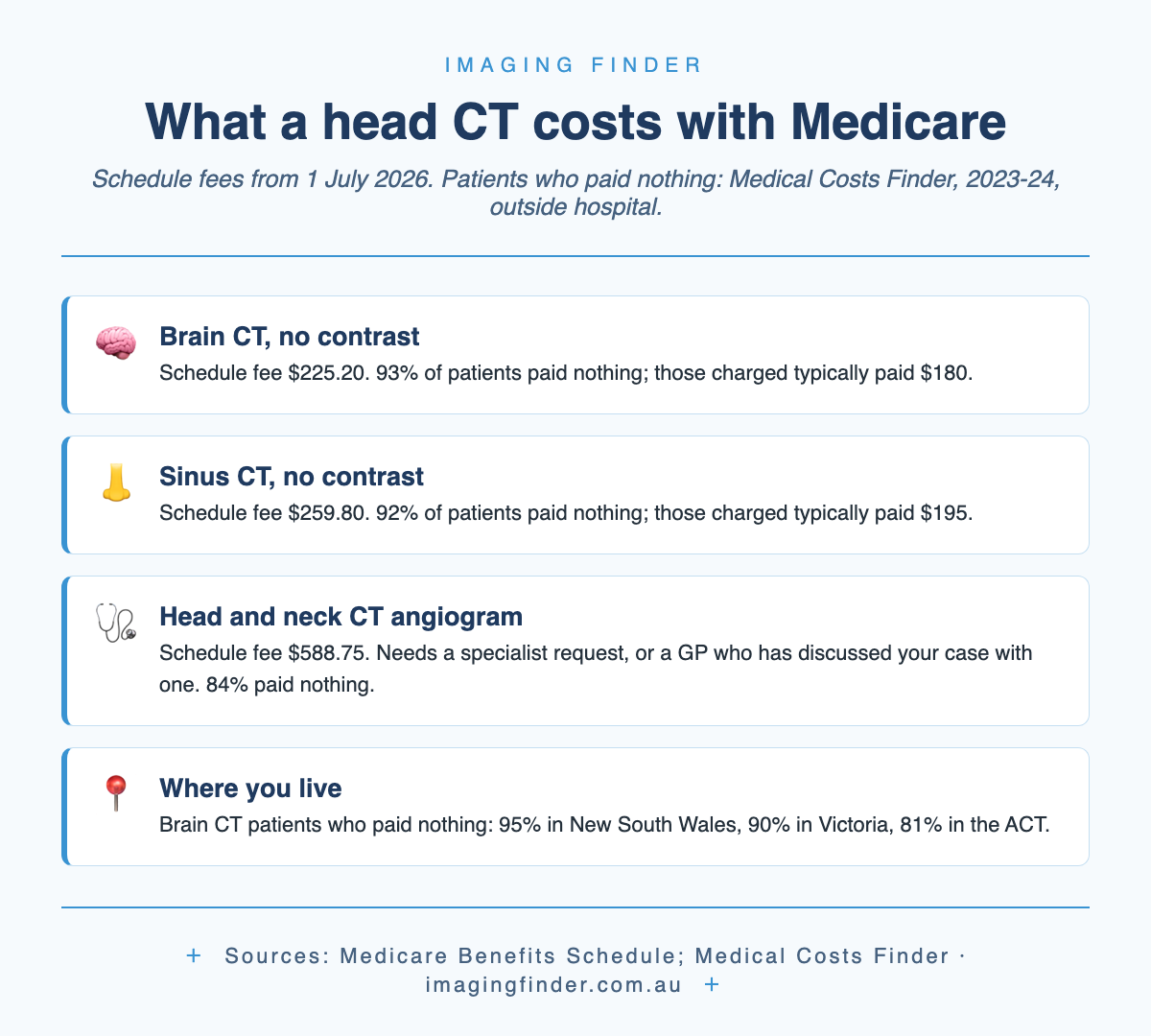
Short answer: A plain CT scan of the brain has a Medicare Schedule fee of $225.20, and most people pay nothing for it: in 2023–24, 93% of patients had no out-of-pocket cost, and those who were charged typically paid $180. A sinus CT ($259.80) is much the same, with 92% paying nothing. Your GP can request either one. The exception is a CT angiogram of the head and neck arteries, which needs a specialist’s involvement.
On this page
• How much does a CT brain scan cost?
• Can a GP or dentist request a head CT?
• Does your state change the price?
• Which clinics bulk bill a head CT?
• CT or MRI for your head: should cost decide?
How much does a CT brain scan cost?
For most people, nothing. About nine in ten patients pay nothing for a head CT, because the clinic bulk bills it – meaning it accepts the Medicare benefit as full payment and you hand over nothing at the desk. The Schedule fee is the price the Government sets for each Medicare item (clinics set their own fees and can charge more). When a clinic bulk bills, Medicare pays it 95% of the Schedule fee. When a clinic bills you privately instead, you pay its fee on the day and get 85% of the Schedule fee back from Medicare, so what you are really out of pocket is the difference.
“Head CT” is not one scan, though. Medicare has nine head CT items (brain, sinuses, eye sockets, the pituitary gland and the inner-ear bones, with and without contrast dye), plus a separate CT angiogram for the arteries of the head and neck. Here is what each costs on paper and what people actually paid:
Schedule fees and rebates are as at July 2026. The last two columns come from the Government’s Medical Costs Finder for 2023–24 (scans outside hospital, counted per patient). A clinic can charge more than the Schedule fee, so the “typical payment” is a guide to the size of a gap, not a quote.
The pattern is striking once you see it laid out: for every head item with published figures, between 90% and 94% of patients paid nothing, and the rest typically paid between $150 and $195. Only the angiogram, at 84%, sits lower. Contrast dye adds to the Schedule fee but barely changes the odds of a bill. (If you are worried about the dye itself rather than the cost, our CT contrast safety guide covers kidney function, allergies and what to tell the clinic.) For CT of other body parts, our CT scan cost guide has the chest, abdomen and spine figures.
If it’s urgent, skip the price check: if someone has a head injury and falls unconscious or has a fit, call triple zero (000) and ask for an ambulance. In a public hospital, anyone with a Medicare card can be treated free of charge as a public patient.
Can a GP or dentist request a head CT?
A GP can, for all nine head items. Under Medicare’s request rules, a GP can request any CT item (a few, like the angiogram below, add conditions of their own), whereas for MRI a GP can request only specific items. So you don’t need a specialist referral to get Medicare paying for a CT of your brain or sinuses.
The request does need to say why you need the scan. CT uses radiation, and the radiologist has to be able to decide whether the benefit outweighs the radiation risk before going ahead, so if a form just says “CT brain” with no clinical reason, the clinic may need to ask your doctor for more information, which can delay your scan. (If radiation dose is what is on your mind, our CT radiation guide puts it in context.)
The one head-related scan with a different rule is the CT angiogram of the head and neck arteries (57352). Medicare pays for it only when a specialist requests it, or when a GP requests it and the form states your case has been discussed with a specialist, and only when the scan is looking for a narrowed, blocked or ballooning artery or a clot.
Dentist asked for a sinus CT? Most general dentists can’t request a Medicare-funded head CT: the list of items they can request doesn’t include any of them. Some dental specialists can: periodontists, endodontists, orthodontists and paediatric dentistry specialists can request the plain sinus and facial-bone CT (56022), and prosthodontists a few more head items. Oral and maxillofacial surgeons who are also registered medical specialists, and the small group of dentists approved before November 2004, can request more. If your form comes from a general dentist, ask the clinic before booking whether Medicare will pay, or see your GP, who can request it if they agree you need it.
Does your state change the price?
A little. Brain and sinus CT are free for most people everywhere that figures are published, but the ACT stands out:
Figures are from Medical Costs Finder for 2023–24, per patient, outside hospital. No figures are published for the Northern Territory, or for sinus CT in Western Australia. (The $4 for Western Australia is the published typical payment among the few people there who paid anything.)
The newest national numbers point the same way. From July to September 2026, 85% of all Medicare CT services were bulk billed (every body part, counted per scan), ranging from 93% in the Northern Territory to 80% in South Australia and 69% in the ACT; across Australia, people who were billed for a CT outside hospital paid an average of $171.
Which clinics bulk bill a head CT?
Several large clinic groups publish a policy of bulk billing routine diagnostic CT for patients whose scan is covered by Medicare. These are the published billing policies we checked in November 2026, as examples rather than a complete list:
- I-MED: all four area billing guides we read (North Sydney, Inner West, Capalaba, dated September 2025, and north-west Melbourne) list general diagnostic CT as bulk billed for both concession card holders and other patients.
- Exact Radiology: its January 2026 price guide lists diagnostic CT, with or without contrast, as bulk billed.
- Perth Radiological Clinic: its billing policy offers bulk billing to outpatients for Medicare-eligible diagnostic CT (not cone beam CT or doctor-performed procedures).
- Imaging Associates, Carlton: offers bulk-billed CT, including head scans, and accepts requests written on another radiology company’s form.
That last point applies everywhere. If your GP printed your request on one company’s letterhead, you are free to take it to any clinic that does the scan. These policies describe routine diagnostic CT for eligible patients; they are not a promise about a CT angiogram or about every clinic in a group, so the booking question below still matters.
CT or MRI for your head: should cost decide?
No, and the rules mostly stop it anyway. A GP can request a Medicare-funded head MRI only for a short list of reasons: for adults, unexplained seizures or an unexplained chronic headache with suspected intracranial pathology (a problem inside the skull); for children under 16, an unexplained seizure, an unexplained headache where significant disease is suspected, or sinus disease that hasn’t settled with treatment. Specialists can request other brain MRI items. The adult GP head MRI has a $463.80 Schedule fee, and in 2023–24 87% of patients paid nothing, with a typical $150 payment for the rest. So the out-of-pocket odds are close, even though the MRI costs Medicare about twice as much.
My view as a radiologist is that the question your doctor is asking should choose the scan, not the bill. CT is fast, which is why it is the go-to for urgent problems such as bleeding inside the skull after a head injury; MRI takes longer but gives very detailed pictures without X-ray radiation. Neither is the “better” scan in general, and with the typical gaps only about $30 apart, swapping one for the other to save money would be a strange trade. If you want to understand why you were sent for one rather than the other, our MRI or CT guide and brain MRI cost guide go through it.
How to find a clinic and check before you book
Our scan cost calculator for diagnostic CT asks who requested your scan and whether you have a concession card, then compares the published billing policies of clinic groups near your postcode. To see CT clinics on a map, start with your city: Sydney, Melbourne, Brisbane, Perth, Adelaide, Canberra, Hobart or Darwin.
Ask the clinic when you book
✓ “My request is for a CT of the [brain / sinuses]. Is that bulk billed for me, or what will I pay on the day?”
✓ “Will it be done with contrast? If so, is there anything I need to do beforehand?”
✓ “I’ve had a head scan before at another clinic. Can you get those images so the radiologist can compare?”
If one clinic quotes a gap, ring another before you pay it. With nine in ten head CTs costing patients nothing, a quote is often a sign of that clinic’s policy rather than of your scan.
Common questions
Will my private health insurance pay the gap?
No. By law, private health insurance can’t cover out-of-hospital diagnostic imaging, so any gap on an outpatient head CT is yours to pay, whatever your policy.
Can I get a head CT without a referral?
Not in the usual way. Medicare pays nothing for a requested scan unless the clinic has a doctor’s request before it starts, and as above, the radiologist needs the clinical reason on that request. Start with your GP; our guide to referrals for X-ray, ultrasound and CT explains who can write one, and the guide to scans without Medicare covers what happens if you aren’t eligible for Medicare.
My request is a few months old. Do I need a new one?
Not for Medicare. Diagnostic imaging requests don’t expire; they stay valid until the scan is done. If your symptoms have changed since then, though, tell your doctor, because the scan they asked for may no longer be the right one.
Sources
- Medicare Benefits Schedule, head CT items 56001, 56007, 56010, 56013, 56016, 56022, 56028, 56030, 56036
- Medicare Benefits Schedule, item 57352 (CT angiography of the head and neck arteries)
- Medicare Benefits Schedule, items 63551 and 63507 (GP-requested head MRI)
- Medicare Benefits Schedule, note IN.0.6 (requests)
- Medicare Benefits Schedule, note IN.0.19 (bulk-billed benefits)
- Medical Costs Finder (items 56001, 56007, 56010, 56013, 56016, 56022, 56028, 56030, 56036, 57352, 63551)
- Department of Health, Disability and Ageing, Medicare statistics: diagnostic imaging and pathology (July to September 2026–27, published 16 November 2026)
- Services Australia, bulk billing
- healthdirect, CT scan
- healthdirect, MRI scan
- Services Australia, screening, tests and scans covered by Medicare
- healthdirect, head injuries
- Department of Health, Disability and Ageing, public hospitals
- Department of Health, Disability and Ageing, what private health insurance covers
- I-MED Radiology, billing guidelines: Brookvale, Chatswood, Hornsby
- I-MED Radiology, billing guidelines: Drummoyne, Five Dock, Newtown
- I-MED Radiology, billing guidelines: Capalaba (September 2025)
- I-MED Radiology, billing guidelines: north-west Melbourne
- Exact Radiology, price guide (January 2026)
- Perth Radiological Clinic, billing policy
- Imaging Associates, bulk-billed CT scans in Carlton
This article is general information, not personal medical advice. Discuss your individual report and next steps with the healthcare professional responsible for your care.

Author: Dr. Mark Bekhit
Dr Mark Bekhit (MBChB, FRANZCR) is a musculoskeletal radiologist practising in Brisbane and an AHPRA-registered specialist in diagnostic radiology (MED0002920947). He spends as much time building software as reading scans: he founded Imaging Finder (Australia) and Radiology Clinics NZ to make imaging easier to find, and builds radiology dictation and pain-tracking tools with one aim — better patient outcomes and a smoother reporting workflow. Outside the reading room he's usually training, bringing the same performance mindset to imaging.
Leave a Reply