By Dr. Mark Bekhit, Radiologist · Last updated November 2026
Short answer: Often, but less often than any other kind of scan. Medicare pays towards almost any ultrasound a doctor requests, yet from July to September 2026 only 66% of Medicare-funded ultrasounds were bulk billed, compared with 80% to 88% for X-ray, CT, MRI and nuclear medicine. Whether yours is free depends on the type of ultrasound (pregnancy and breast scans most often carry a gap), the clinic you choose, your state and whether you hold a concession card.
On this page
• Are ultrasounds bulk billed?
• Which ultrasounds most often have a gap?
• Does where you live change it?
• Why can the same scan be free at one clinic and cost $170 at another?
Are ultrasounds bulk billed?
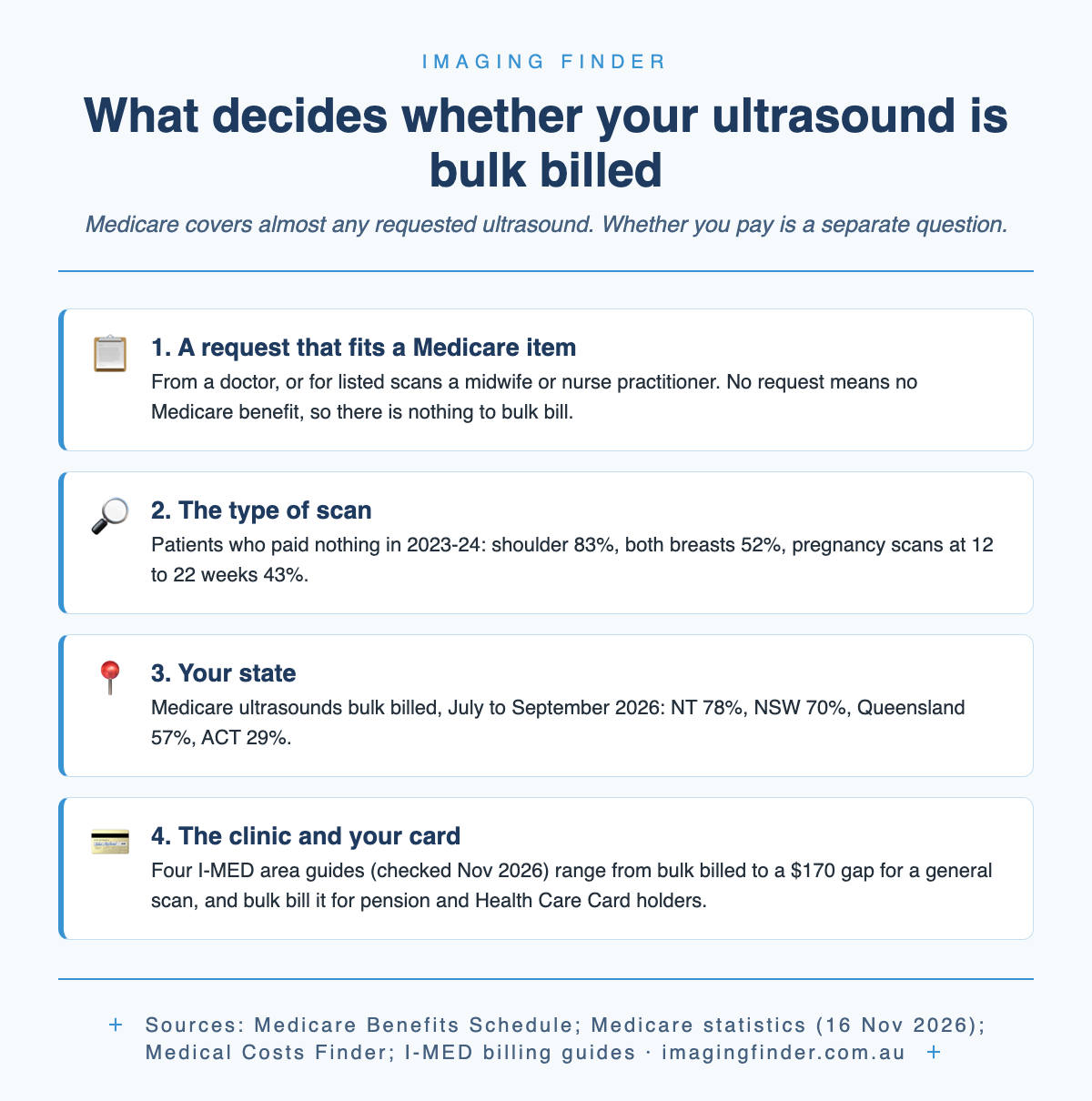
Two different things get mixed up here, and mixing them up is how people end up surprised at the front desk. “Covered by Medicare” means Medicare pays a benefit towards the scan. “Bulk billed” means the clinic accepts that benefit as full payment, so you pay nothing, and that part is entirely the clinic’s choice.
The Medicare part is rarely the problem with ultrasound. Unlike MRI, where a GP can request only a short list of scans, a GP can request almost any ultrasound on the schedule, participating midwives can request the main pregnancy scans, and nurse practitioners a listed set. When a clinic bulk bills, Medicare pays it 95% of the Schedule fee. For an abdominal ultrasound with a $131.00 fee, that is $124.45 to the clinic and nothing from you. If the clinic bills you privately instead, you get $111.35 back and pay whatever the clinic charges above that.
Clinics make that choice far less often for ultrasound than for any other kind of imaging. In the Medicare figures published on 16 November 2026, 66% of ultrasounds from July to September 2026 were bulk billed, against 80% for MRI, 82% for X-ray, 85% for CT and 88% for nuclear medicine. Those figures count every ultrasound Medicare paid for, in or out of hospital (including heart, vein and pregnancy scans), and they count scans rather than people, so roughly one Medicare ultrasound in three was not bulk billed.
Which ultrasounds most often have a gap?
The single biggest clue is the type of scan on your request. The Government’s Medical Costs Finder shows how many patients paid nothing for each Medicare item in 2023–24, and the spread is wide:
These are national figures from 2023–24 for scans done outside hospital, counted per patient, so they are a guide to your odds rather than a quote; our ultrasound cost guide shows what the people who did pay typically paid. What stands out to me, reading them as a radiologist, is how ordinary the free ones are: shoulder, abdomen and leg-vein scans were free for about four people in five, while breast scans and pregnancy scans before 23 weeks were the most likely to cost money (our pelvic ultrasound guide covers pelvic scans in more detail).
Good to know: If you are pregnant, budget for the scans at 12 to 16 weeks and 17 to 22 weeks, because fewer than half of patients paid nothing for them. Our pregnancy ultrasound cost guide covers each scan, and the breast ultrasound cost guide explains why breast scans so often carry a gap.
Does where you live change it?
Yes, and by more than most people would guess. The same Medicare figures, split by state, show a range from almost four in five scans bulk billed in the Northern Territory to fewer than one in three in the ACT. Every state has slipped since 2021, Victoria only slightly:
Western Australia and the ACT have fallen furthest since 2021, and Queensland has dropped sharply too; in the ACT about seven in ten Medicare ultrasounds are now not bulk billed. (All three columns count Medicare-funded ultrasound services, not people. The last column is the average among scans outside hospital where the patient was billed, so it is a rough guide to the size of a gap rather than anyone’s actual bill.)
Living in the country doesn’t help either. In cities, 68% of Medicare ultrasounds were bulk billed from July to September 2026, against 59% in regional centres and 56% in large rural towns; only very remote communities, at 77%, beat the cities.
Why can the same scan be free at one clinic and cost $170 at another?
Because each clinic, and sometimes each area within one clinic group, sets its own billing policy. I-MED publishes area billing guides, and they show this better than any explanation could. These are the minimum gaps each guide lists for patients without a concession card (the Capalaba guide is dated September 2025; the others are undated and were online on 17 November 2026):
The guides call these prices indicative and say they can change, so treat them as examples checked in November 2026 rather than today’s price at any one branch. Two patterns hold across all four, though. A pension or Health Care Card holder’s general or musculoskeletal ultrasound is bulk billed, although card holders are still charged for some pregnancy scans in Capalaba and north-west Melbourne and for breast scans in Capalaba. And for everyone else, pregnancy and breast scans carry a gap.
Other groups’ published policies (all checked on 17 November 2026) land in different places. Exact Radiology’s January 2026 price guide (Ipswich and the Lockyer Valley) lists general ultrasound and the early dating scan as bulk billed, but $100 for a breast ultrasound (bulk billed for concession card holders) and $150 for a morphology scan. Imaging Associates’ Rowville clinic says it bulk bills Medicare-eligible ultrasound except pregnancy scans and procedures. Capital Radiology says that across its services it bulk bills in the majority of situations, but names obstetric ultrasound as an example that can leave you paying the difference. In Perth, Perth Radiological Clinic bulk bills outpatients only for Medicare-eligible diagnostic CT and PET (with some exceptions) and charges a gap for most other services, though it bulk bills most services for pension and Health Care Card holders. One catch: Perth Radiological Clinic and Queensland X-Ray both say they don’t accept the Commonwealth Seniors Health Card as a concession.
How to find a bulk-billed ultrasound near you
Start with the fact that your request form is not a booking. Your doctor may hand you a form printed with one company’s logo, but you are free to take it to any clinic that does the scan. That freedom matters more for ultrasound than for most scans, because the clinic down the road may bill the same scan very differently.
Our scan cost calculator for ultrasound shows the clinic groups with a clinic near your postcode and compares their published billing policies, and you can tell it whether you have a concession card. From there, our ultrasound clinic pages for Sydney, Melbourne, Brisbane, Perth, Adelaide, Canberra, Hobart and Darwin list the ultrasound clinics in each city, each linking to its own listing, so you can look up two or three and ring them. If cost is a real barrier and the scan isn’t urgent, ask your doctor whether a public hospital referral is an option; it is free as a public patient but prioritised by clinical need, so it can take longer.
Ask the clinic when you book
✓ “Is this exact scan bulk billed for me?” Read out what the request says, such as “ultrasound of the abdomen”.
✓ “Does that change with my card?” Name the card, because some clinics don’t count the Commonwealth Seniors Health Card.
✓ “If there is a gap, how much will I be out of pocket after Medicare?”
✓ “My request is on another company’s form. Can you still do it?”
The first question does the most work, because “Do you bulk bill?” can get a cheerful yes from a clinic that bulk bills shoulders but charges for breast scans, while asking about your exact scan gets you the answer that applies to you. Clinic groups such as Lumus Imaging base the estimate on the Medicare item that matches your request. Please don’t ask your doctor to word a request differently to make it cheaper; the request has to describe why you need the scan, and the clinic bills the item that matches it. Our ultrasound preparation guide covers what to bring, the bulk-billed radiology guide compares billing across every kind of scan, and the bulk-billed MRI guide does the same job for MRI.
Common questions
Will my private health insurance pay the gap?
No. By law, private health insurance can’t cover out-of-hospital diagnostic imaging, so an outpatient ultrasound gap is yours to pay whatever your policy.
Does an ultrasound gap count towards the Medicare Safety Net?
Yes, for scans outside hospital. What you pay out of your own pocket counts towards the Extended Medicare Safety Net for the calendar year, and once you pass its threshold ($2699.10 in 2026, or $861.20 for concession card holders and families on Family Tax Benefit Part A) Medicare pays more back on later out-of-hospital services. Only amounts you paid the clinic in full before claiming count.
Can I get a bulk-billed ultrasound without a referral?
No. Without a request there is no Medicare benefit, so there is nothing for a clinic to accept as full payment and you pay its private fee. Our guide to referrals for X-ray, ultrasound and CT explains who can write one, and the guide to scans without Medicare covers private prices.
Sources
- Services Australia, bulk billing
- Services Australia, screening, tests and scans covered by Medicare
- Services Australia, Medicare Safety Net thresholds
- Medicare Benefits Schedule, note IN.0.6 (requests)
- Medicare Benefits Schedule, note IN.0.19 (bulk-billed benefits)
- Medicare Benefits Schedule, ultrasound items 55032, 55036, 55065, 55070, 55076, 55244, 55700, 55704, 55706, 55718, 55864
- Department of Health, Disability and Ageing, Medicare statistics: diagnostic imaging and pathology (July to September 2026–27, published 16 November 2026)
- Medical Costs Finder (items 55032, 55036, 55065, 55070, 55076, 55244, 55700, 55704, 55706, 55718, 55864)
- Department of Health, Disability and Ageing, what private health insurance covers
- Department of Health, Disability and Ageing, public hospitals
- I-MED Radiology, billing guidelines: Brookvale, Chatswood, Hornsby
- I-MED Radiology, billing guidelines: Drummoyne, Five Dock, Newtown
- I-MED Radiology, billing guidelines: Capalaba (September 2025)
- I-MED Radiology, billing guidelines: north-west Melbourne
- Exact Radiology, price guide (January 2026)
- Imaging Associates, bulk-billed ultrasounds in Rowville
- Capital Radiology, Medicare, fees and billing
- Perth Radiological Clinic, billing policy
- Perth Radiological Clinic, outpatient billing guide
- Queensland X-Ray, billing information
- Lumus Imaging, payments and billing
This article is general information, not personal medical advice. Discuss your individual report and next steps with the healthcare professional responsible for your care.

Author: Dr. Mark Bekhit
Dr Mark Bekhit (MBChB, FRANZCR) is a musculoskeletal radiologist practising in Brisbane and an AHPRA-registered specialist in diagnostic radiology (MED0002920947). He spends as much time building software as reading scans: he founded Imaging Finder (Australia) and Radiology Clinics NZ to make imaging easier to find, and builds radiology dictation and pain-tracking tools with one aim — better patient outcomes and a smoother reporting workflow. Outside the reading room he's usually training, bringing the same performance mindset to imaging.
Leave a Reply