By Dr. Mark Bekhit, Radiologist · Last updated July 2026
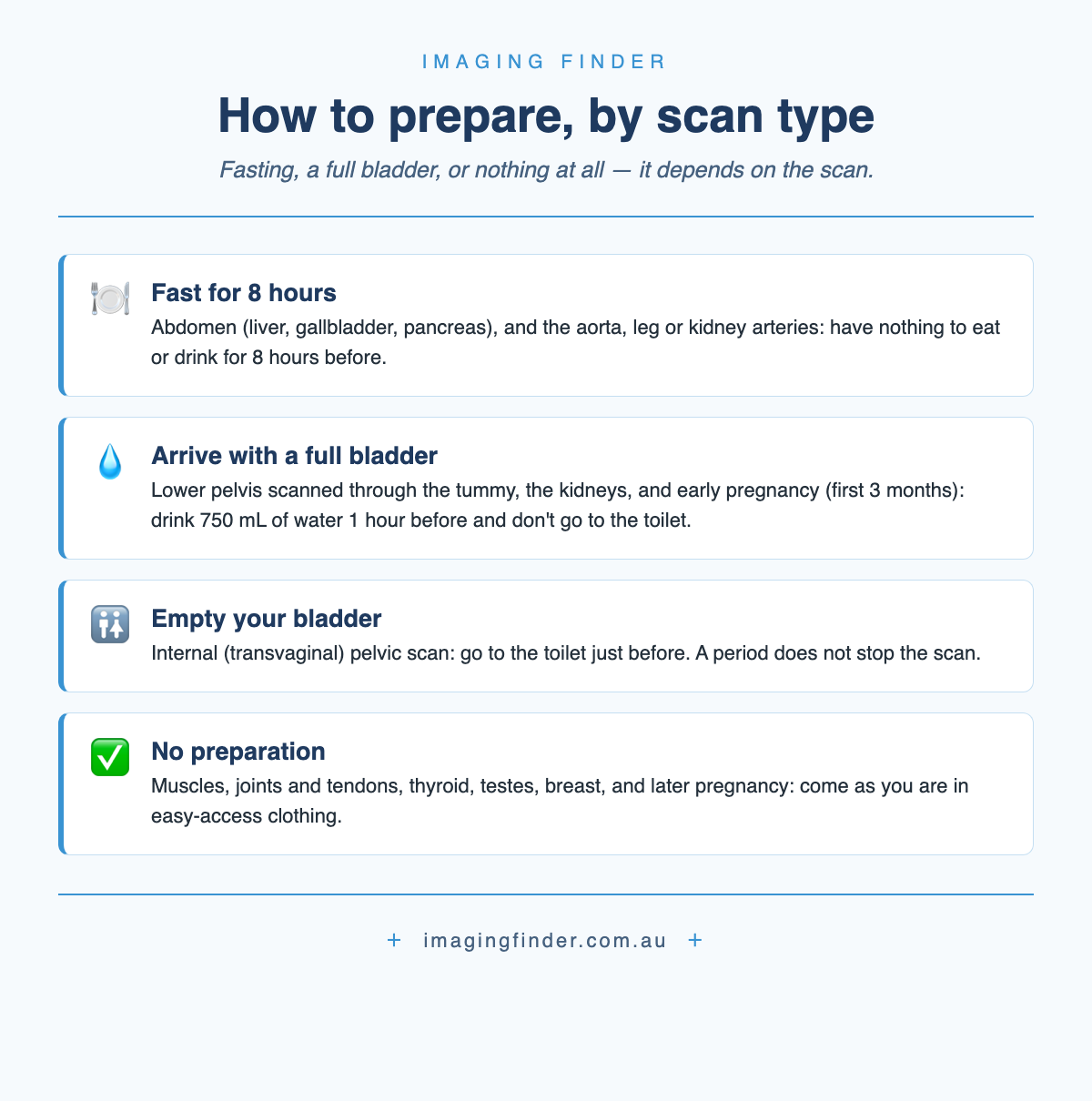
The short answer: how you prepare depends on which ultrasound you are having. Scans of the abdomen, such as the liver and gallbladder, usually need you to fast for 8 hours. Scans of the lower pelvis or the kidneys usually need a full bladder, so you drink 750 mL of water an hour before and do not go to the toilet. Scans of muscles, joints, the thyroid or the breast need no preparation at all. Check which group your scan falls into using the table below, and bring your referral and Medicare card.
On this page
How should I prepare for my ultrasound?
Ultrasound preparation comes down to one thing: giving the sound waves a clear path to the organ your doctor wants to see. For the abdomen that means an empty stomach; for the lower pelvis and kidneys it means a full bladder; for muscles, joints and the thyroid it means nothing special at all. The table and infographic below cover the common scans and the two things that trip people up: fasting and a full bladder. Ultrasound is also used to guide treatments, not just to take pictures: if your appointment is really for something like a cortisone injection under ultrasound, ask the clinic for the extra instructions.
For a gynaecological pelvic scan, what you pay depends on which of three Medicare items the practice bills — our pelvic ultrasound cost guide explains the split and what the internal scan involves.
Two rules cover most of the confusion. First, fasting is for scans where trapped food or gut gas would blur the picture — the gallbladder shrinks after eating, so an empty stomach for 8 hours makes it easy to read. Second, a full bladder is only for scans that look through the lower abdomen at the pelvis or kidneys; the bladder acts as a window. For an internal (transvaginal) scan the probe sits close to the organs, so you empty your bladder instead.
Good to know: if you have diabetes, or take regular, over-the-counter or complementary medicines that might be affected by fasting, ring the imaging practice before the day and ask what to do about your dose. A baby or child having a scan has their own age-specific instructions.
What should you bring to your appointment?
A few minutes packing the right things saves a repeat trip — without your referral, for example, most practices cannot claim a Medicare benefit and will not scan you until they have it.
Bring these with you
✓ Your referral or request letter from your doctor (paper or electronic).
✓ Your Medicare card, and any concession, pension or DVA card.
✓ Any scans of the same area done elsewhere in the past 2 years, so they can be compared.
✓ A list of your medicines, and a heads-up to the clinic if you have diabetes.
✓ Loose clothing that gives easy access to the area being scanned.
The Australian Government’s healthdirect service makes the same point about bringing your referral and older images. If your previous scans were done at another practice, bring the images or the report rather than assuming the new clinic can pull them up.
Do I need a referral, and does it expire?
Yes — to get a Medicare benefit for an ultrasound you need a request from your doctor or another eligible health professional. Under Medicare’s rules that request has to be in writing with enough detail to identify the scan; it does not even have to be signed. Our diagnostic imaging request guide explains the eligible requester groups, clinic choice and no-expiry rule.
A request does not expire the way a specialist referral can. Medicare states that requests for diagnostic imaging do not expire and stay valid until the test has been done. So if you were handed a request months ago and never booked it, it is usually still fine. If one request lists several scans, they need to be done within 14 days of the first.
You also get to choose where you go. Services Australia says you are free to choose your own clinic as long as they offer the test you need, even if the request form has a particular clinic’s name printed on it. If Medicare eligibility across different scan types is what you are trying to work out, our guide to Medicare-eligible scans by modality lays it out.
What happens during the scan, and when do results come back?
An ultrasound uses high-frequency sound waves, sent into the body through a hand-held probe called a transducer. A sonographer spreads clear gel on your skin so the sound passes in cleanly, then moves the probe over the area while the picture builds on a screen in real time. It does not use radiation and is safe to use in pregnancy — one reason it is the first scan chosen for so many problems.
Most scans take around 20 to 30 minutes, though scans of blood vessels can run longer because of the detail involved. You will not get your result on the spot. A radiologist reviews the images afterwards and sends a written report to the doctor who referred you. If you want to make sense of that report when it lands, our guide to reading your radiology report walks through the language.
If the scan is a pregnancy one, the rebate depends on how many weeks along you are and on the request form itself — our guide to pregnancy ultrasound costs and Medicare explains which item applies at each stage.
What will it cost, and where can you book?
What you pay for an ultrasound depends on the clinic, so it is worth sorting out before you go. Services Australia’s advice is to ask how much you will have to pay before the test, and you owe nothing when the service is bulk billed. Our guide to bulk-billed radiology explains how to find a clinic that bulk bills. Our ultrasound cost guide shows current Medicare benefits and the questions to use for a written quote; and the wait-times guide helps if you need an appointment quickly.
When you are ready to book, compare clinics near you on Imaging Finder — start with the how-to-find-an-ultrasound-clinic guide, or browse a capital directly: Sydney, Melbourne, Brisbane, Perth, or every location. Availability differs a lot between practices in the same suburb, so ringing two or three is often the fastest way in.
Common questions about preparing for an ultrasound
Can I drink water or take my medicines while fasting for an abdominal ultrasound?
The standard instruction for an abdominal scan is nothing to eat or drink for 8 hours beforehand, so the gallbladder fills and bowel gas is reduced. The one exception is essential medication for conditions such as diabetes, which the “good to know” note above covers — sort that out before the day rather than skipping a dose.
Do I really need a full bladder?
Only for some scans: the lower pelvis viewed through the tummy, the kidneys, and sometimes early pregnancy. For those, drink 750 mL of water an hour before and do not go to the toilet. For an internal (transvaginal) scan it is the opposite — empty your bladder first.
Can I have an ultrasound during my period?
Yes. An internal (transvaginal) scan can still be carried out during a period, and it is often an advantage when looking at gynaecological problems, so there is no need to reschedule unless your clinic asks you to.
Is an ultrasound safe in pregnancy?
Yes. Ultrasound uses sound waves rather than radiation, and healthdirect describes it as very safe and safe to use during pregnancy. That is why it is the routine choice for pregnancy scans.
Does my referral for an ultrasound expire?
No. A request for diagnostic imaging does not expire under Medicare’s rules; it stays valid until the scan has been done, so an older request you never used is normally still good.
How long will the scan take?
Most ultrasound appointments take about 20 to 30 minutes. Scans of blood vessels can take longer because of the detailed images the sonographer needs to capture.
How we know: sources and method
Preparation details are drawn from InsideRadiology, the patient-information service of the Royal Australian and New Zealand College of Radiologists (RANZCR). Safety, referral and results facts are cross-checked against the Australian Government’s healthdirect service, the request rule against Medicare Note IN.0.6, and the “ask the price and choose your clinic” guidance against Services Australia. Every figure in the table above — 8 hours of fasting, 750 mL of water, an hour before — comes from these sources, all read in July 2026.
- InsideRadiology (RANZCR) — Ultrasound: preparation by scan type
- InsideRadiology (RANZCR) — Transvaginal ultrasound
- healthdirect (Australian Government) — Ultrasound: safety, referral and results
- MBS Online — Note IN.0.6: form and validity of a diagnostic imaging request
- Services Australia — Scans and tests covered by Medicare
This article is general information, not personal medical advice. Availability, Medicare eligibility, billing and preparation can change — confirm the specifics with your referrer and the clinic.

Author: Dr. Mark Bekhit
Dr Mark Bekhit (MBChB, FRANZCR) is a musculoskeletal radiologist practising in Brisbane and an AHPRA-registered specialist in diagnostic radiology (MED0002920947). He spends as much time building software as reading scans: he founded Imaging Finder (Australia) and Radiology Clinics NZ to make imaging easier to find, and builds radiology dictation and pain-tracking tools with one aim — better patient outcomes and a smoother reporting workflow. Outside the reading room he's usually training, bringing the same performance mindset to imaging.
Leave a Reply