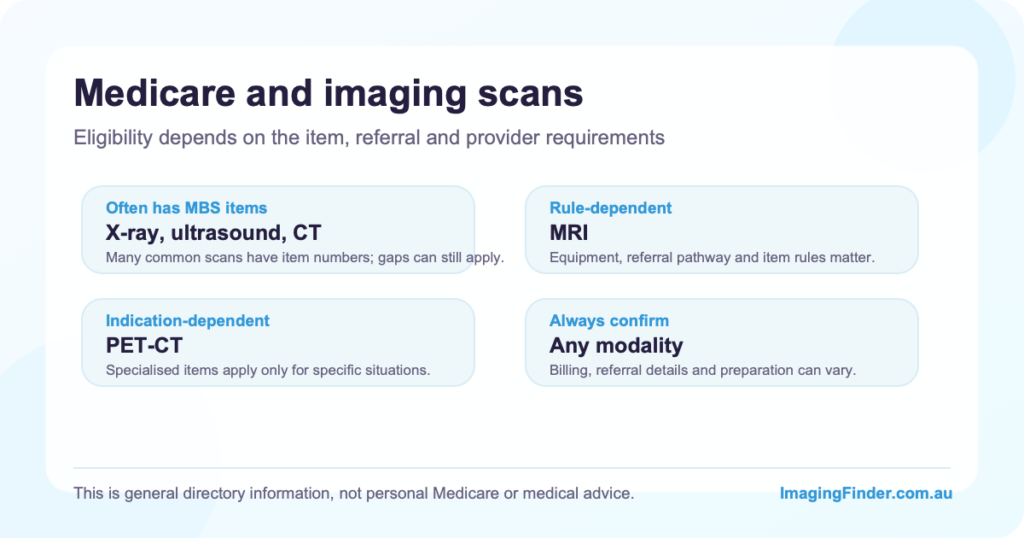
Short answer: Medicare pays a benefit on every major scan type — X-ray, ultrasound, CT, nuclear medicine, bone density and diagnostic mammography — when the referral matches a Medicare Benefits Schedule (MBS) item. For almost all X-rays, ultrasounds and CT scans, a GP referral is enough. MRI is the strict one: most adult MRI items need a specialist request. Screening mammograms sit outside the referral system entirely — BreastScreen Australia offers a free mammogram every 2 years to women over 40, no referral needed. If the clinic bulk bills, you pay nothing on the day.
On this page:
- Which scans does Medicare cover?
- What does ‘covered’ actually mean?
- Is a GP referral enough — and who else can request a scan?
- MRI and PET-CT: the two with stricter rules
- Do you need a referral for a mammogram?
- Who qualifies for a Medicare bone density scan?
- What will you pay on the day?
- What changed on 1 July 2026?
- How to book without a billing surprise
- Common questions about Medicare and scans
Which scans does Medicare cover?
Diagnostic imaging has its own category of the MBS, and every modality you are likely to be referred for has items in it. What separates the modalities is not whether Medicare pays — it is who must sign the referral and whether your reason for the scan matches the item.
| Scan type | Does Medicare pay? | The rule that matters |
|---|---|---|
| X-ray | Yes, broadly | Any doctor can refer. Physiotherapists, chiropractors, osteopaths, podiatrists and dentists can also request specific X-rays — details below. |
| Ultrasound | Yes, broadly | A GP referral is enough. An abdominal ultrasound, for example, is item 55036 with a $131.00 schedule fee. |
| CT | Yes, broadly | A GP referral is enough for standard CT. The main exception: CT of the coronary arteries needs a specialist request (item 57364). |
| MRI | Yes, with strict limits | Most adult items need a specialist request; GPs can request a short list. See the MRI and Medicare guide. |
| PET-CT | Yes, for named indications | Each item is tied to a specific clinical scenario, mostly cancer staging. See the PET-CT guide. |
| Mammography | Two pathways | Screening through BreastScreen Australia is free with no referral; diagnostic mammography needs a doctor’s referral (item 59300). |
| Bone density (DXA) | Yes, for defined groups | Everyone aged 70 or over qualifies for a first scan (item 12320); younger patients need a listed risk factor. |
| Nuclear medicine | Yes, item-specific | Bone scans, thyroid scans and similar studies have their own items, and a GP can request them. |
Schedule fees and item rules quoted on this page are as at July 2026, read directly from MBS Online.
Two things this table cannot tell you: whether your particular reason for the scan matches the item wording, and whether the clinic will charge a gap. The first is checked by the radiology practice against your referral. The second is a business decision each clinic makes, which is why the same scan can be free at one practice and cost $80 up the road.
What does ‘covered’ actually mean?
When people ask whether a scan is covered, they usually mean one of four different things: an MBS item exists, they personally qualify for a rebate, the clinic bulk bills, or they will pay nothing. Those questions have different answers, and a booking call goes faster when you ask the one you actually mean.
| What you say | The precise question to ask |
|---|---|
| Is it covered? | Is there an MBS item for this exact scan and reason? |
| Is it bulk billed? | Will the clinic accept the Medicare benefit as full payment? |
| Is there a rebate? | Will Medicare pay a benefit, even if I still have a gap? |
| Is it free? | Will I have any out-of-pocket cost on the day? |
| Can my GP order it? | Does this item accept a GP request, or does it need a specialist? |
A receptionist can answer the precise versions in a minute if they have your referral in front of them. The vague version — ‘is it covered?’ — usually earns a vague answer, because the honest reply depends on which of the four you meant.
Is a GP referral enough — and who else can request a scan?
For X-ray, ultrasound, CT and standard nuclear medicine, yes: under the MBS requesting rules, any medical practitioner — including your GP — can request any of these services. You do not need a specialist to get a Medicare rebate on a chest X-ray, a pelvic ultrasound or a CT of the spine.
For the patient-focused rules on who can write each request, whether it expires and choosing another clinic, see our X-ray, ultrasound and CT request guide.
CT has a couple of checked exceptions. CT coronary angiography must be requested by a specialist or consultant physician (item 57364), and for several CT angiography items the MBS notes require that a GP who requests them first discusses the case with a specialist and records that on the request form.
Some non-doctor health practitioners can also request imaging that attracts a Medicare rebate — a point many patients (and some practitioners) miss. The lists are set out in the same MBS requesting note, accessed 7 July 2026:
| Who is referring you | What Medicare accepts from them |
|---|---|
| Physiotherapist or osteopath | X-rays of the spine (any region), hip joint and pelvis — for example, cervical spine item 58100 and hip item 57712 |
| Chiropractor | The same spine, hip and pelvis X-rays, except items 58120 and 58121 — the studies covering 4 spinal regions or 3 spinal examinations in one visit |
| Podiatrist | X-rays of the foot, ankle, leg or femur (item 57521 and related items), plus a small set of ultrasound items such as ankle and hind-foot scans (item 55888) |
| Dentist | Dental and jaw imaging, including the OPG (item 57960) |
The rebate only applies when the request stays inside those lists. If your physiotherapist wants a knee ultrasound, that request sits outside their list — you would pay privately, or go back to your GP for a referral that attracts the rebate.
MRI and PET-CT: the two with stricter rules
Most adult MRI items are payable only when a specialist or consultant physician requests the scan (MBS note IN.0.18), and the scanner itself must be Medicare-eligible — a GP can request a short list of items, such as knee MRI after acute trauma for patients aged 16 to 49 (item 63560). Which MRIs a GP can refer, and why two nearby clinics can give different answers about the same referral, is covered in full in our MRI and Medicare guide. Whether you can book an MRI with no referral at all is answered in our MRI referral guide.
PET-CT is narrower again: every Medicare PET item names its indication, mostly cancer staging — staging proven non-small-cell lung cancer (item 61529) and newly diagnosed lymphoma (item 61620) are typical examples. Referral pathways, tracers and private costs are in our PET-CT guide.
Access is the other difference. Of about 940 imaging clinics listed in our directory (as at July 2026), about 486 list MRI and about 140 list PET-CT — so for these two scans, where you can go is a real question, not just what the rules say.
Do you need a referral for a mammogram?
Mammograms run on two separate systems, and the split decides both the referral and the cost. For screening — no symptoms, just checking — BreastScreen Australia provides a free mammogram every 2 years for women over 40, and no doctor’s referral is needed. Women aged 50 to 74 are actively invited by letter; women 40 to 49 or 75 and over can still book, provided they have no breast cancer symptoms.
For diagnosis — a lump, pain, discharge, a strong family history or a past breast cancer — the pathway reverses: you need a doctor’s referral to a radiology practice, where diagnostic mammography is billed under MBS items such as item 59300 ($105.40 schedule fee). The two systems do not mix: as the Department of Health puts it, your doctor cannot refer you to BreastScreen for a diagnostic mammogram. Radiology practices that perform diagnostic breast imaging are listed on our mammography pages — for example, mammography clinics in Melbourne. If a screening mammogram reported dense breasts, see whether you need an ultrasound too. For a full walk-through of which mammogram you need and what each one costs, see our guide to BreastScreen vs a diagnostic mammogram.
Who qualifies for a Medicare bone density scan?
Bone densitometry (DXA) is rebatable for defined groups rather than on request. The simplest gateway is age: everyone 70 or over qualifies for a first scan under item 12320, claimable once in a 5-year period, with a follow-up item (12322) every 2 years if the first scan shows borderline bone density.
Under 70, you need a listed reason. The main ones: a fracture from minimal trauma (item 12306), long-term glucocorticoid (steroid) therapy or hypogonadism (item 12312), and listed chronic conditions such as rheumatoid arthritis, primary hyperparathyroidism or chronic liver or kidney disease (item 12315). The schedule fee is $122.55, and a GP can request all of these — no specialist needed. For a fuller walk-through of who qualifies, what it costs and how to prepare, see our guide to the bone density (DXA) scan in Australia. ‘I’d just like to check my bones’ without one of those criteria is not rebatable — you would pay for the scan privately.
What will you pay on the day?
Every MBS item has a schedule fee. For imaging done outside hospital, Medicare pays 85% of that fee as your rebate — and if the clinic bulk bills, a special rule for diagnostic imaging (MBS note IN.0.19) lifts the benefit to 95% of the fee, paid straight to the clinic.
Bulk billing means the clinic bills Medicare directly and accepts that benefit as full payment — you pay nothing for that service. One catch from Services Australia’s own wording: if you have more than one service in a visit, you may not be bulk billed for everything, so a bulk-billed X-ray and a privately billed ultrasound can share the same appointment.
A worked example. A cervical spine X-ray (item 58100) has a schedule fee of $79.05. Bulk billed, you pay $0. Privately billed at, say, $100, Medicare rebates $67.20 and your gap is $32.80. The item is identical in both cases — the difference is entirely the clinic’s billing policy, which is why our bulk-billed radiology guide is mostly about how to find the first kind of clinic.
And the correction that surprises people: private health insurance cannot fill this gap. By law, private health insurance does not offer cover for out-of-hospital medical services — the Department of Health lists GP visits, specialist consultations in their rooms, and out-of-hospital diagnostic imaging and tests. Your insurer only becomes relevant when imaging happens as part of treatment as a private patient in hospital, where Medicare pays 75% of the schedule fee and hospital cover can contribute to the rest.
What changed on 1 July 2026?
The MBS diagnostic imaging changes for 1 July 2026 are modest but two of them help patients directly:
- Same-day breast imaging got easier. Co-claiming restrictions were removed from four breast imaging items, and the ‘Multiple Services Rule’ — a $5 fee reduction for each additional same-day imaging service — was removed for 14 breast imaging items. A woman being worked up for breast cancer can now have her mammogram, ultrasound and image-guided biopsy on the same day without the rebates shrinking.
- Referrals got a longer shelf life for multi-scan requests. Patients now have 14 days, up from 7, to receive all imaging services written on a single request form.
- Some nuclear medicine fees rose. Schedule fees for scans using gallium-67 and thallium-201 increased — the factsheet’s stated reason is ‘higher and sustained input costs’.
How to book without a billing surprise
The sequence below sorts out almost every Medicare imaging question before you commit to an appointment:
- Read the referral and identify the exact scan written on it.
- Check the clinic offers that scan at the branch you want — service pages such as ultrasound clinics in Brisbane or CT clinics in Melbourne are built for this step.
- Ask the two questions that matter: is the item on my referral rebatable here, and do you bulk bill it?
- Ask about preparation — fasting, a full bladder, kidney function tests before contrast.
- If the phone answer is hedged, email or upload the referral so the bookings team can quote against the actual item.
- If the clinic cannot do it, ask which nearby branch can, before you hang up.
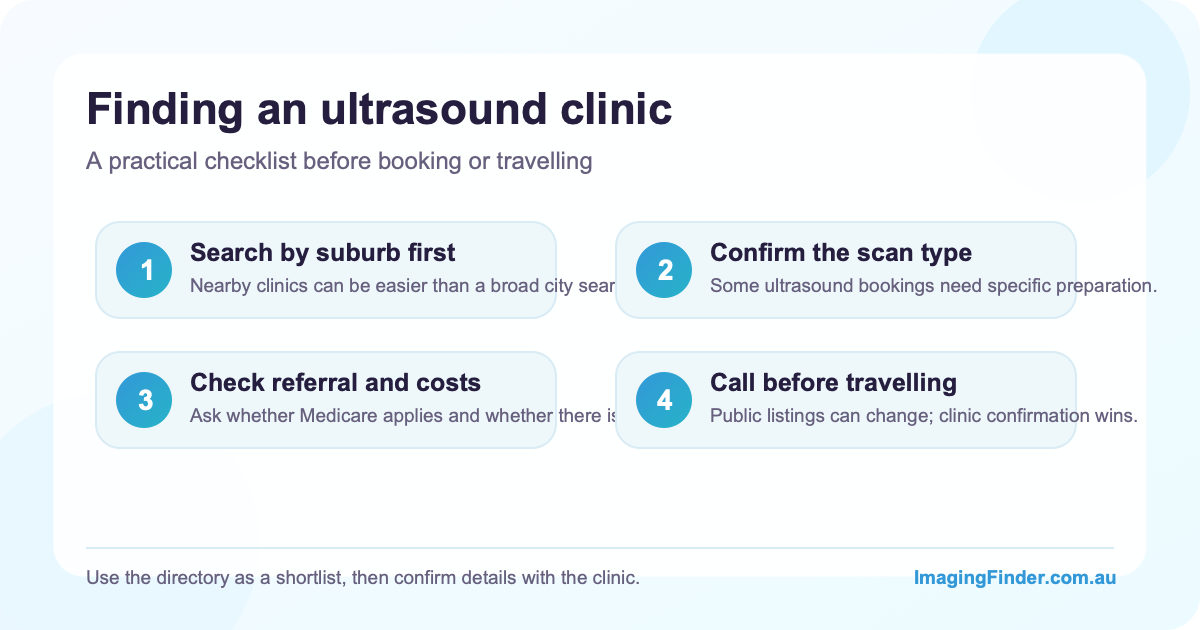
Preparation questions matter more than people expect — an ultrasound booked without the right fasting or bladder prep usually has to be rebooked for another day, and if your request form lists several scans, they all need to happen within the form’s 14-day window. Our guide to preparing for an ultrasound appointment covers the common protocols scan by scan.
After the examination, use the radiology report guide to identify the main conclusion, any limitation and the follow-up question to take back to your referrer.
Common questions about Medicare and scans
Is a GP referral enough for an X-ray, ultrasound or CT?
Almost always, yes. Any medical practitioner can request X-ray, ultrasound, CT and standard nuclear medicine items under the MBS requesting rules. The exceptions worth knowing are CT of the coronary arteries, which needs a specialist request, and a few CT angiography items where the GP must document a specialist discussion on the request.
Does Medicare cover a mammogram?
Screening and diagnosis run on separate systems. BreastScreen Australia gives women over 40 a free screening mammogram every 2 years with no referral, and actively invites women 50 to 74. If you have symptoms, you need a doctor’s referral for a diagnostic mammogram at a radiology practice, billed under MBS items such as 59300.
Is a bone density scan covered by Medicare?
Yes, for defined groups. Everyone aged 70 or over qualifies for a first DXA scan (item 12320, once per 5 years). Under 70 you need a listed reason, such as a minimal-trauma fracture, long-term steroid therapy, or conditions like rheumatoid arthritis or chronic kidney disease. A GP referral is sufficient for all of them.
Does bulk billing mean the scan is free?
For that scan, yes — the clinic bills Medicare and accepts the benefit as full payment, so you pay nothing. Two cautions: bulk billing is the clinic’s choice per service, not a property of the scan, and if your visit includes several services, some may be bulk billed while others are billed privately.
Can my physio or chiropractor order an X-ray?
Yes, within limits Medicare sets by item. Physiotherapists, osteopaths and chiropractors can request X-rays of the spine, hip and pelvis; podiatrists can request foot, ankle, leg and femur X-rays plus a few ultrasound items; dentists can request dental and jaw imaging including the OPG. Anything outside those lists needs a doctor’s referral to attract a rebate.
Does private health insurance cover scans?
Not at a regular imaging clinic. By law, private health insurance cannot cover out-of-hospital medical services that Medicare covers, and the Department of Health names diagnostic imaging and tests explicitly. Insurance becomes relevant only for imaging you receive as a private patient in hospital, where your hospital cover can contribute alongside Medicare’s 75% benefit.
Related reading
How we know: sources and method
Every Medicare rule on this page was read directly from the official source on 7 July 2026 — MBS Online item descriptors and explanatory notes, the Department of Health’s BreastScreen and private health insurance pages, and Services Australia’s bulk billing explainer. Clinic counts come from the clinics listed in the Imaging Finder directory in July 2026; they tell you where a service is offered, not whether your specific referral is rebatable — the clinic checks that against the current schedule when they see your referral. Item fees change at indexation, so treat dollar figures as a guide to scale rather than a quote.
- MBS Online: who can request diagnostic imaging (note IN.0.6) — accessed 7 July 2026
- MBS Online: MRI request and equipment rules (note IN.0.18) — accessed 7 July 2026
- MBS Online: CT rules (note IN.0.15) — accessed 7 July 2026
- MBS Online: bulk billing incentive for imaging (note IN.0.19) — accessed 7 July 2026
- MBS Online: diagnostic imaging changes from 1 July 2026 (factsheet) — accessed 7 July 2026
- Department of Health: BreastScreen Australia program — accessed 7 July 2026
- Department of Health: what private health insurance covers — accessed 7 July 2026
- Services Australia: bulk billing — accessed 7 July 2026
Once you know which scan Medicare covers, the next step is finding a clinic that offers it — browse radiology clinics in Sydney, Melbourne, Brisbane and Perth.
This article is general information, not personal medical advice. Availability, Medicare eligibility, billing and preparation can change — confirm the specifics with your referrer and the clinic.

Author: Dr. Mark Bekhit
Dr Mark Bekhit (MBChB, FRANZCR) is a musculoskeletal radiologist practising in Brisbane and an AHPRA-registered specialist in diagnostic radiology (MED0002920947). He spends as much time building software as reading scans: he founded Imaging Finder (Australia) and Radiology Clinics NZ to make imaging easier to find, and builds radiology dictation and pain-tracking tools with one aim — better patient outcomes and a smoother reporting workflow. Outside the reading room he's usually training, bringing the same performance mindset to imaging.
Leave a Reply